
To English Learners, Focus on Memorizing Most Frequent Words
You can start with 2,809 words.

I know New General Service List (NGSL)—a list of high-frequency English words—fairly late in my journey of learning English as a second language.
As a learning resource, it can save you a lot of time on vocabulary building.
Instead of memorizing random words from the vast pool of 600,000 English words (a rough estimate from the Oxford Dictionary), you can start with NGSL, which lists 2,809 words.
High-frequency words
Charles Browne, a professor of applied linguistics, and his colleagues created the NGSL project.
NGSL addresses a general problem that second language learners encounter to help them achieve practical and real-world English proficiency.
In a TEDx Talk, Charles Browne gave an example of Japanese students who, on average, only know about 2,000 words after studying English for 14 years. The number is not enough to communicate effectively.
Based on corpus linguistics research, the project identified 2,809 words that cover 90 to 92% of general English texts.
The wordlist covers the most foundational words of general English and other genres and lists fewer words than other lists.
NGSL is the core word list, which is an improved version of the original General Service List (GSL).
With this list, learners can focus on memorizing less than 1% of English words.
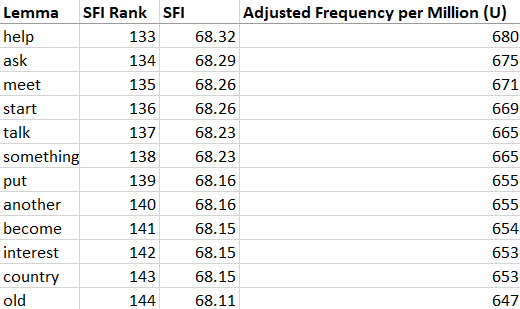
You can learn about NGSL from his website which offers free resources for learning.
The resources include downloadable word lists, definitions, online learning applications, online assessment tools, online research tools, text analysis and grading tools, and a blog.
Other free websites like quizlet.com and memrise.com for flashcard learning and iPhone and Android applications for mobile learning also use the same approach.
Zipf’s law and vocabulary thresholds
NGSL is built on the foundation of Zipf’s law, a mathematical pattern that describes the frequency of words in a language:
The most frequent words account for a large proportion of the text, and the less frequent words account for a small proportion.
This means that knowing the most frequent words can help learners understand the main idea and the general meaning of any text they encounter.
According to research, there is a minimum percentage of known words required for reading comprehension.
Laufer and Ravenhorst-Kalovski (2010) suggest that learners need to know at least 95% of the words in a text to achieve adequate comprehension and 98% to guess unknown words from context.
Knowing the most frequent words can help learners reach these thresholds and improve their reading comprehension skills.

The most frequent words are the basis of language proficiency.
Learning them is not only important for reading but also for other language skills, such as listening, speaking, and writing.
They are the core words used in everyday communication and are also the building blocks of a more complex and specialized vocabulary.
Learning them helps learners develop their overall language proficiency and communicate effectively in various situations.
If you like the topic of language in this story, you may also want to check out this list.
Hi! Thank you for reading until this part. I hope you enjoyed my story and learned something new. :)


