
To Darwin
A poem about human evolution.
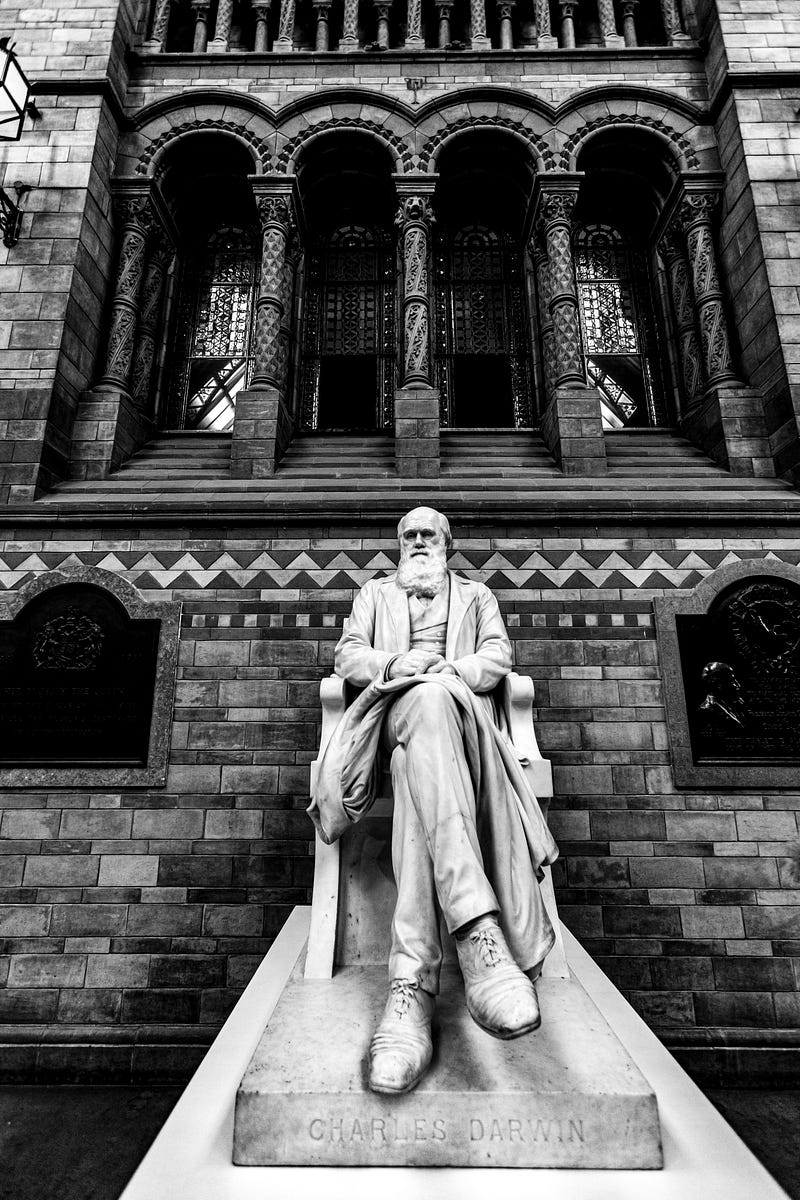
O, the grandmaster of philosophy!
And the patron saint of biology!
I recite to thee:
I decoupled myself by performing
the most effective therapy
And the greatest meditation of all: poetry;
To observe my motionless body
In search of the mysteries of lostness,
And the paths to self-identity.
I sought that exact moment
When a species evolves into another:
From an Australopithecus to
Homo Habilis into Homo Erectus to the next.
A minute-by-minute record,
A frame-by-frame snapshot
Of the final changes in
The DNA of an embryo
In the womb of its unwitting
Heidelbergian mother that
Engendered the primeval baby-sapient.
That moment, that precious second of
The mutation is a secular miracle,
A natural yet defiled magical process
Of procreation, survival, and growth,
In pursuit of self-promotion
On this Planet Number X
Of the Galaxy Y. Voila!
Welcome to human society:
At the mercy of biochemistry
And genetic coding over zillions of years.
Each incremental incident
Producing that microscopic change
That all adds up to our paranoid existence.
The flawless scientific logic of trial and error,
Mediated by a handsome dose of coincidence,
Cannibalism, and self-preservation.
But were they, too, the naked, feeble
Hominid ancestors of ours, romantic?
Did they love to rhyme
With the opening words of
Their primitive languages?
Did they observe thunder, rain, and rainbow
With similar bewilderment?
Did they watch the night-sky
And it's billions of stars and
Thought, “Is it, one giant
Piece of hanging net adorned
With gems and diamonds?”?
Or did they know not any
Precious metals and stones?
Did they see their reflections in the water
And amazed at the beauty of the beholder?
Or like me, they, too, saw shabby images,
As though on a mirror, and frowned,
Groaned, mocked, and took pity
On their own souls and self?
Did they, too, comprehend that
This ephemeral body is but a vessel
For the brain: a watery, fatty creature that
Cannot walk or live outside its host?
We are at the mercy
Of that demigod and its
All-powerful courtesans:
The heart, the gut &
The nervous scheme.
But what’s the point of carrying
Around this tangle of neurons?
Oh, the mind, of course!
It is the domicile of the latter,
Which holds in its palms
The twin portions of id
And super-ego:
The constant tug-of-war
Between instinct and critique.
We know not
Which one is poisonous
And which is nourishing.
It is a great unsolved puzzle,
My polymath friend:
They both might be succulent,
Or both equally noxious.
Halifax, 28.06.21


