
To dare or not to dare: cognitive biases and risky decisions.
How people cope with uncertainty and risks, and its effects on decision-making

Most people would agree that risky and uncertain situations are scary. Because who likes to change things from how they are if that works alright already? Change is scary because there is no guarantee on what the outcomes would be and whether we will like that outcome.
And while there is a common belief that some people are more risk-takers than others, the reality shows that it is all about perceptions. The truth is that nobody prefers risk or uncertainty to safety and certainty, or at least nobody does it consciously. Most of the time — all the time — people choose a risky option because they didn’t see the risk in it. Or because instead of seeing risk they saw something else, an opportunity, for example.
Cognitive biases have a lot to do with how we perceive risk and how we make decisions in risky and uncertain contexts. This post explains it well.
The way we think, learn, process, and analyze the information and the environment surrounding us influences our perceptions of risks and opportunities. For example, one person may see risks in quitting their pay job — because they’ll probably lose purchasing power — and another person might think of it as an opportunity — because they could find a better-paid job.
In fact, some people would see the fact of not taking the risk as a bigger risk itself….I know it gets tricky.
But look at it like this, imagine that your choice is between taking a train or not taking a train. The train could take you anywhere, but you won’t know where it takes YOU unless you take the train. Some people would see taking the train as risky because it can crash or end in a place they don’t like. Someone else would see not taking the train as risky because they could miss going to an amazing place they haven’t been before. For them, there is no risk associated with taking the train because the worst scenario would be ending at a place they don’t like — but that they’ve never been, and even if they’ve been there it’s still better than not taking the train at all.
The way we frame outcomes of choices, as either risk or opportunity, depends a lot on how confident we are in ourselves and in the outcomes, on how we face change, and on how much we think we can control our fate.
And while, confidence and control biases can lead us to take on more opportunities and atteint higher goals, if we let them grow too much they could leave us blindfolded and take us to dangerous places.
So to prevent us from getting to those dangerous places, let’s take a deeper look at what these biases are about, the good and the bad.
1. Overconfidence
Confidence is a key element to accomplishing anything, it helps you thrive for your goals and persevere. How could you try new things if you don’t believe you can succeed while doing them, right?
But, an overconfident individual is extremely certain of their own beliefs, even when they don’t know the answer. And the only thing that is more dangerous than not knowing something is not knowing that you don’t know something. Overconfidence is just that, not knowing what are the limitations of our own knowledge.
Not being aware of our knowledge limitations can blur our perception of the choices we have and the consequences of those choices. A blur perception of the consequences could lead us to put less effort when needed, take unnecessary risks, and inefficient decisions.
Similarly, underconfidence is not knowing that you know, is an unjustified belief that our knowledge is not correct. Underconfident people tend to feel less capable than others and thus have a low willingness to do things, as they feel they won't be able to achieve them anyway.
Let's take the example of an athlete singing up for a world competition. A confident athlete would train and practice hard during a year and would think he can win the competition or at least be on the podium. An overconfident athlete would train for some days just before the competition because he thinks he will win even without training because he is the best. An underconfident athlete will not even sign up or train because he thinks he has no chances of making it to the first 10, thus there is no point in trying.
Confidence is thinking that you know, underconfident is not knowing that you know and overconfidence is not knowing that you don’t know.
2. Optimism
“A pessimist sees the difficulty in every opportunity; an optimist sees the opportunity in every difficulty.” — W. Churchill
Optimistic people tend to think that they are more likely — compared to others — to experience positive outcomes, and less likely to suffer from negative consequences.
Optimism is another kind of confidence that is not related to the person's competences or ability to perform but is merely confidence in the future. It is the confidence that the future will turn out ok. Unlike overconfident people, optimistic individuals are more likely to thrive for their goals even when the environment is unpleasant. that is, optimistic people instead of overlooking the risks of a situation, they tend to view more easily the positive side of those risks and turn them into opportunities.
It also encourages higher cognitive flexibility. Yes, thinking more about positive outcomes enhances our ability to interpret information, recombine resources and solve problems in creative ways.
Optimism helps us see the environment as safe — even when there is uncertainty — allowing us to be more playful and novelty-seeking while focusing less on the small details.
On the contrary, pessimistic people tend to have a problematic view of the environment, no matter how safe it is. They tend to be more detail-oriented and put more effort into analyzing information so that they don’t incur risks. this is one of the reasons pessimistic people tend to be less innovative as they tend to froze when the environment is highly dynamic and uncertain.
3. Self-efficacy
Perceived self-efficacy is the belief we have in our abilities, skills, and capabilities to succeed in something. It is the belief that we will be able to overcome the challenges and meet our goal successfully. Self-efficacy is another kind of confidence, but it’s completely dependent on our abilities — that are in our control — rather than in the outcomes.
Self-efficacy is linked to self-esteem, because the more we value ourselves the more we will value our skills. Self-efficacy, unlike overconfidence and optimistic behavior, is likely to evolve with time, experience and field. That is, a person may have a high degree of self-efficacy for creative tasks and low self-efficacy in sports. Also, she can increase her self-efficacy in a specific domain through training.
As optimism, Self-efficacy helps us thrive for our goals and endure difficult situations as it enhances our motivation to do things because we think we are capable of accomplishing them and being successful. Also, people with high self-efficacy beliefs are more likely to come up with strategies to atteint their goals and adapt their behavior accordingly.
Contrary to overconfidence or optimism, people don’t underestimate the probability of risks and failure, instead, they see failure as a possible outcome but see themselves as highly likely to bounce back from it. Thus they are less afraid of failure and risky situations.
4. Locus (or illusion) of control
Locus of control is the extent to which people believe they have control over the events that influence their lives and the outcomes of their decisions, even — and especially — in the presence of uncertainty.
There are two types of locus of control, internal and external. People with internal locus control belief that everything that occurs to them is the produce of their own actions. That is, no matter how uncertain or risky a situation might be, they believe the outcomes of those situations are contingent on what they do. For them, everything is under their control and they believe that the outcomes of their actions could change if they wanted to.

On the other hand, a person with an external locus of control has the illusion that the outcomes and consequences of their decisions depend mainly — or solely — on external variables over which they have little or no control. For them, no matter what they do, their actions won’t change the results of a situation or decision.
Take the example of a student who does badly on a test. If he has a high level of internal locus of control, he will conclude that he received a bad grade because he didn’t study enough for the test or because he didn’t pay attention or understand well the concepts given in class. The student with high levels of an external locus would claim that his bad grade is due to the professor's pedagogy that wasn’t appropriate, or to the test itself that was particularly difficult, or to the fact that unluckily for him it was Friday the13th. Everything and everyone else is to blame but themselves.
Locus of control goes on a continuum spectrum, it is unlikely that we have 100% internal or external locus. Some people have even dual locus, depending on the situation and the influence of other biases. For example, overconfident people tend to show internal locus of control when they succeed at something “I pass the test because I am smart”, and external locus of control when the outcomes are unexpected and contrary to their beliefs “I failed the exam because the professor doesn’t like me”.
People with an internal locus of control tend to show higher accountability for their actions, are less influenced by external opinions, are more autonomous and face more easily challenges. But too much of internal locus can also have its pitfalls, such us recognizing less the work of others, becoming narcissistic and underestimating the power of uncertainty and risks.
5. Status quo
“The people who are crazy enough to think they can change the world are the ones who do.”- R. Siltanen
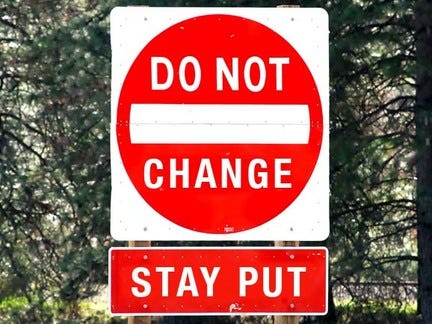
Most people prefer familiarity to newness. People that are prone to this biased prefer their current environment — what they know to be true — to any future different environment — what could be true.
The status quo bias impacts all kinds of decisions, from small and trivial ones (e.g. choosing a meal from the menu, choosing an itinerary to drive back home) to bigger and more important ones (e.g. choosing an insurance provider, buying a car). People highly prone to status-quo would prefer a familiar choice to an unfamiliar choice but with potentially better benefits.
The status-quo bias is even more predominant when there are many options to choose from, there is no much information available about the unfamiliar choices and when time is limited.
An easy example would be when you go to a restaurant where you’ve been once already. The waiter comes to your table and all of your friends have already chosen their meal, you are undecisive but the waiter is impatiently looking at you waiting for you to order. If you suffer from status-quo bias, in a rush to order something and not make the waiter get mad, you will probably choose the same meal you had the first time you went to that restaurant. You’ll think to yourself “it wasn’t that bad” as at least you know what to expect. Or, when you have to choose an insurance plan from a wide range of providers, you’ll probably choose the one offered by your bank even if the guarantees as not as good as the online-only provider, because at least you know their procedures and they have been fairly good when it comes to banking services.
Status quo can be explained by people’s fear to lose, — as we tend to weight more the potential loss of an alternative than the gains, — sunk cost thinking — we tend to continue investing in something just because we have already invested — avoiding cognitive dissonance — considering an alternative to the status quo is already in contradiction with our initial beliefs — and regret avoidance — we regret more the bad outcomes resulted from new actions than bad outcomes resulted from known actions or no action.
Status quo bias is what keeps people from trying new things, thinking differently, and standing by their opinions. They suffer more from peer-pressure context-pressure (time, resources available, information asymmetry).
So, what?
We are confronted on a daily basis to choose in the presence of uncertainty and risk. The truth is that no matter how much adventurous and risk lovers we are, uncertainty is not our friend. Our mind tries to cope with the unpleasant feeling of not knowing what is going to happen, and while sometimes she can be right, the probability of her being wrong is quite big. And who wants to be wrong when the stakes are really high, right?
So now that we are aware of these common biases that appear when coping with uncertainty. There are some simple strategies that we can put in place to take more informed decisions.
- Consider asking for a second expert opinion. It’s ok to be confident in your knowledge, but just in case, ask for expert advice. They’ll probably know more about the specificities of the situation you are dealing with and they can open your eyes to things you haven’t noticed yet.
- Sleep on your decision, when possible. Most of the time when we make decisions in rush we take either what it’s more familiar or what is closer to our initial thoughts. So sleeping on a decision can be of great help as we can have a fresher look to the alternatives the next morning. W
- Make a list of your assumptions or previous knowledge. Most of the time we make our minds even before we are presented with the options to choose from. A good strategy is to list what are our previous knowledge, thoughts, and assumptions on the decision, end then try to verify if these hold true or if there might be some misconceptions.
- Before explaining to yourself or others why you make a specific choice, try doing it backward. Explain why you didn’t choose the other options. In this way, you will be able to see if there are some choices that were left out with no real justification.
- Think about what decision would you make if there was no risk involved, or if the context was different if you hadn’t time limitation or resource constraints. These could help you see if the choice you are making is really the best choice or is just the reflection of your fear of adversity.
- Try to put different masks on when evaluating options. There is a widely known design thinking strategy to evaluate ideas called “the six hats”. Each hat asks us to behave in a certain way and evaluate ideas from that specific perspective: the facts, the “gut”, the negative, the positive, the creative, the process. For more info on the “six hat approach by de Bono see the following video.


