
To Be the Hero in Your Story, You Have to Face Your Dragons
Ignore your life problems, and they’ll turn into deadly monsters.
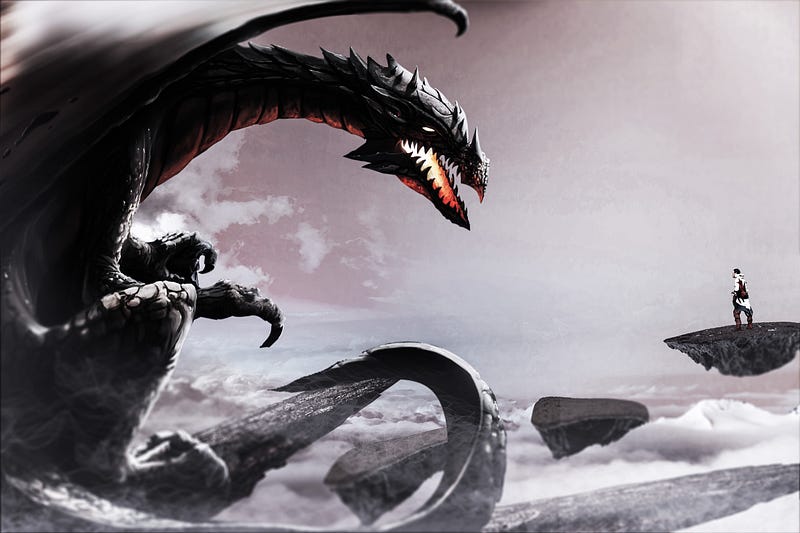
Billy Bixbee was rather surprised when he woke up one morning and found a kitten-size dragon in his room. Billy patted the creature on its head before running downstairs to tell his mother.
“There’s NO SUCH THING as a dragon,” said Billy’s mother. Since she said it like she meant it, Billy listened — and thus, decided to ignore the dragon. Oddly, the more Billy and his mother ignored the dragon the bigger it got. Even when the dragon sat at their table and ate all the pancakes, Billy and his mother didn’t react. After all, you can’t do anything about something that doesn’t exist.
It wasn’t until the dragon got as big as the house and ran off with it on top of its back that the Bixbees changed their minds. “There IS a dragon,” insisted Billy before he patted the now-giant dragon for the second time. Except, this time Billy kept patting and with every touch, the dragon got smaller until it deflated back to its original size.
“I don’t mind dragons this size,” said Billy’s mother before adding, “Why did it have to grow so big?”
“Maybe it wanted to be noticed,” said Billy.
As with many picture books for the young, the author inserted a deep message for only adults to discern between the lines. Jack Kent’s cartoon meant: Ignore a problem, and it will grow and take over your house — your life.
Ignore Your Baby Dragons & they Grow into Deadly Monsters
Life problems are like dragons. They merely start as a harmless egg, then they hatch into a tiny lizard that can at best scratch you if you get too close — Still, no real danger to fear. Over time though, the tiny creature will develop into a mighty fire-breathing monster, near impossible to confront, let alone beat. Patting only works in children’s stories.
If you’ve let unpaid taxes stack up, chances are you know what I’m talking about. Or maybe, you’ve ignored a “small scratch” that transformed into a burning hot infection. Remember that small grudge you held on your spouse because he or she didn’t follow your advice. Do you recall how it turned out when it all came out in anger when you fought over what to watch on Netflix?
These are a few examples of real-life dragons that grow in the darkness and come back hungry for blood. We all expect their return, and yet we don’t do much about it. Instead, we wait and make excuses to wait. We wait for a better mood, a better time maybe, and sometimes we don’t even bother inventing an excuse; we just pretend the dragon doesn’t exist — just like Billy’s mother. “Why?” Because avoidance is more comfortable than confrontation — at least for our brains.
Our survival instincts are rightfully wired to avoid deadly confrontations. You’re alive today because one of your ancestor’s instincts made him or her go around the saber tooth tiger that was chilling under a tree. The same reflexes made your ancestor avoid burning forests while looking for shelter and sharks while fishing for dinner. Beasts, fires, and sharks are ancient dragons that our brains evolved to stay away from due to a lack of knowledge. Your ancestors didn’t know how to tame nature nor had the tools for it, so they fled with their lives. They fled the unknown to survive.
Over time, however, humanity managed to make these ancient dragons less common and threatening. We live in safe cities away from predators and wildfires. The catch is; as we eliminated most ancient threats, we replaced them with others — new dragons. A modern-day dragon could be paying the rent, meeting a deadline, and settling an argument with your friend or spouse. These problems are seldom lethal but still scary nonetheless. The somewhat-funny-but-not-so-exciting fact is; our brains react to both ancient and modern-day dragons identically: avoidance and stress.
Your brain considers an argument with your spouse as risky as wrestling with a starving tiger. “Why?” Because your subconscious doesn’t know exactly what to expect from the argument as it didn’t know precisely how to deal with the tiger. As with your ancestors, vagueness terrifies your brain.
So, what can we do to convince our brains that our money problems, relationship issues, and professional projects aren’t life-threatening dangers? How do we make our brains eager to face the modern-day dragons and harness their gold? How do we become the heroes of our stories?
Psychologists Jordan Peterson and Peter Gollwitzer have spent a few decades wrestling with these questions. Despite their different approaches, both have come to the same conclusion: When facing life’s dragons, precision is the best weapon.
Identify Your Dragon, and you’ll Pick the Right Weapon
Whether it’s Greek mythology or video games, dragons come in a variety of types. There are fire, water, and even zombie dragons. Each has its own strengths and weaknesses. What doesn’t change is that every fictional character prepares for their fights by analyzing their opponents.
If you’re about to face a frozen beast, flaming swords can be effective. How about undead dragons? They say they’re powerful from a distance but vulnerable in hand-to-hand combat. After all, they have no scales — only bones.
The more you study your dragon, the more vulnerabilities you uncover — and thus, the less afraid you become. From there, the previously-invincible monster starts to appear less-so. In other words, you realize you can actually win — and the same pattern applies to our lives.
In his book 12 Rules for Life, clinical psychologist Jordan Peterson explained that once you precisely identify an issue, you will likely recognize that you were far more afraid of it than you should have been. He further noted that part of identifying the problem is also recognizing what isn’t the problem. Singling out the issue shrinks all your vague fears into one precise one — and thus, helps you to feel less overwhelmed. With this new information, you can begin to focus on finding solutions on your own or through advice from others. Peterson went on to explain that studying your life’s dragons and preparing to fight them involve the same weapon: precise speech.
In Rule 10 of his book Be Precise in Your Speech, Peterson argued that precise articulation of an issue can be harder than it seems. Your problems are usually a combination of thoughts and emotions related to a set of events. We all know too well that what’s in our minds and hearts isn’t always easy to put into words — and thus, training is required. Here are three easy keys to help you hone your speech precision:
- Deconstruct your problems: small chunks are easier to articulate than complex issues. Start small and clarify your life’s dragons, one sentence at a time.
- Write down your problems: writing is thinking with structure. Focus on your issue until you reach a coherent version that you can process without feeling confused or overwhelmed.
- Encourage your counterparts to paraphrase you: in a conversation, you get to improve your understanding of yourself. Sometimes, other people’s words are more accurate than yours. Leverage your peers’ knowledge to zero in on your on-going issue.
Once you get a grip on what kind of dragon you’re dealing with, your mind embraces the now-manageable challenge instead of escaping it. Then comes the time to prepare for the fight.
Conceive a Dragon-Slaying Strategy with Intention
Sure gathering information and equipment before confronting your dragon is essential, but you'll end up devoured if you lack strategy. Your flaming sword won’t burn down the frozen dragon on its own. What if the beast decided to fight from a distance? Did you consider that possibility?
Strategy is what separates reckless adventurers from heroes. Day-dreamers from achievers. We all know it, and science has proved it. In an experiment conducted in cooperation with students from the Max-Plank-Institute for Psychological Research in Munich, psychology professor Peter Gollwitzer asked participants to set themselves relatively complex goals to achieve — dragons to slay — during their Christmas holidays.
The first group set vague goals without a strategy such as “find an internship,” while the second adopted what Gollwitzer referred to as implementation intentions. According to Gollwitzer, “the purpose of an implementation intention is to lay down a specific plan that helps to promote the initiation and efficient execution of a goal-directed activity.” Keeping the internship example, an implementation intention could be: “Calling three marketing agencies in Munich every day from Monday to Friday to ask for internship opportunities.”
Gollwitzer’s results showed that adventurers who define specific strategies against their dragons are three times more likely to beat them compared to heroes who improvise.
In his report, Gollwitzer stressed the importance of answering three main questions to formulate your strategy. These questions are:
- Where does your intention take place? (The place of the fight.)
- When can you proceed? (The time of the battle.)
- How will you execute your intention? (The steps you’ll follow.)
Once you answer these three questions, your dragon-slaying strategy becomes ready for execution. From there, the fight begins.
Final Words & Takeaway
We love fairy tales for a reason — they wondrously conceptualize our lives. Still, behind the floating isles, shiny treasures, and magical powers, reality stands. The dragons are life challenges, the gold represents achievements, and the hero represents, well, YOU.
Your life is your story, and you get to decide who gets the fairy tale ending, the scary dragons, or the striving hero. The journey is usually tough, but for it to end with a triumph, it has to begin with a challenge:
- Study your dragon: pinpoint your problems and goals.
- Prepare a fighting strategy: set clear implementation intentions.
Keep in mind that dragons aren’t just the problems that pop into your life. They could also be objectives you want to achieve. Heroes usually act out of necessity, but they also chase new challenges voluntarily.
So, whichever it is for you right now, what exactly is on your mind?