
To Be or Not to Be a Victim
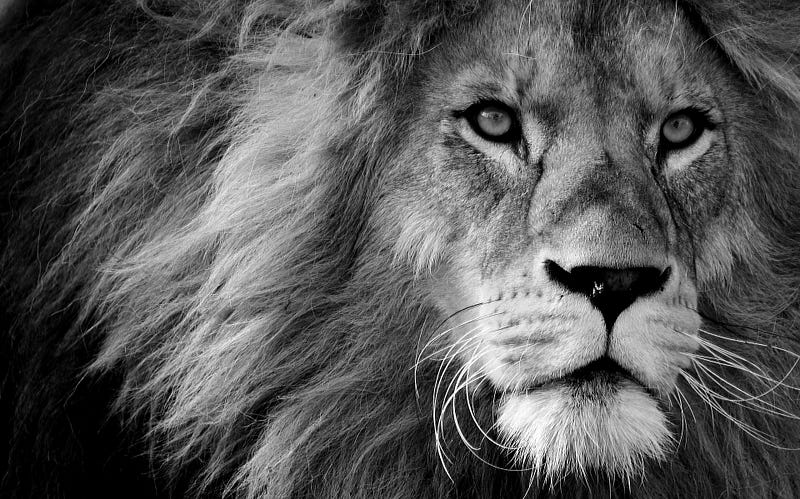
How overcoming my victim mentality and taking responsibility for my life turned me into Nietzsche’s lion
As a mother, I accept I am the primary butcher of my children’s perfection.
Not that I’m making an argument that anyone could turn out perfect even with the most unblemished childhood. First we’d have to argue over the definition of perfection, and since it’s too late for that in my case, I’m not going to worry about it.
At the very least, my goal, as I’ve always professed, is to screw up my kids in the least amount possible.
But after a rough start as a kid, and a resulting adolescence I’m lucky to have survived, I’ve come to the conclusion that perfection doesn’t diminish as we suffer the consequences of living.
If we are careful to utilize all the crap that we must endure to our advantage, excellence becomes the result of our suffering.
Where’s the point of no return?
Is there any injury a parent can inflict on a child that creates a wound too severe to come back from?
For half of my life, I believed my father’s abandonment created the kind of trauma that would give me an excuse for all my anger, all my screwed up behavior for life. I now know that I was wrong.
As the story goes, my abusive alcoholic father kidnaps me when I am two. When my 22-year-old mom finds out where I am (apparently at his girlfriend’s house), she shows up with her .45 and makes him a deal he can’t refuse.
He leaves me alone for the rest of my life, and he never has to pay child support.
You gotta admire a man who stays so religiously true to his word. I have no memory of my father. Never got a Christmas card or birthday check. He was like a fantasy creature. I got to make him into anything I wanted.
My mom tried her best to convince me I was better off without him, to somehow rationalize away my longing for him, by telling me things like he used to throw cats off freeway overpasses.
Or how his friends would secretly pass her money to buy us food on their way out of the house with my father to go drinking. This would usually end up translating into anger toward her. How could she marry someone like that and make him my father?
Everyone loves the victim, right?
My fantasy father disappeared with my childhood.
The self-indulgence of adolescence embraced the man my mother had described, a man whose actions made me a victim to be pitied, a victim who shouldn’t be held responsible for any of my dysfunctional actions.
The discovery of alcohol emboldened my behavior, and helped to solidify the story I made up about myself.
I was exceptional, superior almost. My suffering was special, and I made sure everyone knew about it.
My mother sent me to numerous therapists who accepted me on a charity basis. I took full advantage, spending the hour a week indulging my self-pity and nodding with my therapist as she explained to me all the inexcusable mistakes my poor mom was making.
My poor mom. She never had less than three jobs at a time. Breakfast shift at the Marriot from 4–9. Cleaning houses all day. Then cocktail waitress at the now shuttered Redondo Beach Strand nightclub from 9–2.
To my utter shame, she cleaned the houses of many of my classmates. The clothes she wore to clean houses were better described as rags, and I remember walking past her like I didn’t know her one day when she surprised me to pick me up from school.
But she never complained. She did it all, day and night, for 40 years with a smile on her face, picking up stray animals that crossed her path, even letting homeless people sleep in her car.
But none of this mattered to the victim me. I was willingly being fed a diet of blame that complimented the story I wanted to believe about myself.
I have no doubt growing up as a latchkey kid, poor and fatherless affected me.
I lost my virginity at 14 on a field behind my old Catholic grade school with an 18-year-old I’d chosen to relieve me of the burden of purity under the ever-sanguine eye of the bus-sized Our Lady of Guadalupe mural painted on the backside of the church.
(My sister and I had been lucky enough to attend the Catholic school for free thanks to the charity of a kind priest who refused to charge my mom tuition.)
I drank to excess and had little regard for my personal safety.
I cringe now as a mother thinking back on the short flashes of memory I have of myself, drunk, racing down tiny, dark streets in the beat-up ’81 Toyota Corolla hatchback my aunt and uncle gifted me at 16, hoping an accident might encourage my equally damaged boyfriend to appreciate me.
I couldn’t seem to shake the association I’d created between victimhood and love.
I don’t know why I reasoned that people would like me better if they were aware of all the suffering I’d endured, but modern psychology might have said I was afflicted with a victim mentality.
People with this outlook “often possess an excessive sense of victimhood and entitlement. By shifting the blame onto others, they are able to protect their own exaggerated sense of self.”
Bingo!
I wanted something to happen to me. I was addicted to the drama of personal disaster. I felt comfortable when the chaos that was my inner life reflected in my outer life. This disorder was surely influenced by the trauma of abandonment I endured.
But where it became my responsibility was in the nurturing of dramatic self-pity — that story I fed myself, and in the expectation of some delusional mix of admiration and pity from everyone else.
Death of a victim
I never told anyone, but one myth survived my childhood fantasies.
I harbored a secret belief that my father would show up at my high school graduation. You know how that day seems like a really big deal when you’re young? I would just know it was him, and we would hug and live happily ever after.
One night when I was 17, a few days before my graduation, something hit the self-destruct button on the myth of my father’s return. I didn’t realize it at the time, but another myth died with it.
My trauma did not define me. It didn’t impart any unique status. And more importantly, I wasn’t a prisoner of what had happened to me.
My boyfriend and I were drinking in his car, parked somewhere in the woods of Santa Paula near his college, and the realization that my father was not going to show up to my stupid high school graduation cut through my drunken haze.
That one sober thought somehow glowed within the haze. And things got sloppy.
I cried myself dry that night, all the Boone’s Strawberry Hill wine my boyfriend plied me with hoping the booze would give him less work to do (we believed back then that Boone’s made you horney) going to salty waste.
God it hurt. That realization. That acceptance.
But I never cried over my father again, at least, not until the morning of my 40th birthday. But we’ll get to that. His very existence rarely ventured into my thoughts, and when it did, it had little effect on me.
I wasn’t cured by any means. I stayed for three more years with the alcoholic, abusive cheater I was addicted to.
But the monstrous ice burg of victimhood calved from the glacier of my identity that night before my high school graduation. The loss of that weight buoyed me to a level where I could grasp responsibility for myself, the foundational starting point for self-development.
It took some time, but I eventually shed any attachment to the boyfriend too. Someone finally told me he’d cheated (duh), and that was it. Any desire for him was gone. It hurt to discover his betrayal, but it was what I needed to let go.
This became a pattern in my life. But every single one of those chapters of stupidity and pain were necessary (for me) to level up.
Nietzsche’s Three Transformations of the Spirit
I was about 25 when I came across the episodes of Bill Moyers featuring Joseph Campbell on PBS.
This was just before YouTube, and I couldn’t afford cable in the cozy apartment I shared with two wayward rats and a rescue cat, so PBS was my best bet at entertainment, bunny ears willing.
There’s more wisdom packed into the interviews, called The Power of Myth, than you could digest in a lifetime. But one discussion in particular roused me from the cannabis nods that usually hit after a long night bartending and few night caps from the bong I used to enjoy when my responsibilities didn’t extend beyond myself and my four-legged brood.
In this discussion, Campbell relates Friedrich Nietzsche’s Three Transformations of the Spirit, which describes three stages a person must progress through to reach his or her full potential, what Nietzsche considered the meaning of life.
These stages are a camel, a lion and a child.
You start out as a camel, carrying a progressively heavier load as you learn the rules of society and deal with your individual challenges. When it is ready, the camel runs out into the desert and becomes a lion.
“The greater the load, the more powerful the lion,” Campbell said.
The lion’s job is to fight a dragon called “Thou Shalt.” Each scale is a different “thou shalt,” and the lion must overcome each scale until they are all conquered.
Campbell explains that the thou shalts are all of the rules and expectations of society we burdened ourselves with as camels. We have to learn to become the master of those rules rather than they being our master.
It doesn’t mean all the rules and traditions are inherently bad, we just have to decide to follow the rules because we agree with our society’s values, not because society expects it of us.
“This is the way in any art work,” Campbell tells Moyers. “You go to work and study an art. You study the techniques, you study all the rules, and the rules are put upon you by a teacher. Then there comes a time of using the rules, not being used by them.”
After the dragon “Thou Shalt” is vanquished, we become a child. A child is the metaphor for a person who sees the world with wonder, who doesn’t dwell on the past and doesn’t care about the opinion of others.
It is in this state a person takes her place at the center of the wheel of life, unaffected by the turning of the wheel.
My cat and rats grumbled as I jumped off my couch at the start of this interview, ruining the cozy crevices they had snuggled into around my body. I pushed in the blank VHS tape I kept at the ready for just such an occasion and hit the record button.
Had I become a lion that night in my boyfriend’s car, throwing off society’s expectations of how a damaged person should feel and act? And that bit about “the heavier the load, the stronger the lion” gave meaning to the suffering.
It made me stronger.
As long as I was able to throw off the burden of the suffering — my attachment to my victim identity — then it did give me an advantage, just not in the way I wanted it too as a teenager.
I’d wanted my father’s abandonment, our poverty, the sleeping on the floors of laundry rooms and waking up with slugs on our faces, the living in a garage with roaches the size of small cats, the humiliation of a mother who cleaned my classmates houses, and all the other undesirable circumstances I’d been forced to endure as a kid to entitle me to some kind of debt owed by everyone else who had it easier than I did.
But Campbell was telling me the advantage I had didn’t have anything to do with anyone else, and expecting it to meant I would be doomed to living as far from my true potential as possible.
Where the weight of my load benefited me was in my relationship with myself, in the struggle to move beyond being a victim of things beyond my control.
The metaphors Campbell revealed to me grounded my past, exposing a path of soft earth I could sink my toes into as I stumbled forward. They were a map that unveiled a goal worthy of the journey.
I imagined myself as a strong lion who’d left my camel body behind that night I cried my father out of my heart.
First contact
Twentysomething years later, I know I’m still a lion. I’m not sure how many scales my Thou Shalt dragon has left, but I imagine the last are likely the most stubborn.
I did allow something my father did to make me cry one last time, and it was relatively recent. About 17 years ago, a half-sister I never knew I had contacted me on the old MySpace.
She told me her father had finally revealed to her that he’d had a daughter he’d abandoned as a child. Her name was Blake.
We spoke a bit over messenger, and then she told me “dad” wanted to send me an email. Could she have my email address?
I waited for that email for weeks, and when it came, the satisfaction I knew I would get from telling my father I wasn’t interested in having any contact with him was just as sweet as I’d imagined it would be.
For a little while. But when he responded he just said okay. He didn’t beg. He didn’t try harder. I realized that’s what I had wanted. It’s what I had expected.
He didn’t write well, and he admitted he hadn’t read my entire email (to be fair it was probably better suited to being a novella than an email). He didn’t read well, he’d said. Reading was hard.
Wouldn’t it have been nice if he had been intelligent and rich with so much remorse, he wanted to leave me millions in the will? The remorse he had. The intelligence, not so much. And he was poor as dirt.
I was a writer with a father who found reading too hard. Discovering who my father was, after 27 years, was a disappointment.
Then, I had kids. That changed everything. My ego got a reality check.
I sent my father an email, telling him I wanted to share some pictures of my kids. He told me I was beautiful, just like my mother. He told me he loved me.
Loved me! I didn’t say it back, never did, cause I didn’t feel like I loved him. I didn’t know him.
It was like how people say they love Jesus. I never quite understood how I was supposed to love someone I didn’t know. He sounded like a great guy, and even if he was God, I still couldn’t manage to find this love that was supposed to be there.
It was the same idea with my father. I didn’t know him. And in all fairness, it seemed age had tamed him, and he had been a wonderful father to my half-sister.
My poor sister
This was a lot more than I could say for the father of my poor sister. We grew up thinking we were normal sisters, and only found out we had different dads when we were seven and ten, respectively. As unlikely as it sounds, my mother had two children whose fathers completely abandoned them. No child support. No contact. Nothing.
(Another sister came along when I was 12, but her alcoholic father gets the participation trophy for sticking around. And yes, I could populate a small island nation with my half siblings.)
Anyway, when my sister’s father contacted her, she asked him to apologize to our mother as the condition of her agreeing to meet him. He refused, and that’s where their story ends.
The last time my father made me cry
It was the Christmas I was 39 that my heart forgot to function for the moment I realized it was my father calling my phone.
I stared at the phone, flushing as my heart restarted and pumped into hyperdrive listening to the phone ring. I stared until the ringing stopped. I was too scared to answer.
He called again a few months before my 40th birthday. He left a message this time, saying someone had called him claiming to be his daughter and she needed a kidney immediately.
It had obviously been a scam, but he’d been scared it was me. He told me he’d give me his kidney. Just call him back.
So I did. And I’m so glad I did.
He would die three months after that conversation, the only one we ever had.
I told him I would come visit him at his home in Washington that summer. I told him I would bring the kids. He had COPD, and had been given five years to live.
He died before I could meet him, but not before my 40th birthday, when he sent me his first and only happy birthday message.
It was an emoji of a muscley construction worker saying Happy Birthday. And I cried like the little girl who’d wanted nothing more than a birthday card for the 17 years she’d spent as a camel.
It was a long, strange trip, my relationship with my father.
I’m 43 now, and I’m grateful he didn’t stick around. I’m one of these people, like him I guess, who needs to learn the hard way. I may have remained a camel forever if he’d have been a bad dad rather than an absent one.
In the end, I got everything I’d ever wanted from him. He told me he loved me. And I got that happy birthday. Like everything that happens to us in life, it was all perfect.