
Tips On How To Build An Amazing World For Your Story
Part 1: Natural settings and how their symbolic resonances MATTER…
In his book The Anatomy Of Story (which I highly recommend), author John Truby donates an entire chapter just to the “story world,” as he calls it. He says that you can visually describe the story world through three to four major elements. Today I’ll take about the one: natural settings.
Natural Settings
John Truby is really into symbolism, and so he recommends that when you choose your setting, it must carry a multitude of meanings for the audience — you shouldn’t choose it just to choose it. Through knowing the meaning different settings express, he says, you can then better determine if one best expresses your plot, characters, and theme.
“A psychologist of the imagination…comes to realize that the cosmos molds mankind, that it can transform a man of the hills into a man of islands and rivers, and that the house remodels man.” — Gaston Bachelard
Truby then goes into deeply analyzing the meaning of various settings.
Ocean: The ultimate landscape where all creatures are weightless; has often been the place of utopian dreamworlds; a terrifying graveyard, an impersonal force grabbing anyone or anything on the surface and “pulling it down to the infinite black depths”; holds past secrets and old treasure yet to be discovered.
Outer Space: Holds the promise of the diversity of other worlds; a place of unending adventure; a realm of black nothingness.
Forest: A natural cathedral; where contemplative people go; where lovers sneak away; where people get lost; the hiding place of ghosts; where hunters stalk their prey; often causes mental loss before physical one.
Jungle: Evokes the feeling of suffocation; where man is reduced to beast; can best express the theory of evolution, and the modern theory of change.
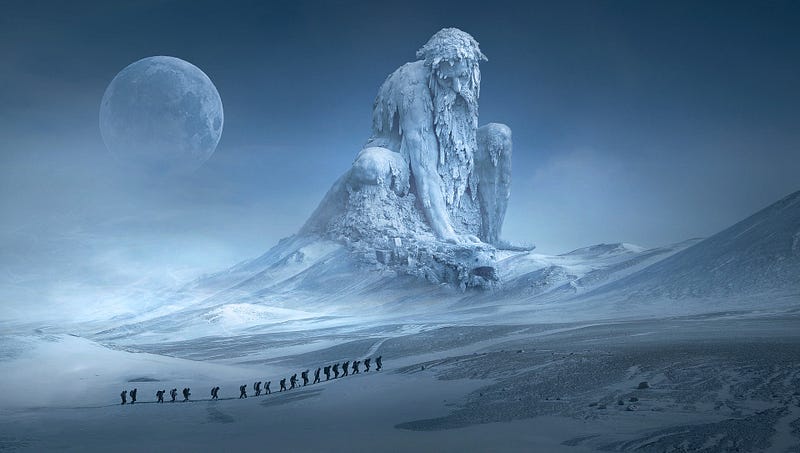
Desert and Ice: Places of dying and death; Seemingly impersonal in their brutality; where the strong-willed go to become toughened and grow through isolation.
Island: A miniature of the earth; a separated place; the laboratory of man; where new forms of living can be created and tested.
Mountain: The land of greatness; where the strong go to prove themselves — whether through seclusion, meditation, or extreme confrontation with nature; the world of the natural philosopher.
Plain: Wide open and accessible to all; free; the place of equality, freedom, and the rights of the common man; where the mediocre make their lives; where the average men live as part of herds, not able to think for themselves, easily led, usually in ways much destructive to them.
River: A path; the road into or out of something.
Weather
Truby outright gives you some “classic correlations between weather and emotion.”
Lightning and thunder: passion, terror, death
Rain: Sadness, loneliness, boredom, coziness
Wind: Destructure, desolation
Fog: Obfuscation, mystery
Sun: Happiness, fun, freedom, corruption hidden below a pleasant exterior
Snow: Sleep, serenity, quiet inexorable death
Conclusion
I hope this little broad tingent gave you a little more direction for your project. Lookout, I’m coming out with a particularly long one about miniature spaces soon!
And definitely pick up The Anatomy Of Story, by John Truby.
Thanks for reading!