avatarEverton Gomede, PhD

Free AI web copilot to create summaries, insights and extended knowledge, download it at here

6870

Abstract

st, y_train, y_test = train_test_split(X, y, test_size=<span class="hljs-number">0.2</span>, random_state=<span class="hljs-number">42</span>)</pre></div><p id="4f8d"><b>Step 3: Building a TinyML Model</b></p><p id="d1c2">We’ll use a simple logistic regression model, which is lightweight enough for TinyML contexts. Though more complex models can be used, logistic regression serves as a good starting point due to its simplicity and efficiency.</p><div id="0268"><pre><span class="hljs-keyword">from</span> sklearn.linear_model <span class="hljs-keyword">import</span> LogisticRegression

<span class="hljs-comment"># Initialize and train the logistic regression model</span> model = LogisticRegression(max_iter=<span class="hljs-number">100</span>) model.fit(X_train, y_train)</pre></div><p id="fcdc"><b>Step 4: Evaluating the Model</b></p><p id="767a">We assess the model using common metrics for classification problems: accuracy, precision, recall, and F1 score.</p><div id="cd23"><pre><span class="hljs-keyword">from</span> sklearn.metrics <span class="hljs-keyword">import</span> accuracy_score, precision_score, recall_score, f1_score

<span class="hljs-comment"># Predictions on the test set</span> y_pred = model.predict(X_test)

<span class="hljs-comment"># Calculate metrics</span> accuracy = accuracy_score(y_test, y_pred) precision = precision_score(y_test, y_pred) recall = recall_score(y_test, y_pred) f1 = f1_score(y_test, y_pred)

<span class="hljs-built_in">print</span>(<span class="hljs-string">f"Accuracy: <span class="hljs-subst">{accuracy:<span class="hljs-number">.2</span>f}</span>, Precision: <span class="hljs-subst">{precision:<span class="hljs-number">.2</span>f}</span>, Recall: <span class="hljs-subst">{recall:<span class="hljs-number">.2</span>f}</span>, F1 Score: <span class="hljs-subst">{f1:<span class="hljs-number">.2</span>f}</span>"</span>)</pre></div><p id="7bee"><b>Step 5: Visualizing Results</b></p><p id="f55c">We can plot the ROC curve to visually assess the model’s performance.</p><div id="f158"><pre><span class="hljs-keyword">import</span> matplotlib.pyplot <span class="hljs-keyword">as</span> plt <span class="hljs-keyword">from</span> sklearn.metrics <span class="hljs-keyword">import</span> roc_curve, auc

<span class="hljs-comment"># Compute ROC curve and ROC area</span> fpr, tpr, _ = roc_curve(y_test, model.decision_function(X_test)) roc_auc = auc(fpr, tpr)

<span class="hljs-comment"># Plotting ROC curve</span> plt.figure() plt.plot(fpr, tpr, color=<span class="hljs-string">'darkorange'</span>, lw=<span class="hljs-number">2</span>, label=<span class="hljs-string">'ROC curve (area = %0.2f)'</span> % roc_auc) plt.plot([<span class="hljs-number">0</span>, <span class="hljs-number">1</span>], [<span class="hljs-number">0</span>, <span class="hljs-number">1</span>], color=<span class="hljs-string">'navy'</span>, lw=<span class="hljs-number">2</span>, linestyle=<span class="hljs-string">'--'</span>) plt.xlim([<span class="hljs-number">0.0</span>, <span class="hljs-number">1.0</span>]) plt.ylim([<span class="hljs-number">0.0</span>, <span class="hljs-number">1.05</span>]) plt.xlabel(<span class="hljs-string">'False Positive Rate'</span>) plt.ylabel(<span class="hljs-string">'True Positive Rate'</span>) plt.title(<span class="hljs-string">'Receiver operating characteristic'</span>) plt.legend(loc=<span class="hljs-string">"lower right"</span>) plt.show()</pre></div><p id="f272"><b>Interpretations</b></p><ul><li><b>Accuracy </b>measures the overall correctness of the model across both classes. A high accuracy indicates that the model is generally good at prediction, but it doesn’t tell us about the balance between the classes.</li><li><b>Precision </b>tells us how reliable the model is when it predicts a positive class. High precision means that when the model predicts a positive class, it is likely correct.</li><li><b>Recall </b>indicates the model’s ability to detect all actual positives. High recall means that the model captures a large proportion of actual positive cases.</li><li><b>F1 Score</b> provides a balance between precision and recall. It is useful when you want to seek a balance between recognizing as many positives as possible (recall) and ensuring that the predictions are accurate (precision).</li><li><b>The ROC Curve </b>and its <b>area under the curve (AUC)</b> offer a graphical representation of the trade-off between the true positive rate and false positive rate across different thresholds. A higher AUC indicates a better-performing model.</li></ul><div id="3d23"><pre><span class="hljs-attr">Accuracy:</span> <span class="hljs-number">0.83</span><span class="hljs-string">,</span> <span class="hljs-attr">Precision:</span> <span class="hljs-number">0.87</span><span class="hljs-string">,</span> <span class="hljs-attr">Recall:</span> <span class="hljs-number">0.82</span><span class="hljs-string">,</span> <span class="hljs-attr">F1 Score:</span> <span class="hljs-number">0.84</span></pre></div><figure id="aefb"><img src="https://cdn-images-1.readmedium.com/v2/resize:fit:800/1*4rVSNzK-9eAuvWVxe8Qpkw.png"><figcaption></figcaption></figure><p id="f736">This example demonstrates a basic approach to implementing, evaluating, and interpreting a TinyML model. In real-world TinyML applications, considerations around model size, computation resources, and power consumption are critical, and more advanced techniques such as model pruning, quantization, and efficient neural network architectures may be necessary to deploy these models effectively on tiny devices.</p><h2 id="3c53">Conclusion</h2><p id="0781">In conclusion, TinyML is a transformative technology that marries the power of machine learning with the ubiquity of embedded systems, enabling intelligent applications on the smallest, power-constrained devices. By addressing current challenges and leveraging ongoing innovations, TinyML is set to play a pivotal role in the next wave of smart devices, making our interactions with technology more seamless, intuitive, and efficient.</p><div id="de2d" class="link-block"> <a href="https://www.tinyml.org/"> <div> <div> <h2>tinyML</h2> <div><h3>TinyML Summit. The topic is advances in ultra-low power Machine Learning technologies and applications.</h3></div> <div><p>www.tinyml.org</p></div> </div> <div> <div style="background-image: url(https://miro.readmedium.com/v2/resize:fit:320/0*jE4l4LABqncVGXj7)"></div> </div> </div> </a> </div><div id="ec86" class="link-block"> <a href="https://tinyml.mit.edu/"> <div> <div> <h2>TinyML | Tiny Machine Learning</h2> <div><h3>If you are interested in getting

Options

updates, please sign up here to get notified! 03.01.2024: A new blog post TinyChat…</h3></div> <div><p>tinyml.mit.edu</p></div> </div> <div> <div style="background-image: url(https://miro.readmedium.com/v2/resize:fit:320/)"></div> </div> </div> </a> </div><div id="ab3f" class="link-block"> <a href="https://arxiv.org/abs/2303.13569"> <div> <div> <h2>TinyML: Tools, Applications, Challenges, and Future Research Directions</h2> <div><h3>In recent years, Artificial Intelligence (AI) and Machine learning (ML) have gained significant interest from both…</h3></div> <div><p>arxiv.org</p></div> </div> <div> <div style="background-image: url(https://miro.readmedium.com/v2/resize:fit:320/0*GvaTA2PFRJKB2TOg)"></div> </div> </div> </a> </div><div id="ee53" class="link-block"> <a href="https://arxiv.org/abs/2211.04448"> <div> <div> <h2>A review of TinyML</h2> <div><h3>In this current technological world, the application of machine learning is becoming ubiquitous. Incorporating machine…</h3></div> <div><p>arxiv.org</p></div> </div> <div> <div style="background-image: url(https://miro.readmedium.com/v2/resize:fit:320/0*Wa3MyT55scXYlO1i)"></div> </div> </div> </a> </div><div id="8a41" class="link-block"> <a href="https://arxiv.org/abs/2304.05201"> <div> <div> <h2>TinyReptile: TinyML with Federated Meta-Learning</h2> <div><h3>Tiny machine learning (TinyML) is a rapidly growing field aiming to democratize machine learning (ML) for…</h3></div> <div><p>arxiv.org</p></div> </div> <div> <div style="background-image: url(https://miro.readmedium.com/v2/resize:fit:320/0*dC9OIYxDIExeukaw)"></div> </div> </div> </a> </div><div id="81c7" class="link-block"> <a href="https://arxiv.org/abs/2303.13569"> <div> <div> <h2>TinyML: Tools, Applications, Challenges, and Future Research Directions</h2> <div><h3>In recent years, Artificial Intelligence (AI) and Machine learning (ML) have gained significant interest from both…</h3></div> <div><p>arxiv.org</p></div> </div> <div> <div style="background-image: url(https://miro.readmedium.com/v2/resize:fit:320/0*GvaTA2PFRJKB2TOg)"></div> </div> </div> </a> </div><div id="4ad6" class="link-block"> <a href="https://arxiv.org/abs/2301.11899"> <div> <div> <h2>Is TinyML Sustainable? Assessing the Environmental Impacts of Machine Learning on Microcontrollers</h2> <div><h3>The sustained growth of carbon emissions and global waste elicits significant sustainability concerns for our…</h3></div> <div><p>arxiv.org</p></div> </div> <div> <div style="background-image: url(https://miro.readmedium.com/v2/resize:fit:320/0*rPQeWLXowE5ZnifQ)"></div> </div> </div> </a> </div><div id="8716" class="link-block"> <a href="https://arxiv.org/abs/2309.11932"> <div> <div> <h2>A Machine Learning-oriented Survey on Tiny Machine Learning</h2> <div><h3>The emergence of Tiny Machine Learning (TinyML) has positively revolutionized the field of Artificial Intelligence by…</h3></div> <div><p>arxiv.org</p></div> </div> <div> <div style="background-image: url(https://miro.readmedium.com/v2/resize:fit:320/0*hZmKMItWPtl5FAHh)"></div> </div> </div> </a> </div><div id="b40c" class="link-block"> <a href="https://arxiv.org/abs/2311.11452"> <div> <div> <h2>Physics-Enhanced TinyML for Real-Time Detection of Ground Magnetic Anomalies</h2> <div><h3>Space weather phenomena like geomagnetic disturbances (GMDs) and geomagnetically induced currents (GICs) pose…</h3></div> <div><p>arxiv.org</p></div> </div> <div> <div style="background-image: url(https://miro.readmedium.com/v2/resize:fit:320/0*01Fa1g7DSLGbxef-)"></div> </div> </div> </a> </div><div id="958a" class="link-block"> <a href="https://arxiv.org/abs/2311.11883"> <div> <div> <h2>Efficient Neural Networks for Tiny Machine Learning: A Comprehensive Review</h2> <div><h3>The field of Tiny Machine Learning (TinyML) has gained significant attention due to its potential to enable intelligent…</h3></div> <div><p>arxiv.org</p></div> </div> <div> <div style="background-image: url(https://miro.readmedium.com/v2/resize:fit:320/0*TudYO8ez1aRj9dYd)"></div> </div> </div> </a> </div><div id="c84d" class="link-block"> <a href="https://arxiv.org/abs/2307.06822"> <div> <div> <h2>TinyMetaFed: Efficient Federated Meta-Learning for TinyML</h2> <div><h3>The field of Tiny Machine Learning (TinyML) has made substantial advancements in democratizing machine learning on…</h3></div> <div><p>arxiv.org</p></div> </div> <div> <div style="background-image: url(https://miro.readmedium.com/v2/resize:fit:320/0*aeRlc5m3QKrpapj6)"></div> </div> </div> </a> </div><h2 id="417c">A Message from AI Mind</h2><figure id="ecd4"><img src="https://cdn-images-1.readmedium.com/v2/resize:fit:800/0*5Wm7sOfTpe5DEbhg.gif"><figcaption></figcaption></figure><p id="0438">Thanks for being a part of our community! Before you go:</p><ul><li>👏 Clap for the story and follow the author 👉</li><li>📰 View more content in the <a href="https://pub.aimind.so/">AI Mind Publication</a></li><li>🧠 Improve your <a href="https://www.aimind.so/prompt-generator?utm_source=pub&amp;utm_medium=message">AI prompts effortlessly and FREE</a></li><li><b>🧰 Discover <a href="https://www.aimind.so/?utm_source=pub&amp;utm_medium=message">Intuitive AI Tools</a></b></li></ul></article></body>

TinyML: Powering the Next Generation of Ultra-Low-Power Devices with Machine Learning

Introduction

TinyML, a burgeoning field at the intersection of machine learning (ML) and embedded systems, aims to deploy intelligent applications on ultra-low-power devices. This essay explores the fundamentals of TinyML, its significance, applications, challenges, and future prospects, elucidating how this technology is revolutionizing the way we interact with the smallest and most energy-efficient devices around us.
Bringing intelligence to the smallest of devices, TinyML lights the path to a smarter, more connected world.

Understanding TinyML

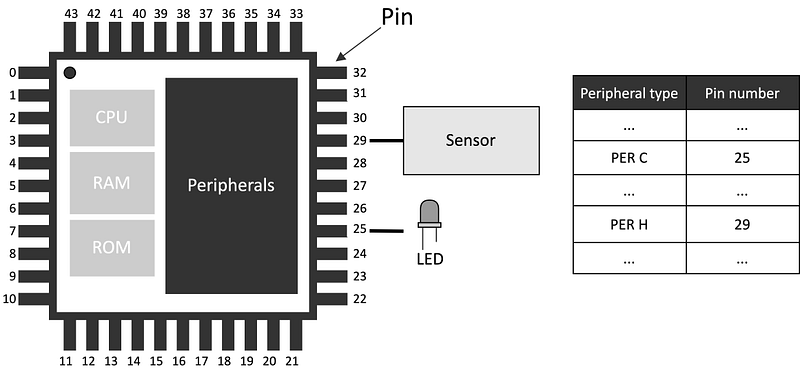
TinyML stands for “tiny machine learning.” It is a subset of machine learning technologies and techniques specifically designed to run on small, low-power devices such as microcontrollers and embedded processors. These devices are often part of the Internet of Things (IoT), enabling smart functionality in everyday objects like wearables, household appliances, and industrial sensors. The core objective of TinyML is to bring the capabilities of artificial intelligence (AI) and ML to hardware with severe constraints in terms of computing power, memory, and energy.
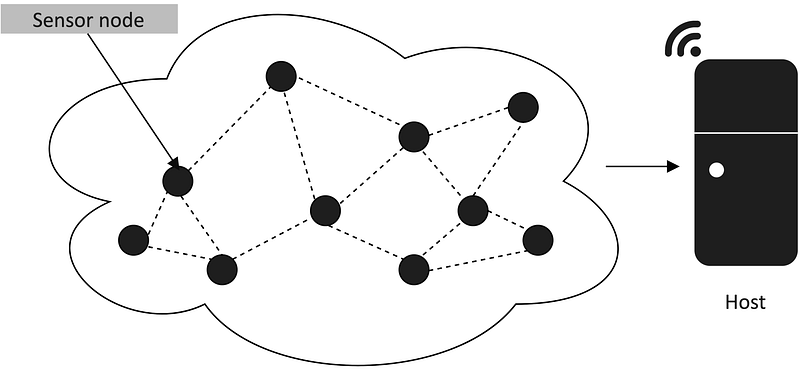
Wireless sensor network

Significance of TinyML

The significance of TinyML lies in its ability to perform data processing and inference locally, at the edge of the network, rather than relying on cloud-based services. This local processing capability reduces latency, saves bandwidth, enhances privacy, and allows devices to operate in environments with intermittent or no internet connectivity. Moreover, by minimizing energy consumption, TinyML enables continuous, real-time AI applications on devices powered by small batteries or even energy harvesting technologies, extending operational lifetimes and opening up new possibilities for smart applications.
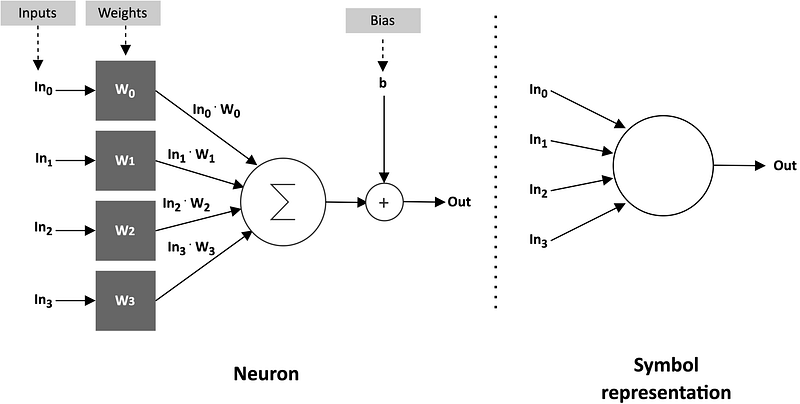
Neuron representation

Applications of TinyML

TinyML has a wide array of applications across various sectors. In healthcare, TinyML-powered wearable devices can monitor vital signs and detect anomalies in real-time, offering personalized health insights and early warnings of potential issues. In agriculture, sensors equipped with TinyML can monitor soil moisture and nutrient levels, optimizing irrigation and fertilization to improve crop yields. In industrial settings, TinyML enables predictive maintenance by analyzing vibrations, temperatures, and other signals to foresee and prevent equipment failures. Moreover, in consumer electronics, it powers features like voice recognition in smartwatches, gesture control in household appliances, and energy-saving modes in smart thermostats.
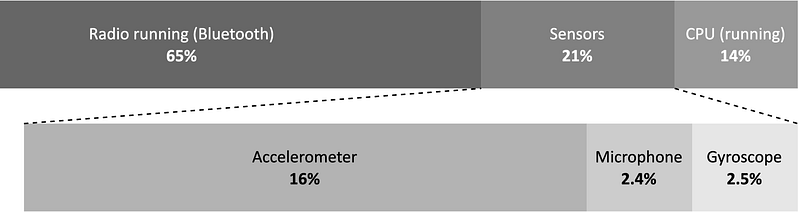
Power consumption breakdown for the Arduino Nano 33 BLE Sense board

Challenges in TinyML

Despite its potential, TinyML faces several challenges. The primary hurdle is the stringent resource constraints of low-power devices, which limit the complexity of models that can be deployed. Designing ML models that are both effective and efficient enough to run within these limitations requires innovative approaches in model architecture, compression, and optimization. Additionally, ensuring the privacy and security of data processed on these devices is paramount, necessitating the development of robust frameworks that safeguard against vulnerabilities without exceeding resource bounds.
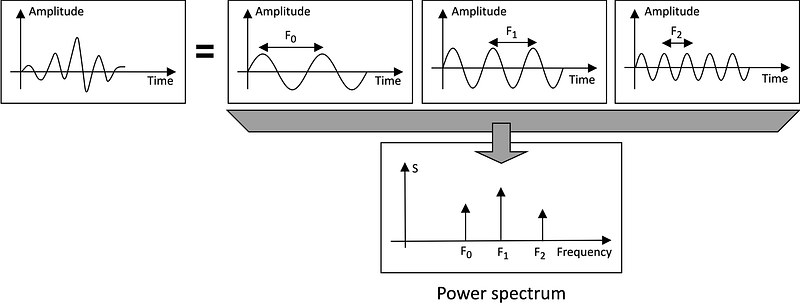
Representation of a signal in the frequency domain

The Future of TinyML

Looking ahead, the future of TinyML is promising, with advancements in hardware, algorithms, and software ecosystems. Innovations in ultra-low-power computing, such as specialized processors and energy-efficient neural network architectures, will further expand the capabilities of TinyML devices. Algorithmic improvements, like model pruning, quantization, and knowledge distillation, will enhance efficiency and performance. Moreover, the growing TinyML community is fostering open-source tools and frameworks that lower the barrier to entry, enabling more developers to create smart applications on low-power devices.
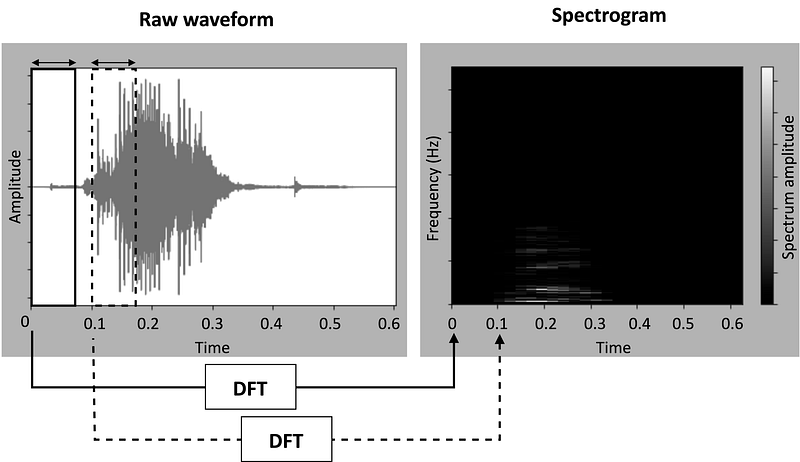
Audio waveform and spectrogram of the red utterance

Code

To illustrate TinyML in action, let’s create a Python example that involves generating a synthetic dataset, building a simple machine learning model suitable for TinyML applications, evaluating it with metrics, visualizing results with plots, and providing interpretations. This example will focus on a binary classification problem, which is common in many TinyML scenarios, such as detecting whether a condition is met (e.g., whether a sound is a specific word or not).

Step 1: Generating a Synthetic Dataset

We’ll use numpy and sklearn to generate a synthetic dataset for a binary classification problem.

from sklearn.datasets import make_classification
import numpy as np

# Generate a synthetic dataset
X, y = make_classification(n_samples=1000, n_features=10, n_classes=2, random_state=42)

Step 2: Preparing the Dataset

We split the dataset into training and testing sets to evaluate the model’s performance.

from sklearn.model_selection import train_test_split

# Split the dataset into training and testing sets
X_train, X_test, y_train, y_test = train_test_split(X, y, test_size=0.2, random_state=42)

Step 3: Building a TinyML Model

We’ll use a simple logistic regression model, which is lightweight enough for TinyML contexts. Though more complex models can be used, logistic regression serves as a good starting point due to its simplicity and efficiency.

from sklearn.linear_model import LogisticRegression

# Initialize and train the logistic regression model
model = LogisticRegression(max_iter=100)
model.fit(X_train, y_train)

Step 4: Evaluating the Model

We assess the model using common metrics for classification problems: accuracy, precision, recall, and F1 score.

from sklearn.metrics import accuracy_score, precision_score, recall_score, f1_score

# Predictions on the test set
y_pred = model.predict(X_test)

# Calculate metrics
accuracy = accuracy_score(y_test, y_pred)
precision = precision_score(y_test, y_pred)
recall = recall_score(y_test, y_pred)
f1 = f1_score(y_test, y_pred)

print(f"Accuracy: {accuracy:.2f}, Precision: {precision:.2f}, Recall: {recall:.2f}, F1 Score: {f1:.2f}")

Step 5: Visualizing Results

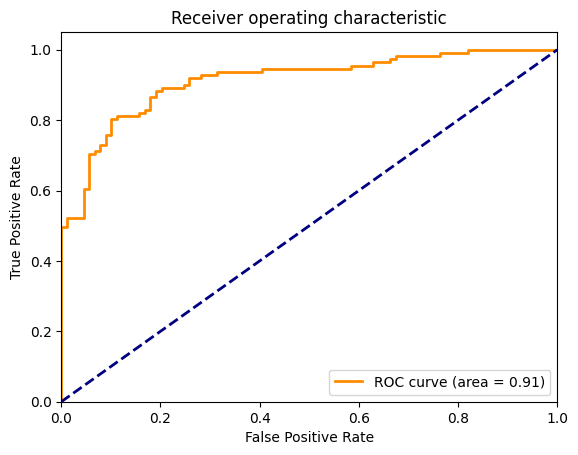
We can plot the ROC curve to visually assess the model’s performance.

import matplotlib.pyplot as plt
from sklearn.metrics import roc_curve, auc

# Compute ROC curve and ROC area
fpr, tpr, _ = roc_curve(y_test, model.decision_function(X_test))
roc_auc = auc(fpr, tpr)

# Plotting ROC curve
plt.figure()
plt.plot(fpr, tpr, color='darkorange', lw=2, label='ROC curve (area = %0.2f)' % roc_auc)
plt.plot([0, 1], [0, 1], color='navy', lw=2, linestyle='--')
plt.xlim([0.0, 1.0])
plt.ylim([0.0, 1.05])
plt.xlabel('False Positive Rate')
plt.ylabel('True Positive Rate')
plt.title('Receiver operating characteristic')
plt.legend(loc="lower right")
plt.show()

Interpretations

  • Accuracy measures the overall correctness of the model across both classes. A high accuracy indicates that the model is generally good at prediction, but it doesn’t tell us about the balance between the classes.
  • Precision tells us how reliable the model is when it predicts a positive class. High precision means that when the model predicts a positive class, it is likely correct.
  • Recall indicates the model’s ability to detect all actual positives. High recall means that the model captures a large proportion of actual positive cases.
  • F1 Score provides a balance between precision and recall. It is useful when you want to seek a balance between recognizing as many positives as possible (recall) and ensuring that the predictions are accurate (precision).
  • The ROC Curve and its area under the curve (AUC) offer a graphical representation of the trade-off between the true positive rate and false positive rate across different thresholds. A higher AUC indicates a better-performing model.
Accuracy: 0.83, Precision: 0.87, Recall: 0.82, F1 Score: 0.84
This example demonstrates a basic approach to implementing, evaluating, and interpreting a TinyML model. In real-world TinyML applications, considerations around model size, computation resources, and power consumption are critical, and more advanced techniques such as model pruning, quantization, and efficient neural network architectures may be necessary to deploy these models effectively on tiny devices.

Conclusion

In conclusion, TinyML is a transformative technology that marries the power of machine learning with the ubiquity of embedded systems, enabling intelligent applications on the smallest, power-constrained devices. By addressing current challenges and leveraging ongoing innovations, TinyML is set to play a pivotal role in the next wave of smart devices, making our interactions with technology more seamless, intuitive, and efficient.

A Message from AI Mind

Thanks for being a part of our community! Before you go:

Artificial Intelligence
Machine Learning
Deep Learning
Data Science
Technology
Recommended from ReadMedium