
Tiny Joys
Tiny Sorrows
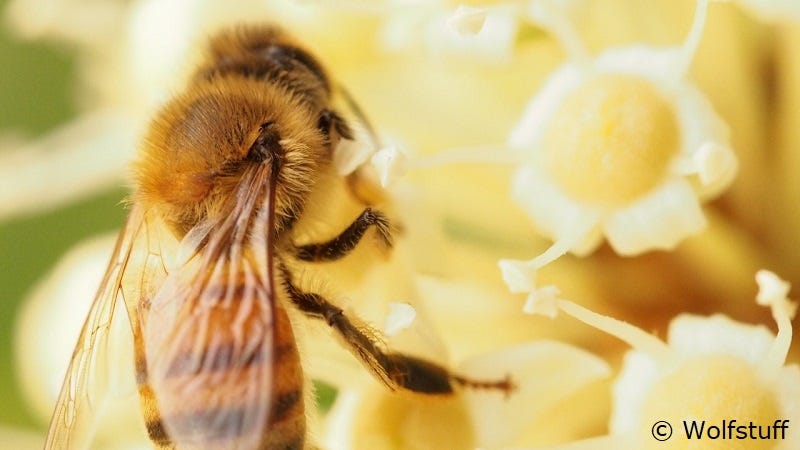
What do they live for the ants, the bees, the spiders? Small joys and sorrows
The principle Bodhisattva vow is to work for and secure the enlightenment of every single sentient being before he or she enters Nirvana him- or herself.
This, of course, is an amazingly gallant goal and undertaking, but it begs, for me at least, the incredibly crucial question: what, precisely, is a sentient being? And by that I mean: what delimits and defines a life form sufficiently aware to be considered sentient. How large? How small? Especially, how small?
Okay, human beings — I take that as a given. Giants and trolls, if they exist, would also be givens.
Animals, yes, givens as well. And that would include birds, fishes, the lot.
Insects, yes, they too are (in Buddhist scripture) considered sentient, individual beings, each and every one (and there are a lot of them buzzing, biting little beings).
How about plants? I mean trees actually communicate, don’t they? Grasses too, most likely. The Pali Canon, as best as I can make out, is silent on this topic.
How about cells? Here, too, the Canon remains mum — as well it probably should be.
Now, there is no doubt in anybody’s mind (I believe) that both plants and cells are alive — which is fifty percent of the sentient being criteria. Cells, by splitting, form colonies which sometimes take the form of plants, sometimes of internal organs, sometimes of brains, et cetera. They metabolize food and what they don’t use for their own growth they can convert to energy. Yes, they are indisputably alive. But what about sentient?
Here’s the definition of that word (according to the New Oxford American Dictionary): adjective, able to perceive or feel things.
Let’s take a look at another interesting definition: Killer T-cells find and destroy infected cells that have been turned into virus-making factories. To do this they need to tell the difference between the infected cells and healthy cells with the help of special molecules called antigens. This way Killer T-cells are able to detect cells with viruses and destroy them.
Let’s repeat the last sentence: This way Killer T-cells are able to detect cells with viruses and destroy them.
Which, obviously means that they are able to perceive things. So, since as cells they are alive, this makes a single Killer T-cell a sentient being, by definition. And by extension, I would thus venture to proclaim that all cells are, each and every single one of them, a sentient being.
How many cells in a human body? Mr. Google reports, “Scientists have concluded that the average human body contains approximately 37.2 trillion cells.”
That also bears repeating: Thirty-seven point two trillion cells. Each, by definition, a sentient being.
I think I may safely assume that the same would hold true for animal cells, and insect cells, et cetera. And then we have the plants, who also consist of living cells.
How many cells in a blade of grass? Some say millions. And how many blades of grass on our planet? Well, you’re welcome to count, then multiply that by millions to determine the number of sentient grass-cell beings.
Of course, this is only planet Earth. I’m pretty sure there is life elsewhere in this very, very large universe of ours, each habitable planet with a similar number of cells (e.g. sentient beings) would be my guess.
And here’s a thought: Does the oxygen atom perceive and recognized the hydrogen ditto and go: “Hey, honey, wanna make some water?”
There are a lot of lot of lot of lot of atoms around.
Bottom line: any given Bodhisattva, if each cell (or, heaven forbid, atom) is a sentient being, has a long, long road ahead of him or her.
I am not saying this to make little of the pledge, but to cast it in a not-quite-so-blind (or blinding, take you pick) light.
But when we talk of enlightenment, surely, we cannot talk of individual atoms. Can we even talk of individual cells? Lose three percent of your body weight (as in dieting) and you’ve made a trillion homeless cell spirits — all now in need of salvation, individually — and/or looking for other cell bodies?
No, I cannot believe that is the case. It would graduate a very improbable task (enlightening the universe) to an impossible, truly impossible task, and we might as well lie down this very moment and give up.
Okay, that was some digression, I’m here to talk about ants, bees, and spiders — and their reasons for getting up in the morning.
Is there such a thing as a happy spider, an embarrassed bee, a jovial ant? Is there ever a trace of what we humans would recognize as emotion in these little guys?
At times I’ve observed a lost ant desperately (it seems) looking for his pals, his nest, his home. He scurries this way and that and back again and then off to the left and, no, to the right, no left was probably it, then back again toward the wall which he now starts to climb, a foot, perhaps two before he, convinced by something, realizes this is not the way home. Or, does he know precisely where home is and he’s actually looking for food to bring back? Or is he looking for something else? Who, apart from other ants, possibly, can tell?
Regarding this ant, I don’t see happiness on the move though, or sadness. I see monotony on the move, a wind-up toy with a pulse.
Lift a log that’s been on the ground for a while, especially after the rain, and an alarmed colony of pill bugs shunning the light (they love the dark, apparently — the wet and dark) all roll up into little balls on cue. Now, how does the day appear to one of these little guys? Can they even tall day from night? I try to take the view of a pill bug and I cannot find a single reason to go on — unless there are happinesses and rewards in my pill-bug life that humans have no way of detecting or even imagining.
Or a blade of grass, or even an old and ever-stationary tree. Are they all biological wind-up toys, simply driven by nature’s edict to survive at all cost? Is there any other purpose, I mean personal purpose, in these existences? I cannot detect or imagine any, no matter how hard I look.
That said, animals a little higher up the food chain appear to love their young. A mama lion licking her cub seems to love him or her; a mama bear will kill anything that threatens her offspring — out of love, or just sheer instinct?
But the smaller the being, the less there seems to be any sort of recognizable emotion or purposeful aliveness present. Yet, I’ve read that cockroaches can befriend humans (prisoners in dirty cells, for one). I shake my head.
My question, though (as yet unanswered) is: do these little critters have a purpose recognizable by themselves as purpose. Do they know where they are going, what they are doing, and why? That, in my book, would make them sentient? Anything less than that, I’m not so sure it would qualify.
In fact, I think a good definition of sentient being might be a being who considers itself sentient — for it’d take sentience to do that.
© Wolfstutf
P.S. If you like what you’ve read here and would like to contribute to the creative motion, as it were, you can do so via PayPal: here.


