
Tiny Changes, Remarkable Results
Atomic Habits by James Clear: An easy and proven way to build good habits and break bad ones.
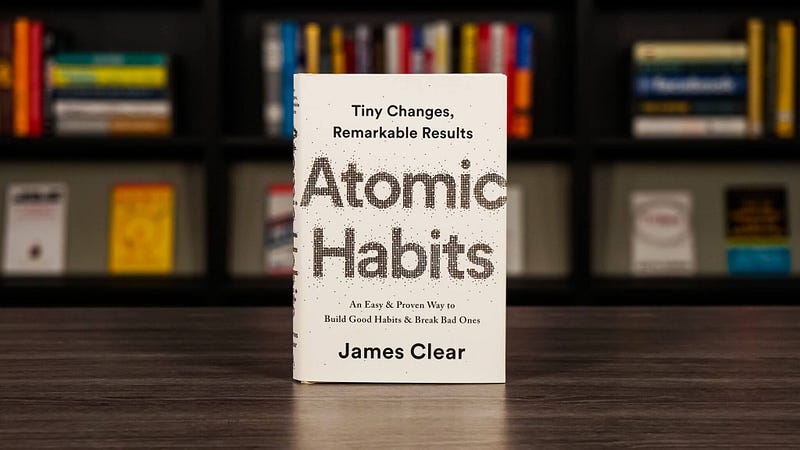
We persuade ourselves that enormous achievement necessitates massive action. We are conditioned to dream big and make radical changes. We put pressure on ourselves to accomplish some earth-shattering improvement that everyone will talk about, whether it’s losing weight, creating a business, publishing a book, winning a championship, or attaining any other objective.
But what if we might make significant changes to our lives by making minor modifications to our daily routines? What if we could consistently improve by 1% over a lengthy period of time?
The trick is to think of it as a compound effect: tiny daily practices over time add up to a cumulative consequence and improvements.
That’s what the book talks about — The power and Process of Building good habits and breaking bad ones.
Atomic Habits gives examples from education, history, business, and sports to show the scientific implications of how small habits can build into life-changing effects. The compound interest of self-improvement is habits. The impacts of your habits multiply as you repeat them, much like money multiplies through compound interest.
One of the best and few of my favorite parts of the book is
- The importance of 1% -37% Habit — Power of compound maths
James Clear emphasis in Atomic Habit — the effect of Compounding over a period of time, both negatively and positively. Do check out his video clip where he explained the 1% magic habit.
If we can get 1% better each day for a year, we will end 37 times better by the time we are done.{ similarly, apply this to a negative habit, if we can get 1% worse each day for a year, we will go zero on the scale).
The compound interest of self-improvement is habits. The impacts of your habits multiply as you repeat them in the same way that money multiplies through compound interest. They may appear insignificant on any given day, but their cumulative impact over months and years can be huge.
We are so conditioned in our society to seek instant pleasure — instant video, instant like, instant follower. The process makes it difficult to concentrate for long periods of time.
Small adjustments are frequently overlooked since they do not appear to have a significant impact at the time. We will never be millionaires if we only save a little money today. We will still be out of shape if we go to the gym three days in a row. Even if we study Mandarin for an hour tonight, we will not be able to communicate in the language. We make a few adjustments and expect immediate results.
As stated in the book — “Time magnifies the margin between success and failure”
Time will multiply whatever you feed it. Good habits make time your ally. Bad habits make time your enemy. the book highlights that habits often appear to make no difference until you cross a critical threshold and unlock a new level of performance.
We assume linear progress, yet the important feature of a compound equation/process is that the result is delayed. This causes our initial unhappiness, as we don’t feel like we’re progressing because the results don’t appear to be linear. As a result, we surrender! Because we aren’t achieving the results we seek, we underestimate the potential of compound interest in small good deeds every day.
- Focus on SYSTEM not GOALS
James Clear identifies a few problems with goal setting. In every sport, the goal is to finish with the best score, yet it would be absurd to spend the entire game watching at the scoreboard. The only way to truly win is to practice and improve every day. Forget about making goals if you want better results. Instead, concentrate on your system.
Goal planning suffers from a strong instance of survivorship bias, with winners and losers having the same aims. We focus on the ones who win — the survivors — and make the error of assuming that ambitious aims lead to their success while ignoring all of the people who had the same ambition but failed.
Goals are useful for setting a course, but systems are more effective for moving forward. When you spend too much time thinking about your goals and not enough time creating your systems, you’ll run into a few issues.
Work on implementing a system — a system of continuous small improvements that they achieved a different outcome. Hence, work on building small good habits every day.
Goals restrict our happiness. The problem with a goals-first mentality is that we continually put happiness off until we reach our goal. Personally, I’ve slipped into this trap so many times.
Happiness is something we may always hope for in the future. We make promises to ourselves that if we get 1000 followers or lose a certain amount of weight, we will relax or be happy.
We mentally confine ourselves to a limited definition of happiness. It’s doubtful that our actual path through life will be identical to the one we envisioned when we first began out. When there are so many ways to succeed, it makes no sense to limit our happiness to one situation. The antidote is a systems-first mentality. We don’t have to wait to give ourselves permission to be joyful when we fall in love with the process rather than the product. We can be satisfied at any time while our system is in operation. And a system can be successful in a variety of ways, not just the one you imagine.
The purpose of setting goals is to win the game. The purpose of building systems is to continue playing the game. True long-term thinking is goal-less thinking. It’s not about any single accomplishment. It is about the cycle of endless refinement and continuous improvement. Ultimately, it is our commitment to the process that will determine our progress.
If we’re having problems changing our habits, it’s not so much an issue with us as it is with our system. Bad behaviors repeat themselves over and over again, not because we don’t want to change, but because our system is broken.
One of the primary topics of “Atomic Habits” is the importance of focusing on the complete system rather than a particular objective.
Deeper meaning as well — A little alteration, a marginal gain, or a 1% improvement is referred to as an atomic habit. However, atomic habits are not just any old habits, no matter how minor. It’s a collection of small habits that make up a broader system. Atomic habits are the building blocks of amazing results, just as atoms are the building blocks of molecules.
Habits are the atoms that make up our lives. Each one is a critical component that contributes to your total progress. These small routines may appear inconsequential at first, but they quickly add up to huge wins that much outweigh their initial investment. They’re both little and powerful. This is what the term “atomic habits” means: a daily practice or routine that is not only little and simple but also a source of tremendous strength; a component of the compound growth system.