
Timothy Found a Tiny Tribe Performing Ritualistic Sacrifices Under the Plumbago Bush
From the short story collection: Twisted Tales to be Read Before Bed, Vol. 1
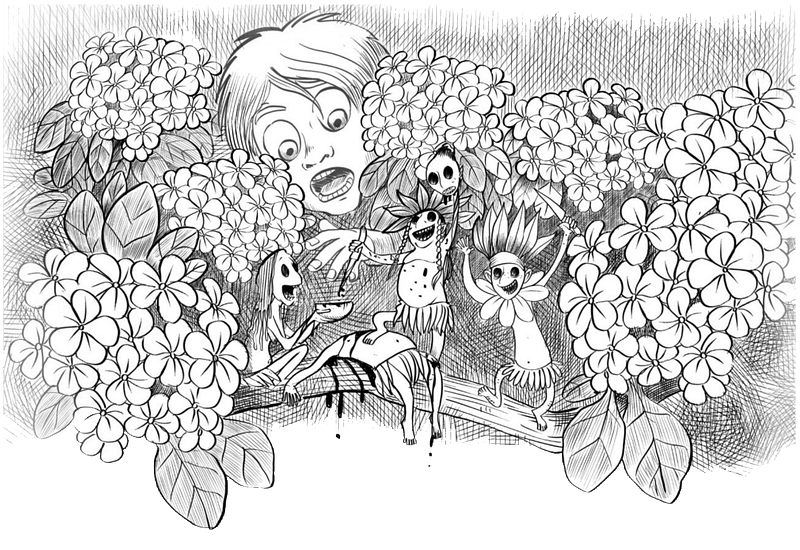
Surely, thought Timothy’s father, there must’ve been a time when they, as parents, had had the upper hand. After all, for some brief period of time in the beginning, presumably, Timothy had been unable to either walk, talk, or feed himself. However, Mr Humphrey could never quite seem to put memories to those times.
“Why don’t you ask Timothy,” Mrs Humphrey said with a slight roll of her eyes when Timothy’s younger sister had a question about her history homework.
And indeed, “Ask Timothy,” was a common refrain around the Humphrey household, the reason being that Timothy did indeed seem to know most things.
In fact, his parents often felt as though Timothy had somehow always known more than they had, and that they had been scrambling to catch up since the day of his birth.
Mrs Humphrey frequently found herself the recipient of compliments and commendations on behalf of Timothy and his extraordinary mind. And in that common (though rather insidious) way that parents have of rating themselves based on the merits of their children, she graciously accepted the praise and wore it proudly.
Privately, she couldn’t help thinking, however, that Timothy had rather too much of one thing, and perhaps not quite enough of another. (Though this was not something she shared with the other mothers.)
Among his own kind (school children, that is to say) Timothy was popular, though not well-liked. To say he was a know-it-all would’ve been something of an understatement.
And when some child would remark, “Ask Timothy — he knows everything,” Timothy would sagely respond, “No, Max. No one knows everything. How could they since new things are being discovered every day?” And all the kids would nod. Of course. You see? Timothy already knew that nobody knew everything.
But he knew almost everything. And Timothy himself would not have argued with that statement.
Knowing nearly everything meant that he was not weighed down by many of the fears that bothered other children. He tended to be more logical and pragmatic in his thinking than most children, and many adults.
And this mountain of his knowledge had a very solid foundation rooted in concrete, quantifiable, verifiable facts. Timothy understood that when something is dropped gravity pulls it toward the earth. And if this something — such as a helium balloon — does not drop, it is not a magical event, it is physics.
Timothy, of course, was not afraid of dark places, because he knew, without question, that monsters did not exist. The darkness beneath one’s bed at night was simply an absence of light, not a hiding place for malevolent things.
And so, he had no hesitation about slipping out of bed in the middle of the night to walk to the bathroom, whereas, many a child either held on till morning or ran as fast as they could for fear of what nameless horror might grab them in the dark.
In this sense, Timothy lacked imagination. While some children might dream of flying, he would roll his eyes at the absurdity of such an idea.
“Do you know how large your wings would have to be to lift your weight off the ground? There is a reason why birds’ bones are hollow.”
And he would shake his head in disgust. (Timothy had a particular knack for throwing obscure facts into a conversation, leaving others feeling woefully inadequate.)
One might’ve thought that his teachers would enjoy this bright student in their classes, and yet he had much the same effect on them, leaving them each feeling somewhat deficient, but not quite knowing why or what to do about it.
But, one cool day in early May, Timothy’s very practical and vast understanding of the world was about to be undone, a change that would come about as the result of something so very trivial. And yet, not trivial at all.
A baseball hit by Bill Bailey had soared over all their heads, cleared the park fence, and rolled into Mrs Wassermann’s garden. As the center fielder and the player closest to the ball, everyone looked to Timothy to retrieve it, which he did.
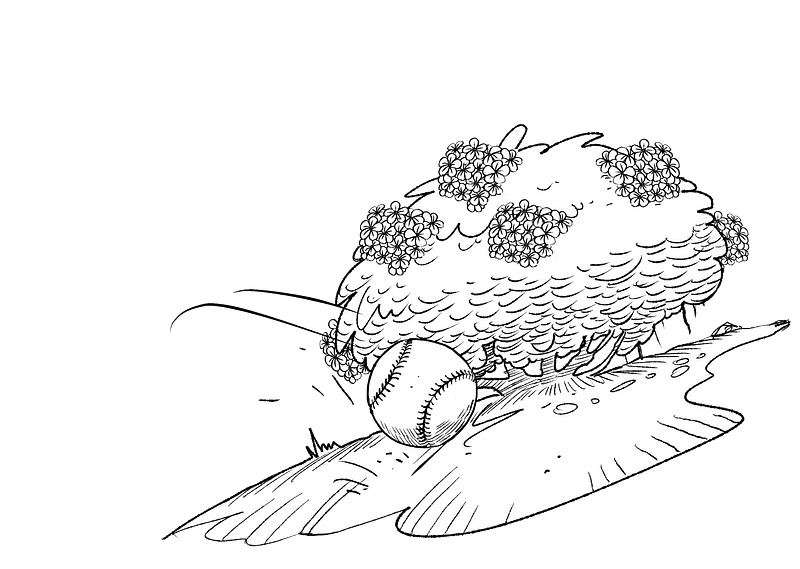
Whatever Timothy had expected to see when he parted the branches of the plumbago bush to locate the missing ball, it had not, most certainly, under any circumstances, been a tribe of tiny leaf-clad beings engaged in some sort of horrific ritual sacrifice.
Now, there are some things, which fall so far outside of the normal or expected, that it takes our brains longer to process them.
Upon first glance, even Timothy’s mighty brain could only take in a small piece of the scene before him, having already instructed him to grab the ball and run back, which he had begun to do before something clicked in his head.
He turned back and re-parted the bushes to confirm that what he had really seen was a collection of lost action figures scattered in the dirt.
However, the ball of tightly wound knowledge that had defined Timothy began to unravel, as a tiny tribesman looked up at him from within the bushes, smiled, and waved, as he proudly held up a small, dripping, decapitated head for Timothy to admire.
Timothy’s brain spun and whirred, trying in vain to find a place to put this piece of information which simply would not fit into any existing box, and which, by its very existence, called into question the veracity of the information stowed away in all of his other boxes.
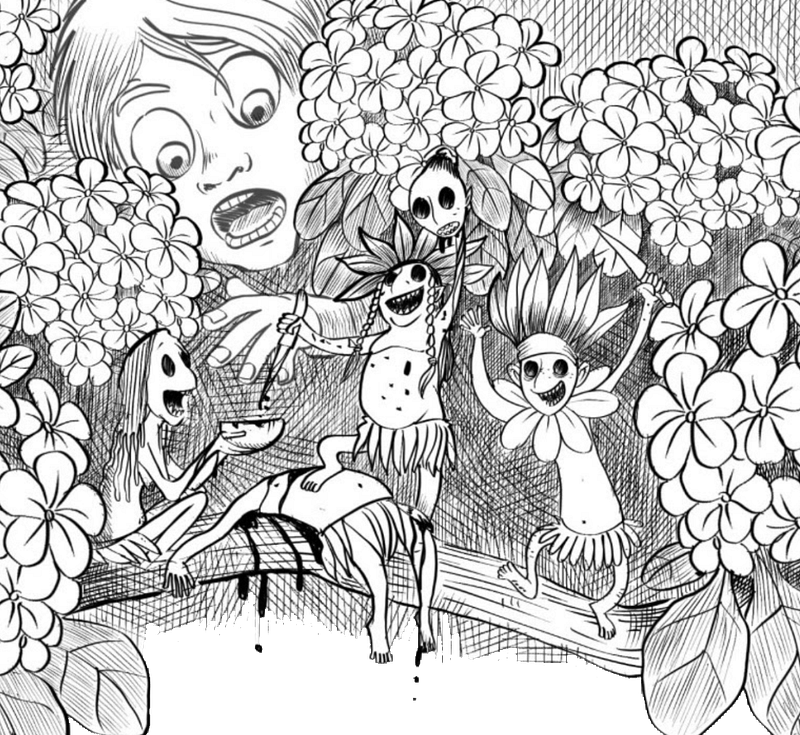
Was he the first person ever to have spied these small but bloodthirsty beings?
Or was he seeing things that weren’t there?
Did everyone know, but no one had told him? (This option seemed to him somehow more plausible.)
Perhaps the irrational fears of other children were not so irrational after all.
Perhaps he was the only one who didn’t know.
What else did he not know?!
By the time Timothy returned to the ball field, ball in hand and a dazed look upon his face, he was a very altered boy.
And for the rest of that afternoon, the other boys muttered to each other that although he might know “almost everything,” Timothy certainly didn’t know beans about playing baseball.
In the place where his mountain of knowledge had once stood, grew a very healthy hill of self-doubt, and though no one could quite say why in the months following, Timothy became less unpopular and much more likable.
For the rest of his life, Timothy would go about wondering if within every plumbago bush and geranium plant there didn’t dwell some as yet undiscovered species carrying out unspeakable sadistic rituals.
And he would never walk cavalierly to the bathroom in the dark of night again.
J. Bruzzese is an American writer living in California.