avatarDr Michael Heng

Free AI web copilot to create summaries, insights and extended knowledge, download it at here

4779

Abstract

irman Kim Jong Un and I (have) removed the shadow of war and resolved to usher in an era of peace and prosperity.”</b></p><p id="3bb1">Again on his<b> <a href="https://english1.president.go.kr/BriefingSpeeches/Speeches/75">1 October 2018 Address on the 70th Armed Forces Day</a>, </b>President Moon Jae-in reiterated that<b> </b>“announcing the Pyongyang Joint Declaration on September 19, Chairman Kim Jong Un and I made clear that <b>war would not come between the South and North, and peace would be settled on the Korean Peninsula.</b> Before 150,000 Pyongyang citizens, I promised a peaceful Korean Peninsula free of nuclear weapons and threats.”</p><p id="2401">For all intent and practical purposes, <a href="http://english.hani.co.kr/arti/english_edition/e_northkorea/867859.html"><b>true and genuine peace</b></a> has indeed returned to the Korean Peninsula. <a href="https://english1.president.go.kr/briefingspeeches/speeches/582"><b>Considerable progress</b></a> has also been accomplished on the various items in the <a href="https://www.ncnk.org/resources/publications/agreement-implementation-historic-panmunjom-declaration-military-domain.pdf"><b>Panmunjom Declaration</b></a>.</p><p id="55d9">However, the UN and its Security Council has yet to use their authority to remove the legacy anomalies of the Korean War, and to acknowledge the fulfillment of various resolutions again DPRK so as to finally <b>“restore international peace and security in the (Korean) area”</b> (<b>UN Resolution 83</b>).</p><p id="bba7">UN involvement in the Korean Peninsula had always been <a href="https://core.ac.uk/download/pdf/56353828.pdf"><b>controversial and even illegal</b></a> under its own Charter and international laws. Firstly, neither the DPRK nor ROK were UN members in 1950; they were only admitted into the UN in 1991. Secondly, even if they had been UN members, <a href="http://legal.un.org/repertory/art32.shtml"><b>Articles 32</b></a> and <a href="http://legal.un.org/repertory/art33.shtml"><b>33</b></a> of the UN Charter had provided for peaceful resolution through negotiations instead of enjoining and empowering other countries into the armed conflicts.</p><p id="3f85">The UN’s <a href="https://www.fordlibrarymuseum.gov/library/document/0337/24468967.pdf"><b>“illegal” intervention</b></a> under its auspices in a fundamentally civil war on the Korean peninsula embolden 16 other countries to supply military assets, equipment, resources and soldiers to the armed inter-Korea conflict in which none of these 3rd party belligerents had any actual direct or indirect strategic interests. In any case, the ROK did not sign the 1953 Korean Armistice which was only intended to be a temporary measure, and which failed to achieve any final agreement at the 1954 Geneva Conference.</p><p id="cf67">The 2018 Korean Peace Treaty as the <b>“final peace settlement”</b> between DPRK and ROK is the only definitive peace agreement that actually achieved the goal of the 1953 UN Korean Armistice to <b>“ensure a complete cessation of hostilities and of all acts of armed force in Korea (until a final peaceful settlement is achieved.)”</b></p><p id="9534">The immediate outcome of the 2018 Korean Peace Treaty is the dismantling of the United Nations Command (UNC) in the ROK. By satisfying the 1953 Korean Armistice, the Treaty effectively ended the “illegal” UNC mandate to establish UNC bases in the ROK and another 7 UNC bases in Japan. The UN Security Council has not taken steps to close the UNC in recognition of the 2018 Korean Peace Treaty as notified to the UN on 6 September 2018, even as they were later signed formally <b>AGAIN</b> on 18 September 2018.</p><p id="9216"><a href="https://www.linkedin.com/pulse/us-holds-key-unlock-korean-peace-dr-michael-heng-pbm/"><b>The US holds the key to unlocking</b></a> the full measure and benefits of the 2018 Korean Peace currently in slow but steady progress. The UN and the World should exert leadership in their Chartered responsibility to drive and assure success in the protocols of the Korean Peace accords.</p><p id="2894">In their <a href="https://en.wikipedia.org/wiki/2018_North_Korea%E2%80%93United_States_Singapore_Summit"><b>1st Singapore Summit</b></a> last year on 12 June 2018, US President Trump committed <b>to provide security guarantees</b> to the DPRK, and DPRK Chairman Kim Jong-Un reaffirmed his firm and unwavering <b>commitment to complete denuclearization</b> of the Korean Peninsula. US President Trump in fact declared that Pyongyang was <b><a href="https://www.cbsnews.com/news/trump-claims-end-to-nuclear-threat-from-n-korea-tells-u-s-to-sleep-well/">no longer a Nuclear Threat</a></b> after the 1st Singapore Summit, and canceled joint military exercises between the US and Sout

Options

h Korean Air Forces in the Korean peninsula. The US has not provided even a negotiating framework for the DPRK security guarantee as agreed with President Trump in Singapore.</p><figure id="e77e"><img src="https://cdn-images-1.readmedium.com/v2/resize:fit:800/1*Euwit4r8WJv8-yHjCrmw8Q.jpeg"><figcaption><b>Singapore Summit photo from www.kls.law.columbia.edu</b></figcaption></figure><p id="3591">Immediately after the 1st Singapore Summit, the DPRK dismantled its nuclear test and satellite launch site at <a href="https://en.wikipedia.org/wiki/Sohae_Satellite_Launching_Station"><b>Sohae</b></a> and shut down a long-range missile factory near Pyongyang. DPRK in fact has not conducted any nuclear weapon test or fired any inter-continental ballistic missile (ICBM) since 28 July 2017. The DPRK also released 3 US citizens arrested and imprisoned for alleged spying and returned the remains of 55 US soldiers killed in the Korean War. DPRK also ceased its domestic anti-US propaganda.</p><p id="7be9">As the other major signatory of the 1953 UN Korean Armistice, the <a href="https://www.theatlantic.com/international/archive/2018/11/north-korea-wont-denuclearize-reconciliation-moon-kim/576745/"><b>US however has been adamant and refused to acknowledge</b></a> the achievement of the “<b>final peaceful settlement”</b> referenced in the Armistice by the DPRK and ROK. The US has yet to formally proclaim the end of the “Forgotten” Korean War.</p><p id="b5d4">US insistence on DPRK denuclearisation is inconsistent with the 1953 UN Korean Armistice, which made no mention of denuclearisation nor had any UN Korean War resolutions made reference to the development of nuclear capabilities by either DPRK or ROK. Denuclearisation was never an integral part of peace efforts in the Korean Peninsula. The development of nuclear capability by the DPRK is not aimed at ROK which is not even a nuclear power. In all likelihood, the DPRK probably sees existential threats from the USA as well as other Korean War belligerents.</p><blockquote id="dabe"><p><b><i>Like many other countries facing real existential threats like Israel, Pakistan, India, China, Iran, United Kingdom, France, Germany, and even the US, nuclear capabilities have proven to be the only deterrent to war and the only strategic factor for continual peaceful existence.</i></b></p></blockquote><p id="c60a">The demand for DPRK denuclearisation should not, therefore, prevent the operation of the 2018 Korean Peace and unleash the abundant global <a href="https://www.linkedin.com/pulse/harvesting-korean-peace-dividends-dr-michael-heng-pbm/"><b>harvesting of resultant peace dividends</b></a> in social and economic prosperity by both countries as well as with their ASEAN and non-ASEAN neighbours, including the USA and Asia-Pacific countries.</p><h2 id="5dda">LET THE JOY OF PEACE POUR UPON THE KOREAN PENISULA.</h2><h2 id="bd86">Related Readings:</h2><p id="a057"><a href="https://www.linkedin.com/pulse/dawn-peace-dr-michael-heng-pbm/"><b>At The Dawn of Peace</b></a></p><p id="9762"><a href="https://www.linkedin.com/pulse/us-holds-key-unlock-korean-peace-dr-michael-heng-pbm/"><b>US Holds Key to Unlock Korean Peace</b></a></p><p id="54fa"><a href="https://www.linkedin.com/pulse/harvesting-korean-peace-dividends-dr-michael-heng-pbm/"><b>Harvesting Korean Peace Dividends</b></a></p><figure id="fb14"><img src="https://cdn-images-1.readmedium.com/v2/resize:fit:800/1*xz9PaDg4JUisd4wJpvij9g.jpeg"><figcaption>Illustration from www.ingpeaceproject.com</figcaption></figure><h2 id="6bd1">Please enjoy my recent Articles. You can also subscribe to my stories and social media posts via your email. Enjoy more interesting Articles by signing up to Medium here:</h2><div id="22bd" class="link-block"> <a href="https://thefuturistoracle.medium.com/membership"> <div> <div> <h2>Join Medium with my referral link - Dr Michael Heng</h2> <div><h3>Read every story from Dr Michael Heng (and thousands of other writers on Medium). Your membership fee directly supports…</h3></div> <div><p>thefuturistoracle.medium.com</p></div> </div> <div> <div style="background-image: url(https://miro.readmedium.com/v2/resize:fit:320/0*xLAt7dqcaRavN6-N)"></div> </div> </div> </a> </div><p id="5d6f"><a href="https://thefuturistoracle.medium.com/membership"><b>Please become a Medium Member</b></a> to directly support me and other writers you read. You’ll also get full access to every story on Medium. You can also receive an <a href="https://thefuturistoracle.medium.com/subscribe"><b>email</b></a> whenever I publish a story on Medium.</p></article></body>

Time to Embrace the Audacity of Peace

Why is the Korean Peace Treaty Denied and Forbidden?

Illustration by www.moviespree.com

The United Nations (UN), as well as many countries, would want to forget the “Forgotten War”. A ceasefire armistice was signed on 27 July 1953 to signal a temporary moratorium suspending hostilities to mark the beginning of Chosôn’s 65-year epic odyssey arriving at her final peace in 2018. A deafening sound of silence descended on the Korean “land of the morning calm (Chosôn)” at the 38th parallel on the Korean Peninsula to envelope it with the hope of lasting calming peace.

From 1950–1953, nearly 5 million people died in the fire, ice, and bloody conduct of war, with over half being the civilian population. With shattered hearts across the Koreas as separated families await the return of loved ones or their remains, the hope for that elusive peace, often just beyond their grasp, would persist and persevere for 65 years before real peace finally arrived at the Korean Peninsula in 2018.

Amnesia struck most of the distinguished Diplomatic Corp at the UN. Very few dared to remember the morning on that fateful 27 July day in 1953. A beautiful sound filled the summer air then. With gunfire echoed from yesterdays at a faint distance, birds had returned to make music as they soar the skies now empty of warplanes.

In April 2018, the Democratic People’s Republic of Korea (DPRK) and the Republic of Korea (ROK) formally concluded the historic Korean Peace Treaty committing to perpetual peace and no war. The audacity of peace in the Korean peninsula has arrived.

However, never in the history of the UN and the world has the dawn of the Korean Peace in 2018 been more regrettable or treated with greater forbidding.

The 2018 advent of Korean peace was greeted with great forbearance and reluctance, even denied and forbidden, by the UN and major news media across the globe. No cheers, no fireworks, no cigars, and no congratulations. Like the birth of an unwanted pariah so gross and offensive to be disowned, discarded, and forsaken.
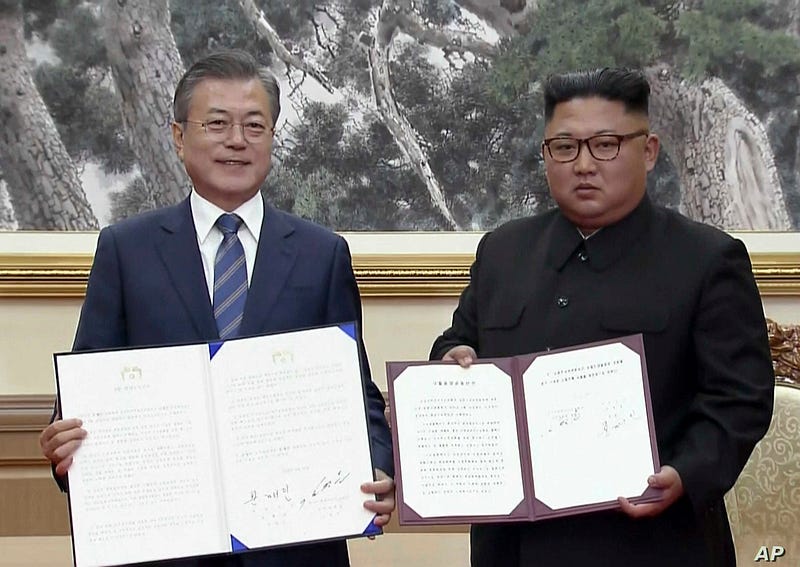
Photo by Associated Press — Signed Korean Peace Treaty

On 27 April 2018, DPRK Leader Kim Jong-un and ROK President Moon Jae-in signed the Panmunjom Declaration for Peace, Prosperity and Unification on the Korean Peninsula to commit their countries to ending the Korean War formally. On 18 September 2018, they converted the Historic Panmunjom Declaration into a full-ledged Peace Treaty to end the Korean War formally after 65 years.

The Panmunjom Documents were also formally submitted to the UN General Assembly on 6 September 2018.
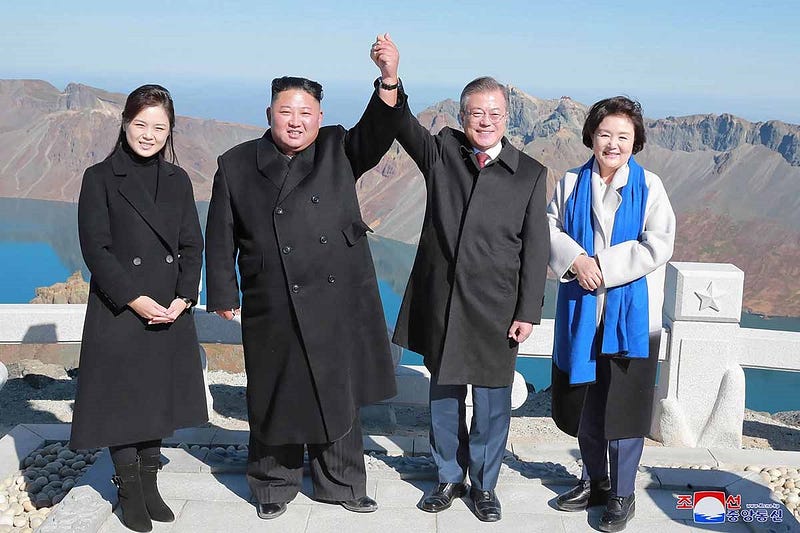
Photo by Agence France-Presse AFP — On the sacred Mt Paektu after signing the Peace Treaty

In separate speeches, Chairman Kim and President Moon promised a new era. Addressing the world’s media live on television for the first time, Chairman Kim said the Koreas “will be reunited as one country”. President Moon said: “There will not be any more war on the Korean peninsula”. At Checkpoint Charlie near the 38th parallel where they concluded the Korean Peace Treaty, Chairman Kim recorded that “a new history begins now” at “an age of peace, at the starting point of history”.

On 26 September 2018, President Moon in his Address to the 73rd UN General Assembly reported that “Chairman Kim Jong Un and I (have) removed the shadow of war and resolved to usher in an era of peace and prosperity.”

Again on his 1 October 2018 Address on the 70th Armed Forces Day, President Moon Jae-in reiterated that “announcing the Pyongyang Joint Declaration on September 19, Chairman Kim Jong Un and I made clear that war would not come between the South and North, and peace would be settled on the Korean Peninsula. Before 150,000 Pyongyang citizens, I promised a peaceful Korean Peninsula free of nuclear weapons and threats.”

For all intent and practical purposes, true and genuine peace has indeed returned to the Korean Peninsula. Considerable progress has also been accomplished on the various items in the Panmunjom Declaration.

However, the UN and its Security Council has yet to use their authority to remove the legacy anomalies of the Korean War, and to acknowledge the fulfillment of various resolutions again DPRK so as to finally “restore international peace and security in the (Korean) area” (UN Resolution 83).

UN involvement in the Korean Peninsula had always been controversial and even illegal under its own Charter and international laws. Firstly, neither the DPRK nor ROK were UN members in 1950; they were only admitted into the UN in 1991. Secondly, even if they had been UN members, Articles 32 and 33 of the UN Charter had provided for peaceful resolution through negotiations instead of enjoining and empowering other countries into the armed conflicts.

The UN’s “illegal” intervention under its auspices in a fundamentally civil war on the Korean peninsula embolden 16 other countries to supply military assets, equipment, resources and soldiers to the armed inter-Korea conflict in which none of these 3rd party belligerents had any actual direct or indirect strategic interests. In any case, the ROK did not sign the 1953 Korean Armistice which was only intended to be a temporary measure, and which failed to achieve any final agreement at the 1954 Geneva Conference.

The 2018 Korean Peace Treaty as the “final peace settlement” between DPRK and ROK is the only definitive peace agreement that actually achieved the goal of the 1953 UN Korean Armistice to “ensure a complete cessation of hostilities and of all acts of armed force in Korea (until a final peaceful settlement is achieved.)”

The immediate outcome of the 2018 Korean Peace Treaty is the dismantling of the United Nations Command (UNC) in the ROK. By satisfying the 1953 Korean Armistice, the Treaty effectively ended the “illegal” UNC mandate to establish UNC bases in the ROK and another 7 UNC bases in Japan. The UN Security Council has not taken steps to close the UNC in recognition of the 2018 Korean Peace Treaty as notified to the UN on 6 September 2018, even as they were later signed formally AGAIN on 18 September 2018.

The US holds the key to unlocking the full measure and benefits of the 2018 Korean Peace currently in slow but steady progress. The UN and the World should exert leadership in their Chartered responsibility to drive and assure success in the protocols of the Korean Peace accords.

In their 1st Singapore Summit last year on 12 June 2018, US President Trump committed to provide security guarantees to the DPRK, and DPRK Chairman Kim Jong-Un reaffirmed his firm and unwavering commitment to complete denuclearization of the Korean Peninsula. US President Trump in fact declared that Pyongyang was no longer a Nuclear Threat after the 1st Singapore Summit, and canceled joint military exercises between the US and South Korean Air Forces in the Korean peninsula. The US has not provided even a negotiating framework for the DPRK security guarantee as agreed with President Trump in Singapore.
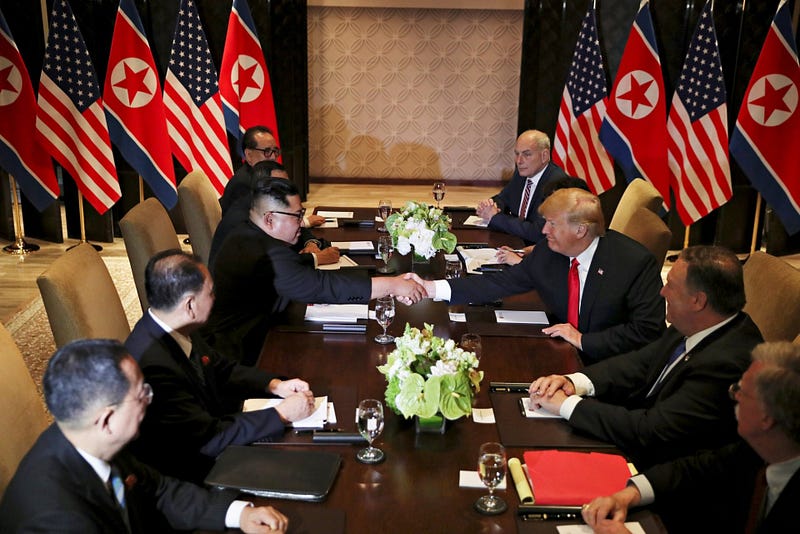
Singapore Summit photo from www.kls.law.columbia.edu

Immediately after the 1st Singapore Summit, the DPRK dismantled its nuclear test and satellite launch site at Sohae and shut down a long-range missile factory near Pyongyang. DPRK in fact has not conducted any nuclear weapon test or fired any inter-continental ballistic missile (ICBM) since 28 July 2017. The DPRK also released 3 US citizens arrested and imprisoned for alleged spying and returned the remains of 55 US soldiers killed in the Korean War. DPRK also ceased its domestic anti-US propaganda.

As the other major signatory of the 1953 UN Korean Armistice, the US however has been adamant and refused to acknowledge the achievement of the “final peaceful settlement” referenced in the Armistice by the DPRK and ROK. The US has yet to formally proclaim the end of the “Forgotten” Korean War.

US insistence on DPRK denuclearisation is inconsistent with the 1953 UN Korean Armistice, which made no mention of denuclearisation nor had any UN Korean War resolutions made reference to the development of nuclear capabilities by either DPRK or ROK. Denuclearisation was never an integral part of peace efforts in the Korean Peninsula. The development of nuclear capability by the DPRK is not aimed at ROK which is not even a nuclear power. In all likelihood, the DPRK probably sees existential threats from the USA as well as other Korean War belligerents.

Like many other countries facing real existential threats like Israel, Pakistan, India, China, Iran, United Kingdom, France, Germany, and even the US, nuclear capabilities have proven to be the only deterrent to war and the only strategic factor for continual peaceful existence.

The demand for DPRK denuclearisation should not, therefore, prevent the operation of the 2018 Korean Peace and unleash the abundant global harvesting of resultant peace dividends in social and economic prosperity by both countries as well as with their ASEAN and non-ASEAN neighbours, including the USA and Asia-Pacific countries.

LET THE JOY OF PEACE POUR UPON THE KOREAN PENISULA.

Related Readings:

At The Dawn of Peace

US Holds Key to Unlock Korean Peace

Harvesting Korean Peace Dividends
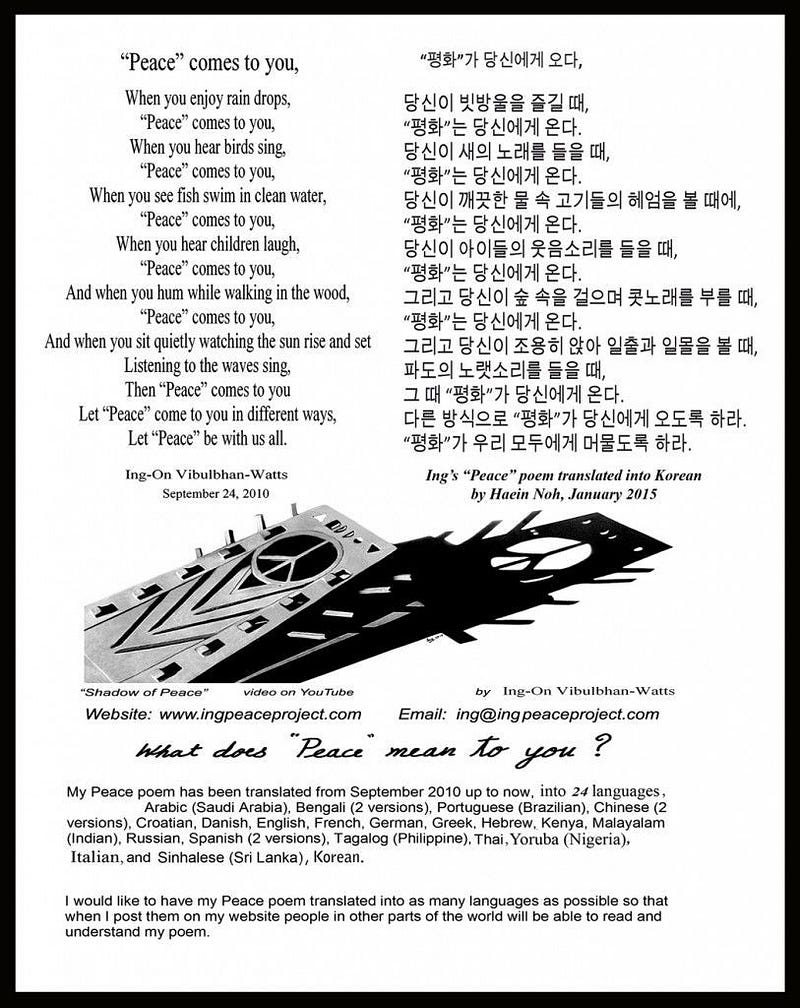
Illustration from www.ingpeaceproject.com

Please enjoy my recent Articles. You can also subscribe to my stories and social media posts via your email. Enjoy more interesting Articles by signing up to Medium here:

Please become a Medium Member to directly support me and other writers you read. You’ll also get full access to every story on Medium. You can also receive an email whenever I publish a story on Medium.

Peace
Leadership
Politics
Korea
USA
Recommended from ReadMedium