
‘Time Shelter’ (2023) By Georgi Gospodinov
Winner of The International Booker Prize 2023
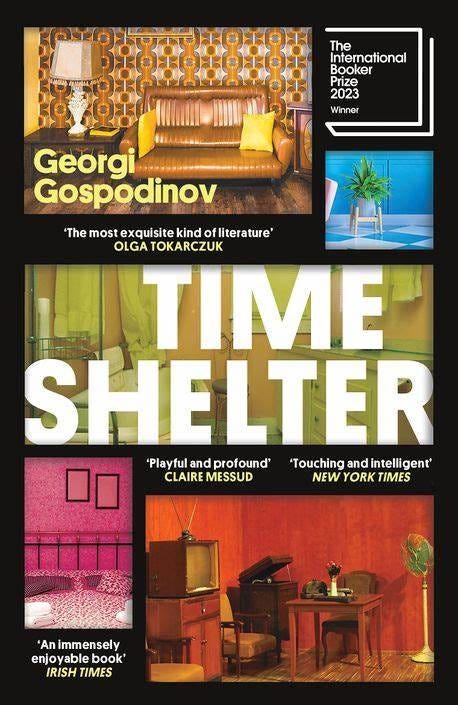
“It’s well known that our inept homegrown police of all eras have always shown unerring taste in poets and writers — they always manage to kill the most talented and leave the most mediocre.” ― Georgi Gospodinov, Time Shelter
“When you have no future, you vote for the past.” ― Georgi Gospodinov, Time Shelter
Time Shelter is Bulgarian writer Georgi Gospodinov’s third novel, and for all its focus on the recreation and immersion in the past, it could not be more timely.
A mysterious therapist, Gaustine, founds a clinic that treats patients with Alzheimer’s by rebuilding the functional past in which they felt most secure. Gaustine begins with rooms and then whole floors until it becomes a “past clinic” within a hospital of nostalgia. A living, working, memory palace of precision and an obsessive’s eye for detail.
There are archive magazines, particularly branded cigarettes, lamp shades, and the all-important wallpapers for each era. Gaustine has created time shelters where patients can return to their most cherished memories and in “safe spaces” heal their traumas and hopefully repair a disintegrating memory.
This reveals many interesting tales of the occupants but the real point is as a framing device for Gospodinov’s narrator to explore the 20th century in Europe through the vanishing points of traumatized or broken individuals.
It reminds me of the framing device in One Thousand and One Nights where Scheherazade tells a story every night to Shahryār a “Sasanian king” to stop him from executing her as he has all the virgins he married after his wife’s infidelity. Each individual in their time shelter is a story and a tale told by Gospodinov. Like the tales told by Scheherazade, this involves the ‘story within a story’ or the embedded narrative technique.
The clinic is so successful that clients with no ailments gravitate toward it. Gaustine imagines towns and cities fixed in particular eras; soon, whole countries want to emulate his idea. Across Europe, political parties promote different decades in their national histories. I am unsure if this is now art imitating life or life imitating art.
What is both brilliantly imaginative and yet politically uncanny is that eventually Referendums are fought on what particular past a country’s future will look like. Back to the future?
One only has to look at those Union Jacks flying and multiplying everywhere in Whitehall and England, the anti-Russian and anti-Chinese rhetoric, and the newly built aircraft carrier Queen Elizabeth II speeding through the South China Sea in 2017 and warned by China, to have an unpleasant reminder of Britain’s colonial past.
Differentiating the past from memory is an essential theme in the novel. When these are combined in the present then they are neither the past nor a memory but a new historical re-creation for the ideological requirements of the dominant political power. The victors not only write the past/history they also re-write the past/history. A person’s memory may be the only truth left. And that can be unreliable too.
Time Shelter was written between the Brexit referendum and the Russian invasion of Ukraine, both of which represent, in their distinctive ways, the modern nation-state’s use of nostalgia — and history — as a psychological and political weapon through the selection of particular eras in the time clinic of the rapidly changing and not-so-new world order.
True to form, Gospodinov finds humour in the bleakness as do so many writers from East European countries and ex-Soviet colonies. In one of the book’s many dark jokes, a Romanian patient finds solace in remembering not what he experienced but what he fantasized about, a life in the US. Although that is rather ironic now given that one is free to do exactly that.
Gospodinov is like a Bulgarian George Orwell and Franz Kafka hybrid as this tale has elements of 1984 running through it but with the absurdity and humour of Kafka.
The narrator bears close relation to Gospodinov himself: a Bulgarian, born in 1968, who has a memory of communism but the author’s coming-of-age is more in the fall of communism and the disintegration of a political Empire. This is where Time Shelter is born in the traumatic meeting between past and present. It is here where the ghost of communism resides. It haunts the novel like the ghost of Hamlet’s father.
We need to beware of nostalgia today as it is being utilized not to provide fictional succour or mental lifeboats for traumatized and damaged people but as a real psychological and cultural weapon in the pursuit of power and the memory of reimagined ahistorical Empires in the West and in the East.


