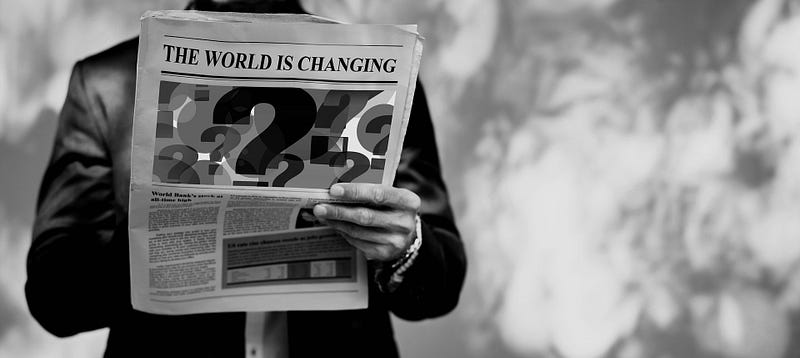
Time for Strategic Continuous Transformation
“Change, or Die” is the Classic Timeless Choice

Long-term business survival requires continuous business reviews, reinvention, and recalibration. The top business leaders’ role is to manage change by reinventing their companies, in a timely manner. The decision to embark on strategic transformation is perhaps the toughest and most challenging leadership decision above all else. It is the tipping point of disruptive action that determines the enduring competitive advantage of lasting successful companies, or corporate demise. A legacy profitable business model does not guarantee its future relevance.
In an article to the HBR, the authors pointed out that five interrelated “fault lines” can indicate that the ground beneath a company is unstable and that it’s time for radical change. The authors’ fault line framework addresses the following basic issues:
1) what is the current business space?
2) whether the business serves the right customers,
3) whether the right performance metrics are used to properly position in its industry,
4) whether the correct business model is deployed, and
5) do employees and partners possess the capabilities for future success?
The framework builds a case for urgent change and to persuade stakeholders to support the decision. The outcome is an organisation-wide effort that translates to tangible value-added changes for customers. And by identifying gaps between an organization’s current state and where it needs to be to continue to thrive, it can clarify and update the vision of how the company must transform to remain viable.
Within just 6 months, an organisation, Aetna, was able to execute the necessary recalibration and reconfiguration to create the necessary internal buy-in through a unified vision of what and who the company is and wants to be. Intensive employee engagement efforts successfully establish the unified belief in the new corporate strategy. They mobilise employee commitment by explaining priority initiatives as well as factoring in employee feedback and insights, using a variety of evaluation, validation, and measurement tools.
The fault lines in organisational transformation provide clarity to overcome the inevitable roadblocks and speed bumps along its long learning journey. Clear consistent vision and business purpose embolden leaders with confidence to frame their challenges in a manner to empower stakeholders to enjoin in the change process long before the situation and business conditions become dire.
READ THE FULL STORY IN THE DECEMBER 2015 ISSUE OF HBR
Please enjoy my recent Articles.
You can also subscribe to my stories and social media posts via your email.
Enjoy more interesting Articles by signing up to Medium here: https://thefuturistoracle.medium.com/membership