
Time: Didn’t Exist before Life
Life creates time.
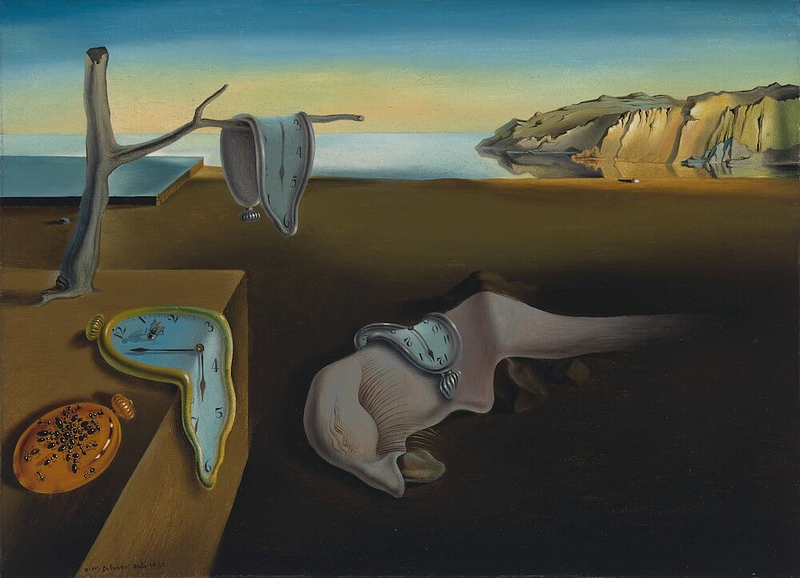
Time is an invented tool of the mind. The mind paints moments onto a canvas to record events in a fixed order. Moments themselves are timeless.
Time does not exist without the mind.
Time only exists in the mind.
We build clocks, nature does not
Nature does not mark time. We interpret natural and created changes as markers of time. Natural atomic events and manufactured gear movements become our clocks.
Nature does not add any meanings or interpretations.
We call a thing a clock and interpret it to track our invented time.
Space-time is imaginary
The brilliant theory of relativity teaches us that time slows as speed increases or gravity grows. However, this is really an observation that all our clocks are slowing down under those conditions. To our minds, even we are clocks.
The theory describes the relative slowing of physical event sequences. We interpret this slowing as the slowing of time. The slowing physical events and the warping space are real. The time is not.
Space-time is an invented tool like an imaginary number is in mathematics. The tool helps us understand real things, but it is not itself real.
Sequences birth our consciousness
Descartes once said, “I think therefore I am.” We can also say “I think because I am.” There is no consciousness without thinking because the “I” in you and me is a thought.
The causal series of electrochemical cascades inside a biological mind spawn emergent thought and consciousness. A rational sequence is fundamental for a mind to function. Disordered sequences become mental malfunction, confusion.
Order is crucial for coherent thought and time was invented as a scaffolding for holding that coherence.
Our natural brains, made of stardust and galactic debris, spawn emergent consciousness from the unconscious meaningless phenomenon that drives the clockwork in our heads.
The invention of time makes organized deliberate thinking practical.
When we evict time we disappear
Our perception of time, because time is our invention, slows and speeds up with our thoughts. We can lose track of time when we lose ourselves in thought.
When we mindfully live in a moment we lose worry and we lose anticipation. Losing time loses us.
Meaning and time are connected
Our invented idea of time becomes the soil into which we plant the seeds of meaning. Meaning has substance, even just as an idea, only when we can compare moments to each other. And comparing moments requires the construct of time; the recognition of before now and later.
Events have meaning only when we see them as influencing the future or having been influenced by the past.
We are blind to the universe without time
We become aware of environmental event sequences only when we archive them into a chronology.
There can be no environmental sequence we understand without chronology. None we can predict without a timeline transforming initial conditions into their outcomes.
We see the universe through the pieces we chronicle, witnessed or cleverly imagined by our minds.
The universe is richer through us
We exist because we invented time. Ideas hold form by draping on the scaffolding of our time.
When we live exclusively in a moment we lose worry and we lose anticipation. Expanding to embrace the idea of yesterday and tomorrow creates the substrate for meaning and the fertile soil in which emotion can grow. We become real in this time-created space.
The natural world has always cascaded its infinite moments, and will do so forever whether we catalog the event chains or not. This was true before the first biological mind invented time.
Events will continue after the last mind goes dark.
Without a mind, the universe is timeless and unaware of itself as it blindly marches on. Through us, moments of beauty, otherwise lost, are discovered and appreciated by the attention we bring with our limited imaginary time.


