
TikTok Is Just a NAB Cart
What is old is new again
I’ll say it again: TikTok is just a NAB cart. A NAB cartridge, get it? No? Then I’ll explain with a history lesson, but in the story style of Joe Rohde, I’ll start at the end and work backward so we can trace the roots.
You probably know what TikTok is or you wouldn’t be reading this but to illustrate, I will distill the platform to its essence. TikTok is a method of broadcasting short-form content from one (or a few) to many (thousands). Filters, stitching, duets, and effects are the window dressing on this base functionality.
If we strip away all those fun tools and toys isn’t this just Vine? I would say yes, with a grain of salt. Vine lacked many of the features of TikTok but more importantly, it was not invested in as a stand-alone product. Vine was sold off to Twitter but was never integrated. Without a clear path to producing revenue, it was left to die on the vine.
Looping Short Form Video
In 1970 the RCA TCR-100 Videotape Cartridge System stepped into the control room with a carousel of tape cartridges. The cassettes held between 30 seconds and 3 minutes of tape but were most commonly loaded with 30 second and 1-minute “spots”. Switching between content streams was not done with TikTokian swipes but by signals from the TV station’s master control. This $160,000 machine could hold 22 carts and contained two playback mechanisms to play commercials seamlessly during “station breaks” (the only thing breaking was the program being aired). As a high school intern at the local NBC affiliate, I was captivated by the clicks, clacks, whirs, and buzzing that came from the electromechanical innards as it shuttled and loaded red boxes. It seemed like something borrowed from the Star Trek engineering room.
This sales reel for the TCR-100 shows how the machine was ground breaking for TV stations but today it is more amusing for the narrator’s fashion.
Today nobody interrupts your TikTok viewing to do “station identification” but the ads are still there, on a carousel, looping in 30 to 60-second increments.
The Birth of Looping Short Form Playback
Until 1954 recorded media was a single continuous analog data stream wound in a spiral. Wire recorders, record disks, and reel-to-reel tapes all required rewinding or resetting the record player having the most flexibility since you can lower the tonearm anywhere. Some record players for home use had mechanisms for resetting the tonearm for continuous play and even dropping a sequence of disks onto the platter. These mechanisms were good selling points for early consumer electronics, but broadcast quality demanded simple queuing, quick start/stop, a good labeling surface, and high-quality audio. The Fidelipac cartridge filled these needs and was heavily used for three decades.
The Fidelipac was a brand name for the NAB (National Association of Broadcasters) Cartridge and was commonly called a “NAB cart”. The cart housed a spool of 1/4 inch audio tape that was pulled from the center of the spool, passed over a padded spring to ensure contact with the read/write heads, and then wound back onto the outside of the same coaxial spool. The rubber pinch roller that drives the tape remained part of the player and would swing up through a hole in the bottom of the cart to pinch the tape against the motorized capstan thus driving the tape forward.
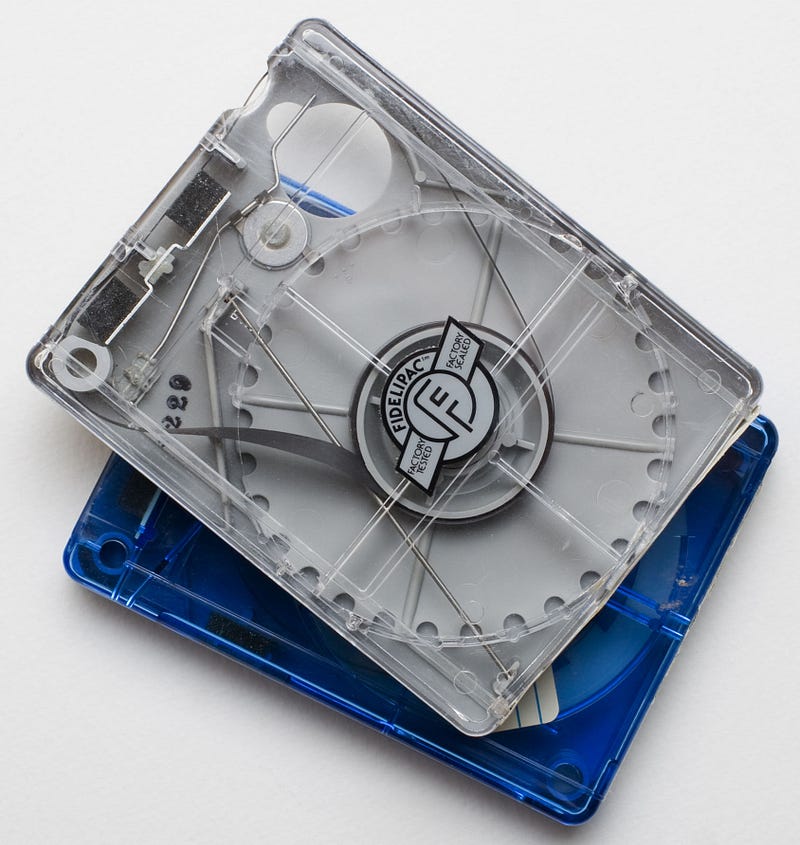
Just like TikTok these cartridges could be played, stopped, and resumed but never rewound. To hear the content again, you have to let it play through to the start of the loop. Cue tones on a second track let the player know where the end/start was. Later versions included stereo audio and additional cue tones for fast-forwarding from the end of the program material to the start point.
Older folks and history buffs reading this might think this is an 8-track tape. In fact, the 8-Track was a later variant of this technology with a few key differences (that made it much worse):
- Tape speed was half as fast at 3 3/4 IPS, lowering the fidelity of high notes.
- The tape thickness was often thinner than broadcast quality making it susceptible to warping, print-through, and the worst horror of all: Getting eaten by the player.
- The rubber pinch roller was part of the cassette, so it would tend to dry out in a hot car and slip (the results could be quite psychedelic).
- The 1/4" tape had 4 stereo tracks allowing switching between tracks (called programs) but it would leave you in a random spot within that track.
- Splitting two sides of an LP into 4 parts made some tracks span tracks (or programs) leaving a significant gap of silence in the middle of a song.
- To fit 8 tracks on the tape reduced the width of the track to 1/32". A track that narrow and moving so slow will have the quality of a dixie cup telephone.
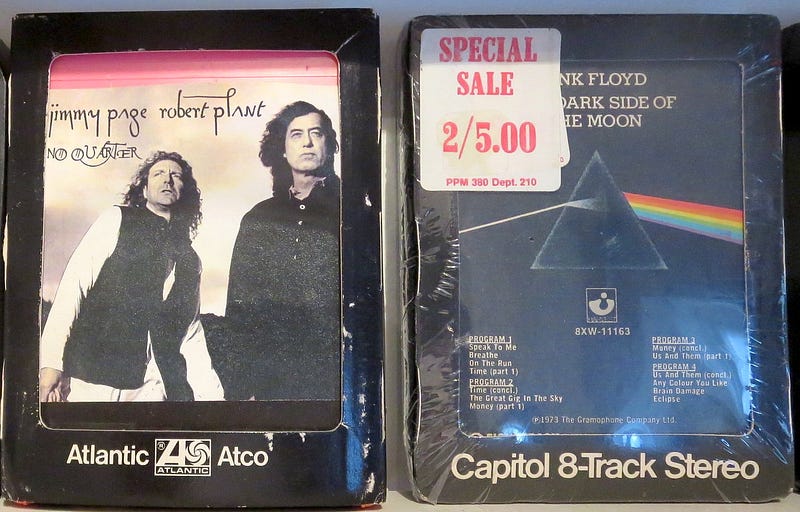
Despite all these shortcomings, it was the lack of rewind that killed the 8-track.
“Hey man, I love Pink Floyd, play ‘Time’ again.” — fast-forwarding at 2x through 1/4th of the album — “Dude, never mind, I hear ‘Money’ on the radio”.
Even if technology changes, there remains a thread of ideas spanning back through history.


