
Mental Health Awareness
TikTok Is Altering The Behavior Of An Entire Generation
The misuse of social media apps like TikTok during teenagehood impacts brain development. It is worrisome.
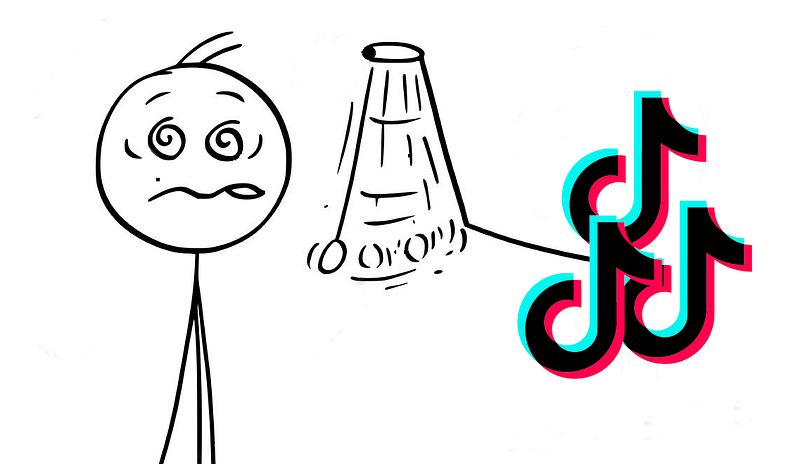
Depriving teenagers of one of their favorite pass times, including social media apps like TikTok could potentially harm mental health in the short term, but it will certainly be a good thing in the long run, especially for upcoming generations.
TikTok, a Video-Sharing App
In 2016, the company ByteDance released Douyin, a lip-syncing app. It was dedicated to the Chinese market only. Facing unexpected success with several million downloads, ByteDance decided to expand Douyin at the international under the name of TikTok. The success was again instantaneous and tremendous.
Millions of teenagers started filming themselves dancing and singing on well-known artists’ songs. So much fun between real and virtual friends. Hours and hours spent on the screen looking at physical details. Hours and hours spent on choosing the right filter to correct the natural imperfections. Hours and hours spent comparing themselves to photoshopped supermodels and filtered individuals.
Having fun is fantastic and has a lot of health benefits. TikTok contributes to it in many ways. However, expert psychologists and psychiatrists are really concerned about the dark side of TikTok, the tip of social media’s and the internet’s iceberg’s impact on mental health.
The Dream to Become a Star
During our teenagehood, we certainly all dreamed to become famous. Watching gorgeous and talented actors and actresses like Brad Pitt, Johnny Depp, or Jennifer Aniston and Courtney Cox, on the screen, any of us would love to think “one day it could be me”.
But the reality was that to end up on the radar of recruiters, we almost exclusively had to go to the nearby big city, register for castings, and wait for our turn in the never-ending lines. Nowadays, technology brings the casting crew to our place.
Social media platforms like TikTok give exposure to a wide audience, and this, from our living room. We may think that the likelihood to become a star increases under such circumstances, but social media visibility algorithms make it unrealistically difficult. Very few lucky individuals make it that far, and it usually comes with a cost.
When mister or miss nobody becomes the center of interest of millions of people, his/her life takes a new, and sharp, turn. All of a sudden, people inject countless money, gifts, and opportunities into their daily life. It becomes a new normal. So normal, that they are slowly losing their empathy for others. New stars start caring for only one unique person — themselves. So normal that it becomes inconceivable to not be looking at, even if it’s just for a short period of time. This is when they realized that they are on the addiction spectrum, and it can’t be healthy.
This pattern has been well characterized. Experts said there are four well-recognized temporal phases occurring in celebrities’mind e.g. love/hate, addiction, acceptance, and adaptation phases. A well-grounded adult has already a hard time dealing with it. We can easily imagine the delicate situation for an adolescent. Indeed, this pattern occurs in only a few newly famous group of people. But regarding the rest of the population i.e. millions of users, that keep restlessly trying to reach a glory moment, other issues are emerging.
Teenagers’ Experiences
Under 25 years old, neuroscientists estimate that the prefrontal cortex of the brain is still in development. This region is particularly important as it builds and defines a self. The prefrontal cortex is receiving inputs from several areas of the brain, including the limbic system, guardian of emotions, rewards, and memory. The role of the prefrontal cortex is to integrate this info and, in return, trigger appropriate behaviors that overcome instinctive reactions such as running away or fighting in response to a stressful situation.
The capacity of focusing one’s attention, predicting consequences of actions, setting goals are also regulated by the prefrontal cortex. It defines who you are by how you will react to complex situations. Studies suggested that the adolescent prefrontal cortex is not very different from an adult in its structure. But it can easily be overruled by motivations centers driven by an exacerbation of new behavior control networks and their related instant gratifications.
Actions need to be taken toward enforcing a moderate use of social media platforms on phones and tablets.
Emotions and Rewards
During adolescence, the brain is adjusting the connections between the different areas of the future mature brain. A diversity of experiences is crucial during this period of life. These experiences activate specific sets of neural pathways and inhibit others. One would understand that the more we experience during teenagehood, the more adaptable and balanced we become as adults.
However, when a system is solicited more than others, there will be repercussions in later-in-life behaviors. It is particularly the case with the overstimulation of the limbic system — the center of emotions and reward regulation.
Delayed Gratification
Before the Internet became widely accessible, the search for information was a long process. To get the latest news, you had to go to the kiosk or to wait for the mailman for delivery. To search for specific info, you had to go to the library and spend hours, even days, before getting them. It was such a moment of satisfaction when you finally found what you were looking for.
You realized then that it was totally worth the long process. Your brain is taking note of this by reinforcing the neural pathway to ensure that next time a similar process is undertaken you’ll get rewarded for your patience. It emphasized the notion of “it is ok to wait to get something good”. This process is also known as “delayed reward or gratification”.
Instant Gratification
For the generation Z, born and raised in the internet era, the notion of “good things can take time before occurring” is not that obvious because difficult to reach considering the technological environment. They grew up with access to an infinite amount of information at any given time. Search engines reply to any questions in a fraction of seconds. The feeling of satisfaction mentioned above is not delayed any more. It happens right away and the brain gets used to it.
A large core of studies has already demonstrated that the use of mobile technology and social media is linked to the heightened preference for an instant reward, creating an impatient population having a hard time planning for the future. Instant gratification also increases risky behaviors. Taken together, impulsive and drastic decisions made on the count of impatience and lack of foreseen consequences are likely to result in risk-taking behaviors. As instant gratification has been intensified by the constant desire of satisfaction that social media offers, we are facing a potential augmentation of risky behaviors in the decade to come.
Fear of Missing Out
In the continuity of emerging issues linked to the overuse of social media apps like TikTok, the well-characterized “fear of missing out” (FOMO) phenomenon is getting into the game. FOMO is the fear to be left out from a social event associated with the fear of being forgotten because of missing it out. The mental health consequences are detrimental for individuals with a brain still under construction (i.e. adolescents).
Their emotional well-being and happiness end up negatively affected which therefore impacts their real life. Teenagers have a harder time building real relationships under these circumstances. Researchers observed an increase of compulsive behaviors illustrated by individuals constantly checking the social media platform on their phones while they should be focusing their attention on learning skills to prepare their future.
Taken all together, the mental health issues caused by the omnipresent use of mobile apps like TikTok could considerably impact our future generations. How heartbreaking would it be to watch an entire generation falling apart because of a constant need for instant reward above delayed gratification? Actions need to be taken toward enforcing a moderate use of social media platforms on phones and tablets. The strategic ban of TikTok and its unintended beneficial effect on mental health could be the first step to save humanity.


