
Thriving: Integrating Being Zones and Life Zones
Much has been written about happiness over the past few millennia. But what I am going to do in this short article is to change the way you think about happiness, while introducing you to two relatively new concepts: thriveability and antifragility. A lot of my work in the past few decades has revolved around exploring and propagating the power of these two fresh concepts and practices which have a direct and immediate effect on how you can live a better and more fulfilling life, while also making the world a better place.
We’ll wrap up with some recommendations on how you can develop your own personal insights into monitoring and mastering the interaction between your “Being Zones” and your “Life Zones”.

I’m going to begin by quoting a very useful summary of the 13 states of happiness from my fellow writer Hanzi Freinacht that are contained in his forthcoming book, “12”. I’ve always enjoyed Hanzi's books and posts because, like a spicy sauce on your favorite dish, he adds a certain piquancy to any serious topic with his sincerely ironic approach to life, the universe, and everything. It certainly makes a nice change from reading another fellow writer of mine here on Medium, Umair Haque, whose generally apocalyptic posts are a kind of homeopathic antidote to depression. Yet he has some important things to say, too.
So, let’s start with Hanzi’s happiness classification system:
Lower states:
1. Hell
2. Horrific (phenomenological reality breaks down)
3. Tortured
4. Tormented
Medium states:
5. Very uneasy
6. Uneasy, uncomfortable
7. Somewhat uneasy, “okay”, full of small faults
8. Satisfied, well
9. Good, lively
10. Joyous, full of light, invigorated
High states:
11. Vast, grand, open
12. Blissful, saintly
13. Enlightened, spiritual unity
As Hanzi says:
“The scale of subjective states helps us describe how “tuned in” we are to life itself, moment to moment. That’s what it’s about. It’s not about surface-level cheeriness, but about happiness at the deepest level. How is existence showing up for you?”
These states are not emotions or feelings- they are “what it feels like to be you” at any given moment. And one can experience a variety of emotions and feelings in any particular state. Current global research shows that some people are born with a set of genetic variants that makes it easier to feel happy, while others are less fortunate. But genes and environment are generally correlated: genes can affect people’s choice of environment and how others react to them.
At the same time, genes can influence how people are affected by the world around them — there is ‘gene-environment interaction’. We’re going to explore both sides of this equation in this article, and how we can use a better understanding of the interaction between our “Being Zones” and our “Life Zones’ to thrive.
So, this is as good a place as any to begin the inquiry into how one can manage, even master, life’s ups and downs, and learn to become increasingly antifragile. Antifragility is the ability to embrace disorder, adapt, and evolve whatever the circumstances. It is the mirror image of Thriveability, which we will come to in a moment.
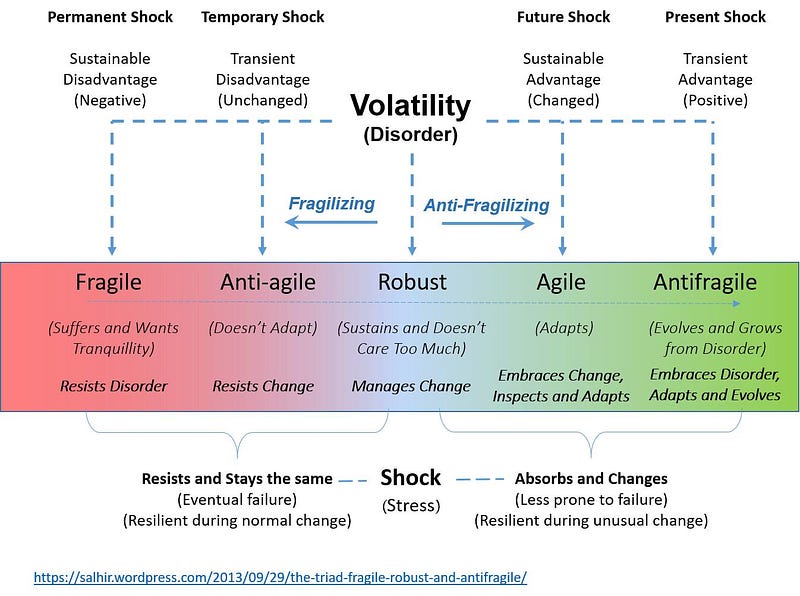
Being Zones
What Hanzi and dozens of other philosophers and psychologists, even businesses such as Gallup, have discovered about states of consciousness and “happiness”, is that they vary according to a scale that usually starts at 1 and ends somewhere between 10 and 13. I’ve written several books that refer to these varying states of consciousness and happiness which include the Wilber Combs States and Stages of consciousness matrix.
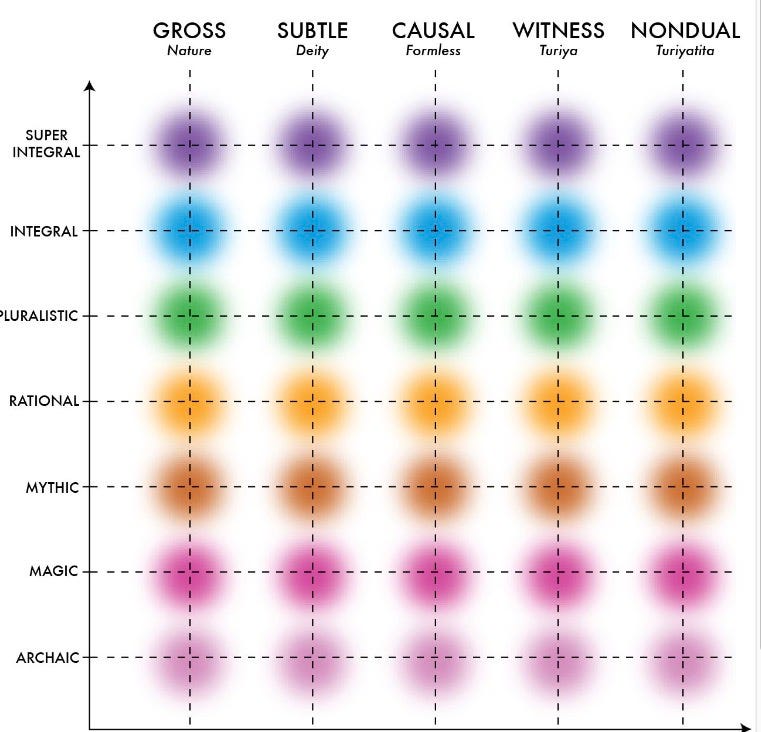
The Wilber Combs Matrix maps stages of development on the Y-Axis and States of Consciousness on the X-Axis- the latter again maps to the kinds of experiences that underlie the 13 states of happiness Hanzi proposes, whereas the former maps to the perspectives and values that our experience of our current state of consciousness and happiness is interpreted from.
In the above diagram, the states of consciousness (gross, subtle, causal, and non-dual) are no longer placed on the vertical line of psychological development but on the horizontal, making the psychological stages of consciousness into variables that somehow define the experience of the (higher) states. In this way, you can have a state experience of the gross, subtle, causal, or beyond at virtually any stage you happen to be.
These states may not be realized as permanent (wakeful, aware) traits of consciousness, but still, they can be peak experiences at every level of development. This explains the fact that children do have subtle state experiences (in peaks), although they are as of yet at the beginning of their psychological development. The same holds for so-called ‘primitive’ cultures that have not developed up to higher post-conventional, world, or kosmo-centric levels. You may be interpreting your own experiences at a magical or mythical level, but that does not preclude you from having non-dual experiences of whatever kind.
This brings a developmental dimension to what is otherwise often a flat land of states that fails to recognize that different states of consciousness can occur at different stages of development and will be interpreted according to whichever state of development a person is currently viewing the world from.
From here on I’ll refer to these states and stages of consciousness as “Being Zones”, including Hanzi’s 13 states of happiness, and will demonstrate that it’s important to understand that one’s state of consciousness and stage of development will vary according to whichever “Life Zone” we are currently talking about.
This is, to some extent, what is still missing at a pragmatic level from both the integral and meta-modern worldviews: context, or what is often called “life conditions”, and what I will call “Life Zones” from here on. There are several different dimensions and scales by which we can assess life conditions and life zones, both at a personal level and also at a local, regional, and national level.
At the personal level, recent research has demonstrated that “Happiness isn’t just a personal experience, it is actually affected by the individuals around you,” said UW Health psychologist Shilagh Mirgain.
Mirgain uses the description of a ripple effect. Like when a pebble is dropped into the water causing ripples — our words, actions, and feelings affect those around us, who in turn affect individuals who come into contact with them, and so on.
“How an individual feels can ripple through his or her social groups and actually influence how the group feels in general,” she says. “In some ways, our emotional states are like a virus — we can spread the positive and negative experience to those around us, even with strangers.”
Mirgain points to research done over a period of time that found the happiness of an individual extends up to three degrees of separation (that is — our level of happiness impacts the happiness levels of the friends of our friends’ friends.) Similarly, if you have a friend, relative, or neighbor who lives within a mile and becomes happy, this increases the probability that you will be happy by 25 percent.
Happiness makes people more sociable, strengthens their immune system, builds more satisfying relationships, improves productivity, lengthens people’s life, and generally makes people more successful in life.
The state of happiness literally primes your mind and body for peak performance. Shawn Achor, another leading researcher in this field, explains, “It turns out that our brains are literally hardwired to perform at their best not when they are negative or even neutral, but when they are positive. Yet in today’s world, we ironically sacrifice happiness for success only to lower our brain’s success rates.”
Sounds great. Then what can we do to improve our levels of happiness?
One thing to pay close attention to is your environment, especially the people around you. Their psychological states are the master key to your psychological state…
But the determinants of happiness do not stop there. Our local, regional, national, and global contexts are also key to how we feel, experience life, and operate. And so we come to the larger scale life conditions that have a direct impact on our life zones, and our experience of life, happiness, and thriving moment to moment.
Life Conditions and Life Zones
In our individualistic, technology-obsessed modernist era, social isolation is increasing to epidemic proportions. Harvard professor Robert Putnam provides a wealth of telling statistics in his book Bowling Alone, asserting that “Our growing social-capital deficit threatens educational performance, safe neighborhoods, equitable tax collection, democratic responsiveness, everyday honesty, and even our health and happiness.”
For example, in “The Spirit Level”, Richard Wilkinson and Kate Pickett (2009) investigate the relation between GDP and other variables that they argue are of more relevance, such as life expectancy, health, and happiness. They all increase with increasing GDP up to a certain point when the relation gets weaker and the curve levels out. In the industrial world, dominated by the materialist achiever value system, economic equality then becomes a better predictor of these indicators of a good life.
How to deal with the material and economic inequalities in a system where profit has become more important than creating jobs and basic income has long been widely debated. For these problems, capitalism and market liberalism appear not to be positive forces. Thomas Piketty in the widely debated “Capital in the Twenty-First Century”, discusses the increased inequalities in income and wealth after 1975, refuting the claimed effect of the Reagan era’s “trickle-down economics” through deregulation and tax breaks for the already wealthy. Capitalism is great at producing new wealth but not at distributing it, Piketty argues, as he proposes a global wealth tax to counteract this. Another “answer”, the sharing economy, is still relatively small, with couch surfing, home swaps, sharing of tools, car rides, and different services now gaining traction slowly.
Life conditions at a national level also vary widely. Some countries have been in an upshift mode for a few decades — Denmark, Switzerland, Iceland. Norway, Finland, Canada, the Netherlands New Zealand, Australia, and Sweden, regularly appear in the top ten slots for happiest countries in the world in a number of surveys.
On the other hand, Zimbabwe, Somalia, Afghanistan, Iraq, Yemen, Syria, and Venezuela are good examples of countries that have experienced major downshifts, which usually results in failed states, dictators and military regimes, and endless, bloody conflict/tribal warfare, in the most extreme cases. In less extreme cases we can see many Eastern European, African, and Latin American countries struggling with a downshift as they attempt to reform their way out of a full collapse. Ukraine is a shocking yet inspiring example of a country undergoing a transformation catalyzed by the Russian invasion since February 2022, though the final outcome remains to be seen.
An interesting example of a country with a small ecological footprint with high life expectancy and happiness is Costa Rica. Thanks to good decisions taken many decades ago to preserve its rainforests and natural beauty for eco-tourism, Costa Rica’s life expectancy, happiness, and well-being exceed that of the USA with one-third of the footprint. It is possible to live sustainably, have economic growth, and enjoy a degree of comfort in beautiful surroundings. Costa Rica and many other countries like it provide us with a clear demonstration that it is not absolutely essential to have the latest technology and modern conveniences to live a good life and be happy.
The UN World Happiness Report, which ranks 156 countries by their happiness levels is based on sophisticated social science metrics that are being used to track the progress on the 17 Sustainable Development Goals agreed to by world leaders in Agenda 2030.
According to the 2022 UN World Happiness Report, life evaluations have risen by one full point or more in some countries (led by three Balkan countries, Romania, Bulgaria, and Serbia) and fallen this much or more in other countries in deep trouble, with Venezuela, Afghanistan, and Lebanon dropping the most. There has, on average, been a long-term moderate upward trend in stress, worry, and sadness in most countries and a slight long-term decline in the enjoyment of life.
For the young, life satisfaction has fallen, while for those over 60, it has risen — with little overall change. Worry and stress have risen — by 8% in 2020 and 4% in 2021 compared with pre-pandemic levels.
On the positive side, the most remarkable change seen during COVID-19 has been the global upsurge in benevolence in 2021. This benevolence has provided notable support for the life evaluations of givers, receivers, and observers, who have been gratified to see their community’s readiness to reach out to help each other in times of need. In every global region, there have been large increases in the proportion of people who give money to charity, help strangers, and do voluntary work in every global region. Altogether the global average of these three measures was up by a quarter in 2021, compared with before the pandemic.
COVID-19 has also demonstrated the crucial importance of trust for human well-being. Deaths from COVID-19 during 2020 and 2021 have been markedly lower in those countries with higher trust in public institutions and where inequality is lower.
Developing Your Own Personal Insights into Monitoring and Mastering the Interaction between Your “Being Zones” and Your “Life Zones”
Over the years I’ve developed a way of reviewing my own life situation using 7 life zones. I usually do this in a meditative state which helps put things in perspective, particularly when I’m facing one or more challenges- and there have been many of those, I can tell you :-)
These seven life zones are what I call the seven F’s, as they all being with the sound “ph”:
1. Physical well-being- how am I physically, emotionally, and mentally? What steps do I need to take now to improve my own well-being?
2. Family- how are my wife, children, Mom, brother, and his family doing? What help or support might they need? I also apply this to my extended family living on four different continents.
3. Finances- what is my current financial state, and what, if anything, do I need to do to ensure the safety and security of myself and those I care about? What can I do to help others in need?
4. Friends- who are my real friends in this topsy-turvy world? How can we enhance our relationships and spend more time enjoying each other's company? Who needs support or help?
5. Focus- how can I make difference while making a living? Where should I be placing my effort right now to make the biggest difference in my life and those I know and care about? How can this be leveraged to benefit the largest number of living beings?
6. Philosophy- what are my blind spots in my “theory of everything”? What do I need to learn, and who can I best learn it from? Is my worldview evolving? Where are the upshifts and downshifts in myself, and how can I enhance my own spiritual intelligence?
7. Freedom- What do I need to become free of, or free from? And how can I enhance my “freedom to”, bearing in mind that every right has a responsibility and every possibility unforeseeable consequences?
For example, it’s quite possible that in life zone 6 or 7 one might be experiencing a spiritual awakening or peak experience whereby we feel as if we are transcending our current reality in the other life zones which are by their very nature temporary.
Physical well-being and finances are two of the most variable life zones where shocks, surprises, and sudden changes of fortune can occur very quickly. We may actually be in a state of poor health and feeling very insecure during such times, yet still, be able to view these experiences from a spiritually transcendent perspective.
Friends and family are often more stable for well-adjusted people and so may change less dramatically than our physical and financial situation. This has certainly been true throughout the recent experience of COVID-19 which suddenly changed the fortunes of many of us in very different ways.
Equally, our climate emergency and biodiversity challenges are also causing shocks, surprises, and sudden changes of fortune for several hundred million people in the most vulnerable areas of our stunningly beautiful planet.
So, it’s fair to say that our ability to be happy at some kind of constant level is not a given at all. In fact, happiness is like the weather — one day it’s lovely and sunny like today when I am enjoying the rays of the sun with my shirt off when yesterday it was raining and windy. No doubt in the next week the weather will change dramatically again as it does this time of the year, and the only control I have over that is how I react to it and plan for it.
As I said at the very beginning of this article, we need to make an important distinction between happiness and thriving. Thriving describes the quality in a person or situation that enables that person or system to become antifragile, whatever their life circumstances.
So, whether your happiness weather is hell or heaven today, your ability to thrive transcends and includes whatever your current state of consciousness is. This is how the term thriveability showed up in my work and consciousness a decade ago.
Thriveability, simply put, is the ability to thrive no matter what your life circumstances are in any of the seven life zones. It also implies the ability to help others around you and make sure they can thrive as well, whatever their life circumstances may be. Thriveability puts the responsibility on you and me to express what is best in us and others around us in the moment to create the conditions in which all of life can thrive on this planet, and perhaps, green our solar system at some date in the future once we have resolved the multiple crises we are in here on earth right now.
Since we began the thriveability movement and Foundation nearly a decade ago this idea and set of practices have slowly started to enter the mainstream just as the concept of thriving and not just surviving has. While I am a fan of much of the work of the integral community as well as the metamodern community and even the emergentist spiritual community now arising, I will always plead with my fellow enlightened activists to never forget that the ultimate responsibility for our future lies in each of our hands and what we do moment to moment every day for the rest of our lives. We need to move beyond the dreaded global drama triangle where a third of the world are victims or rebels, a third of the world dominators, and another third of the world rescuers.
Instead, we can shift our perspectives and practices toward the glorious global empowerment triangle, where mentors and coaches help empower agents of change and transformation and challengers to realize the boundless possibilities for co-creation in the world around us.