
PERSONAL ESSAY
Three Ways of Looking at Space
And its antonym, clutter
Physical Space
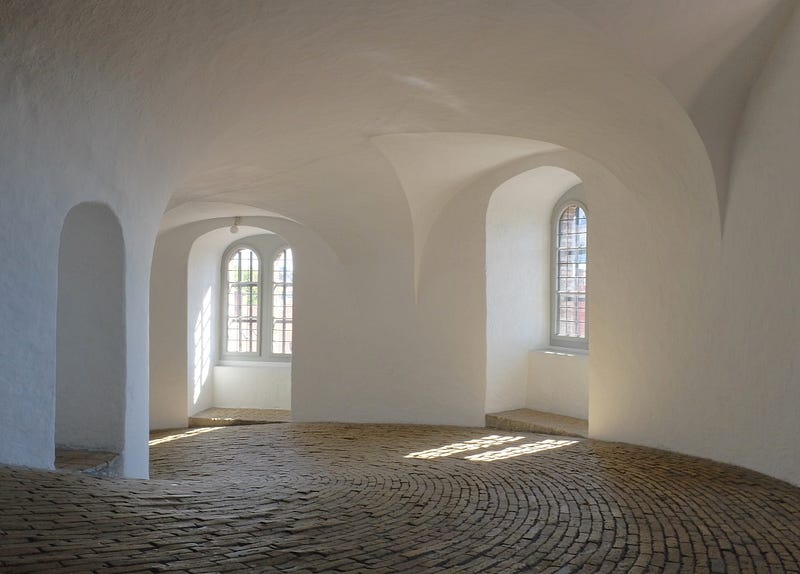
Do you dream of a palatial mansion or of a trendy “tiny house”? How much space does an individual really need? I remember a long-ago visit to a Mumbai family. They lived in an elegant apartment building, not far from the father’s place of business, in an area of town that would have been above their means but for their ingenuity and flexibility.
Mumbai has long been one of the world’s most expensive housing markets, with demand far outweighing supply. Father, mother, and four teenage daughters occupied a flat that, square-footage-wise, barely qualified as a bachelor’s pad. Apart from the tiny kitchen and bath, there were just two small, connected rooms. They functioned as living, work, and study areas in the daytime, and bedrooms at night. Every activity took place at floor level.
How did they do it? The family had basically dispensed with furniture, dwelling almost like nomads in a yurt. The space was uncluttered, neat, and clean. The soft rugs covering the floor were protected by easily washable chadars (sheets) and the bedding was stacked in a corner. Clearly, a lot of thought had gone into this arrangement.
The family members welcomed us with trays of tea and snacks, and unforgettable, big smiles. I couldn’t help wondering how they managed to live so close together, without getting on each other’s nerves. And perhaps that did happen when no visitors were around? Unless each of the family members possessed enough space inside their heads, a mental space that far outstretched the flat’s walls, a space into which they each could retreat at will.
Days later, walking by some circular, mud-and-thatch village houses in the hills near Lonavala, we were able to observe a similar lifestyle: a floor space completely empty of furniture, except for a trunk or two for the family’s clothing. A stack of gleaming brass pots containing food supplies, and wall niches displaying a few prized possessions. Patchwork quilts stacked against the wall, and a baby’s woven hammock suspended from the rafters. This was about 40 years ago. I don’t know if that minimalistic rural life still exists. It was stunningly appealing in its elegant simplicity.
As for the Mumbai family, eventually, the daughters would have married and moved out. For the parents, this much space was definitely adequate. I imagine it felt vast to them.
How much space does a family need? Many people in India live at even closer quarters than they did, while in much of the American Midwest, a 2,500 square-foot house is considered barely sufficient for a middle-class family. According to recent census data, in Michigan “The median size of a new single-family home sold in 2020 was 2,333 square feet.”
Mental Space
Surely, the space between our ears is the most important piece of real estate all of us possess. The space inhabited by our thoughts is much larger than the skull that’s home to our grey matter. In actual fact, that space is limitless. The more we use it, the more it grows. Practically from birth, it invites us to recognize, to learn, to imagine, to fantasize. It’s a space we can condition and populate. Like a house, we can organize and decorate it to suit us. Later, we can teach it all kinds of neat tricks, like how to relax, how to cope, how to travel in our mind, how to observe our own impulses and emotions, how to meditate, and more. And yet, like many of us living in neglected physical spaces, we often don’t realize the potential of this mental “upstairs” space. It doesn’t have to be, or remain, a cramped, cobwebby attic.
An open mind is like an open landscape, with a view of a wide horizon. It is also something that we can cultivate. Yet, every one of my musings evokes many more questions. Like, is there a limit to what and how much we can learn? Can something like empathy be learned? Or is it an acquired trait that a person either has or hasn’t?
Looks like I have some more learning to do.
“Space Space”
“As far as cosmologists can tell, space is almost perfectly flat,” claims the subtitle of an article by Cody Cottier, published last February in Discover Magazine. The statement surprised me because I remembered reading in passing, while scanning my newsfeed, other titles suggesting the Universe was a sphere or even a “donut shape.” In that same article, the author writes, “A mind-boggling property of this universe is that it is finite, yet it has no bounds.” Wait a minute, does that sound like an oxymoron to you, too?
My own thoughts with regard to Space can be radically divergent, depending on my mood. At least once a day, I visualize my place in it, as a tiny speck in a huge Universe. During a longer meditation, I sometimes “see” our Blue Planet (just a marble in the vastness of Space) from a distance, which helps me put many things in perspective, and also tends to fill me with a feeling of fondness for our planet home and its manifold forms of life.
This “mind travel” is where our concepts of physical and mental space intersect. And I find it mind-boggling.
But some days I can’t help thinking of other things: how we Earthlings have cluttered our immediate Space surroundings with space junk. Ever since humans started exploring space, they have left a trail of debris, including lost objects (ranging in size from a toothbrush to a solar panel), dead spacecraft (the oldest one a Vanguard 1, launched in 1958!), rocket boosters (intact or in bits and pieces) and even weapons (a result of various nations’ experiments with anti-satellite weapons).
Imagining current and future manned and unmanned launches having to dodge all this flotsam and jetsam at first makes one laugh, and then want to cry. Oh, the hubris of humankind. Proudly setting out to conquer Space, without ever thinking of cleaning up after itself.
The question of extraterrestrial life, on the other hand, does not keep me awake at night. If it exists, we shall find out at some point. For now, I’m only concerned with keeping my own spaces, physical and mental, as clutter-free as possible.
© Elisabeth Khan 2021