
Three Simple And Unexpected Lessons On Personal Self-Sabotaging Tendencies
Or how digging deeper might lead to useful insights.
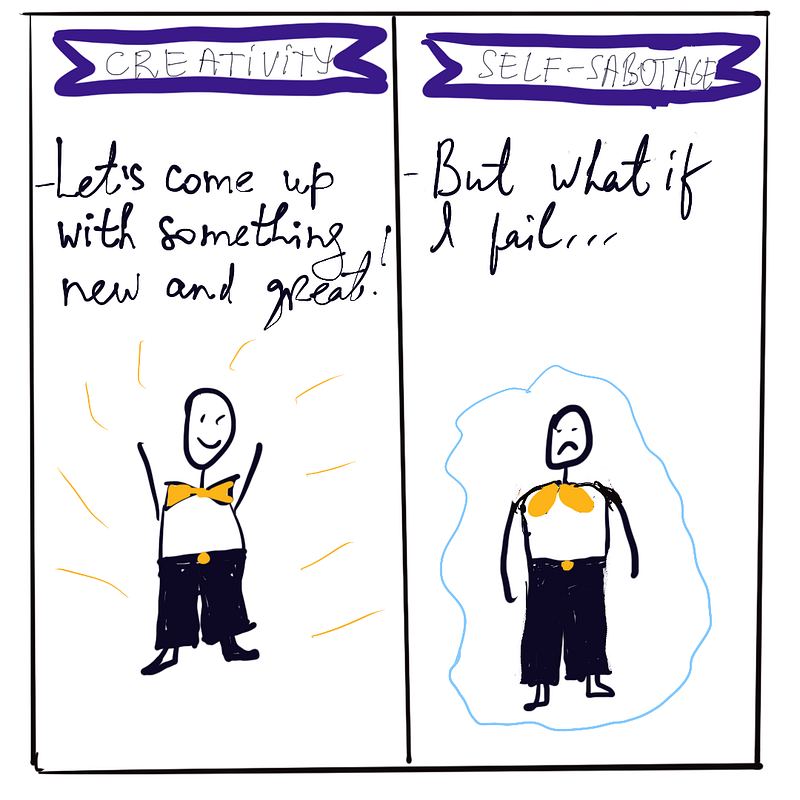
I have self-diagnosed self-sabotage as a root cause of some of my failed beginnings.
So I have spent the last few months contemplating the subject and writing about it on the pages of my personal blog.
I am none the wiser.
But!
Thinking about self-sabotage as a root cause for a few decisions I’ve made in life has genuinely helped me to learn a lot about myself, the way I react to certain things.
I’m having an insight but it’s a minor one. — Midnight in Paris
Things that I’ve learnt so far:
- We will never know for sure.
- Failure is not as evil as it’s painted.
- Beware of confirmation bias.
We will never know for sure
Self-sabotage has been my arch-nemesis for as long as I can remember.
I am a relatively clever girl, if I may say so myself. But I would never allow myself to jump higher than a certain height I estimated for myself during my acne-full pubertal period.
I would achieve something great and then decide that — it was it, enough was enough. I should not even try to jump any higher because ‘who knows’, this might be enough or I might undermine my previous success.
And now I realise that this ‘who knows’ or it’s longer sibling ‘who knows what might happen if…’ has stalled or shot down quite a few of my beginnings and humble achievements.
Who knows if by doing this or that I won’t trip and undo all of my good work, right?
No one knows, that’s the thing.
But you will never know unless you try. And quite often I would not even try because I was too scared to, I suppose.
Writing about self-sabotage has helped me to identify this tendency to question everything and set myself some illusory limits, which never benefited me.
Failure is not as evil as it’s painted
I’ve also realised that I don’t like failing or falling.
Well, duh! But who does? You might ask.
No one, obviously.
But some people don’t attach so much importance to this fear of failure. My biggest revelation was that the fear of failure helped me to self-sabotage my certain beginnings.
Do you know how some primary schools turned sports days into non-competitive days where they don’t announce winners? This story is the story of my life. I’d rather remain neither the winner nor the loser. But stuck comfortably in the grey limbo of indecision.
But by not learning how to fail or that there might be winners or losers, those schools miss a trick. And so do I.
First, how will kids learn to appreciate success if they don’t taste failure? Second, sometimes it’s good to fail because failure teaches us to think. And third, success makes us lazy. We might start thinking we are invincible. Failure, on the other hand, teaches us to grow a thicker skin. Which is not a bad idea in the long run.
Because let’s be honest here — apart from our parents and loved-ones — no one else will be as gentle and considerate with us in our lives. Work will be work. Friends will be friends. And people on the street will be rude and obnoxious. Sometimes.
Life is not a walk in the park. It’s not a constant battle for survivor, either. Especially not here in the western world. But nevertheless, there will be people who are unkind to us. There will be circumstances that are against us. There will be a life in which s*** happens. And if we don’t learn how to fall and fail, well, we might struggle. I am a good example of this theory.
Beware of confirmation bias
I’ve also learnt that I use confirmation bias more often than I thought and that it’s evil. Well, not evil, but my treatment of it turns it into a rather nasty thing. There is a name for it. It’s called the Dunning-Kruger Effect when our incompetence prevents us from noticing gaps in our knowledge.
Let’s say I think I know something. As we discovered at the beginning, there is no way we can know everything. Even the subject we consider ourselves experts in. And once I think I know something, confirmation bias kicks in and I tell myself that there is nothing more I can do here. I need to drop this line of inquiry. As a result, I miss out on so so many exciting things.
Now I can see that it’s a form of self-sabotage. It’s easier for me to dismiss something as a ‘fact’ and not expand my knowledge any further.
I realised it during the parent evening at my child’s pre-school. I thought ‘I knew’ what the key worker was talking about and I deleted it from my memory and didn't ask further questions. Until later that evening when my husband started asking me questions — because I knew, I studied psychology, didn’t I? And with shame and humility I had to Google the term and then admit to my husband that it was not what I thought it was.
Final thoughts
What am I planning to do with my newly acquired knowledge about my self-sabotaging tendencies?
My initial reaction was to wake up on Monday and start anew life by eradicating my fear of failure, overuse of confirmation bias and the limiting belief that ‘this is more than enough’.
But who am I kidding?
I know I won’t turn failures into my friends only because of that minor insight I’ve experienced earlier on.
Instead, I plan to remind myself that not everything is what it seems .
And next time I am about to drop a project, I’ll ask myself: is it my fear of failure or other self-sabotaging musketeers parading as something else?
And then see what happens. I might reconsider my decision. Or I might not. But at least I have created a tiny stepping stone towards dealing with my self-sabotaging demons.