Three Reasons The USA Is The Hardest Country To Invade
Not that anyone wants to try
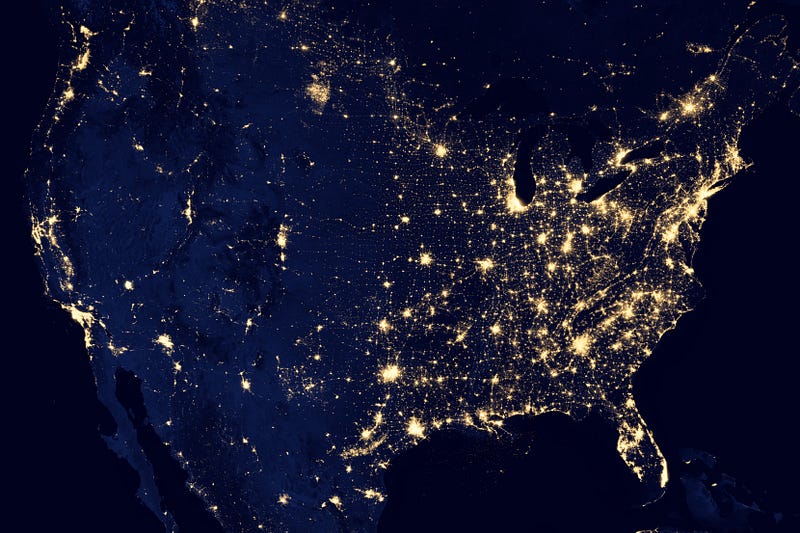
The United States would be the hardest country in the world to invade. And it is not even really close. Through careful statecraft, years of expansion, and the cultivation of allies, the United States transformed itself from a coastal colony of Great Britain into a continental fortress flanked by the largest moats in the world. The United States has impregnable borders, vast interior distances, and massive geographic features that would make any invasion attempt a nonstarter.
Here are three reasons why the USA would be nearly impossible to invade.
Geography
Over decades of expansion and Manifest Destiny, the United States built itself into a continental fortress. It is protected on all sides by a global moat. The southern coast borders the Gulf of Mexico which would be extremely easy for the United States to secure against unwanted advances. The east coast borders the open Atlantic, and the west coast stares out over the vast Pacific. Any invasion attempt would have to sail across thousands of miles of open ocean and would likely completely eliminate the potential for a surprise attack. Even if a potential foe wanted to stage their armed forces in a neighboring country, you only have two to choose from. Both are close US allies, and both would still need to be accessed via air or sea.
Even if you did manage to land troops somewhere in the United States, getting around might not be so easy. The country is riddled with mountain ranges and some of the largest and longest rivers in the world. The Rocky Mountains and Mississippi River would give the United States perfect natural features to fall back behind, making any invasion a long and deadly affair.
The United States is in possession of multiple islands, disconnected territories, multiple large ports, thousands of airports and thousands of miles of paved roads. All of these things would make it easy for the United States to mobilize and move interior forces around to the most defensible and critical areas.
Population
Another obstacle to a US invasion is the US population itself. The US population is the third largest in the world, trailing only China and India. But the biggest problem for a potential invader would be how heavily armed the population is. There are more guns than people in the United States. Civilian gun ownership is estimated to be roughly 120 firearms per 100 civilians. That is the highest in the world — by far!
That means that any occupying force would instantly have to contend with a large and hostile population that is extremely well armed. Partisan movements and guerilla warfare have been the bane of numerous militaries throughout history. The trick to an effective guerilla force is access to supplies, access to weapons, and determination. The United States population would have access to all of these things in spades.
Size
Lastly, the United States is vast. The United States is the fourth largest country in the world and makes up 6% of the world’s total landmass. Even a small foothold in the country would be tenuous. Any invasion would have to capture large swaths of hostile territory with long and stretched supply lines. Supplies would have to flow across the vast oceans of the globe and then be subject to potential sabotage by a large armed population.
The distance between Moscow and Kyiv is roughly 550 miles. That is only a little bit farther than the distance between Washington DC and Boston in the United States alone. The distance between Los Angeles and Washington, DC, is nearly 2,700 miles. The distance between London and Moscow is just 1,800 miles.
That goes to show how large the United States truly is. Those distances also dovetail into the hostile geography with mountain ranges, deserts, rivers, marshes, and more. It can be arduous to road trip from one side of the United States to the other, much less as an invading force.
Conclusion
There are no imminent invasions of the United States on the horizon, but any attempt to do so would be disastrous. Other countries in contention for this honor were Russia, China, Australia, and Great Britain for similar reasons — large populations, difficult access, and hostile geography. However, the United States seems to have all of these factors locked up to the highest degree.