
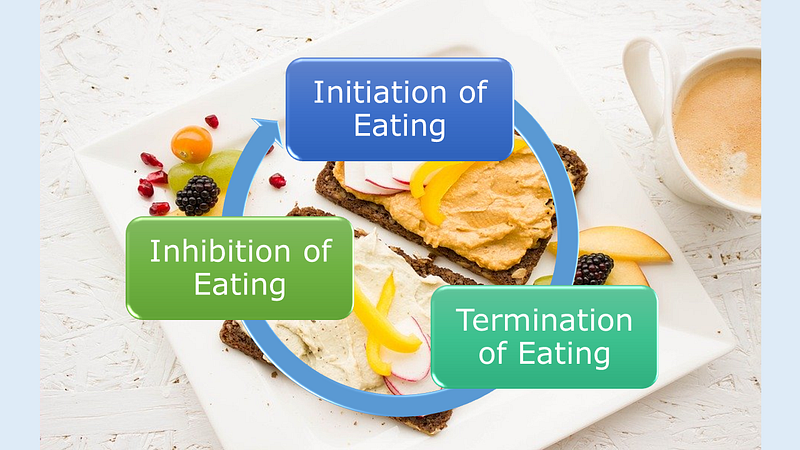
Three Phases of Appetite Regulation And The Hurdles To Successful Appetite Control.
Understanding how appetite works may help you with developing strategies that target your weakness in appetite control.
The regulation of appetite consists of biological and psychological aspects. Biologically, appetite helps us to meet our minimum energy demand and protects us from under-eating. Our appetite appears to be more responsive to protecting us against under-eating than over-eating, resulting in the unintentional weight gain. Psychologically, appetite triggers a feeling of satisfaction and reward, hence promote the consumption of highly-rewarding food (often a high-sugar or high-fat ultra-processed food).
Our feelings of appetite are more than hunger (biological) and wanting/liking (psychological). There are three phases of appetite regulation. Furthermore, both biological and psychological control are involved in each phase.
In this article, I aim to briefly outline each phase of appetite regulation and help you to find out your hurdles to successful appetite control.
Phase 1: Initiation of eating
Phase 2: Termination of eating
Phase 3: Inhibition of eating
Finally, I will provide you with some personal tips on how to overcome these weaknesses. Certainly, those tips may work for some, but not others.
Phase 1: Initiation of eating
How often do you feel like you want to eat something? The moment when you swallow a piece of food into your stomach, you initiated an eating episode.
Biologically, an empty stomach initiates eating, which naturally occurs after an overnight fast. The feeling of hunger in the morning is often known as fasting hunger. Ironically, not everybody feels hungry in the early morning, that is why some people find skipping breakfast is a convenient way to practice “time-restricted feeding”. Stomach emptiness also happens 3–4 hours after a typical meal. Therefore, it is biologically reasonable to desire for food every 3–4 hours.
However, it is also true that we eat not because we are hungry as we have cognitive control over our eating time. We eat because it is time to eat. For example, I know to have lunch at 12:30pm, a tea break at 4:00pm and have dinner at 7:00pm, though your schedule may be different from mine. Interestingly, when a study invited a group of volunteers to stay in a room without natural sunlight and clock (so they don’t know the time), the volunteers still show fixed mealtime intervals, by having a meal every 3–5 hours depending on their regular meal behaviours.
We eat because it is time to eat.
Eating can be contagious too! Our appetite may be triggered if we see somebody else is eating in front of us. The smell of food (such as fried food) can also trigger the secretion of the hunger hormone. Moreover, it is not surprising memory has a role in appetite. When I was little, I used to hate broccoli as I perceived it as bitter based on my first bite, further aggravated by the unappealing look of a “miniature green tree”. Since then, a KFC triggers appetite, but not broccoli.
In short, the initiation of eating dictates how often you eat. If you don’t have a problem with resisting a prolonged period of not eating, congratulations, you have passed this hurdle.
Phase 2: Termination of eating
Termination of eating happens when we complete our meal.
Biologically, termination of eating happens when we achieve satiation. The biological feelings of satiation commonly arise from a full stomach. Surgeons have been able to artificially introduce premature satiation by inserting a balloon in a patient’s stomach, allowing the patient to only eat a small volume of food comfortably.
For this reason, satiation appears to have little to do with calories. Hence, we prefer to consume a large amount of food but has low calories (low energy-density food and high-fiber food) as a mean to promote satiation without having to overconsume calories. Rather, drinking a large volume of water is sufficient to at least temporarily discourage us from ingesting more food or liquid.
The biological termination of eating is not dependent on the calories in the stomach, but the stomach distention.
Psychologically, it is easy to trick the satiation process. There is a well-known “boredom of taste” effect. My research group previously showed that when we presented volunteers with a 16-item buffet, they ate 28% more calories when compared to a 3-item buffet. That is also why we often can tolerate a dessert after a meal even we feel “full”.
The other trick is known as the “completion syndrome”, whereby we always want to finish the meal presented. A field study showed that we normally eat 100% of the meal at least 80% of the time unless the meal is truly unpleasant.
We often “eye-estimated” the amount of food we desire to eat. As bizarre as it seems, here are some interesting studies to back this fact. When researchers presented a 4-item buffet to a group of young adults, the volume of food they ate increases with the volume of food presented to them. Another interesting study asked a group of volunteers to completely finish the soup in a bowl. Volunteers completely consumed the soup from a bowl without realising the soup was being secretly refilled from the bottom. The volunteers were surprised when they were told they consumed 73% more soup than what was initially presented.
A full stomach is rarely achieved unless a person overeats by a lot. Did you fall for any of the tricks that lead to overconsumption?
Phase 3: Inhibition of eating
After a meal, we feel full, therefore the desire to eat is low.
Strong inhibition of eating is desirable to avoid snacking behaviour. There are various biological mechanisms have been proposed that are linked to the strength of inhibition.
After a meal, various satiety hormones are secreted, including CCK, GLP-1 and PYY. Although they have been suggested as the hormones that lead to satiety, scientists often had a hard time to predict the degree of fullness based on the concentration of these hormones in the blood. Furthermore, bulky food may slow down the intestine contraction, causing us to feel stuffed after a meal. When almost all food is being absorbed from the intestine, the low inhibition of eating triggers the next eating occasion.
In fact, the next eating occasion can occur far before the food is completely absorbed. Researchers have been able to distinguish the low-satiety phenotype individuals from high-satiety phenotype individuals and found that those who scored a low-satiety phenotype had higher odds of disinhibition, also linked to psychological wanting or liking for some specific food.
Do you occasionally feel like craving for food even you feel full? The science of craving is a huge topic by itself. Whilst certain food is helpful to prolong the feelings of fullness, I don’t think it is quite helpful to curb with cravings. Different people have different strategies to curb cravings and it is important that you develop yours.
What is your weakness and how you can overcome it?
Have you been able to identify your weakness(es)? It is important to find out where your weakness lies within the three phases:
Phase 1: Did you initiate an eating occasion too often?
Phase 2: Did you not know when to stop eating?
Phase 3: Did you not able to inhibit yourself from eating due to craving?
All these results increase your calories intake, at least in the short term. You might be able to compensate extra calories-in for extra exercises.
I promised to provide a few personal tips to overcome the weakness in each phase:
Phase 1: Understand your trigger and avoid exposure to your trigger as much as possible during non-meal hours. For example, having a “tour” to the tea room during non-meal hours may be one of the triggers for an eating episode. If so, avoid entering the tea room.
Phase 2: We need to be aware that the biological termination of eating is not dependent on the calories in the stomach, but the stomach distention. Most of the time, a meal hardly reach the biological threshold of meal termination and the socio-psychological factors appear to play an important role as previously discussed. In order to realize how much calories you need for the body, you need to use a calorie-counter (I recommend MyFitnessPal). Having done that, you may slowly habituate with the portion size that is just right for you. Be mindful that when more food is presented to you, take only what is enough for you.
Phase 3: Craving is the toughest control of all. For example, sugar craving is one of the common cravings. Instead of actively restricting yourself from reaching high-calorie ultra-processed sugary food, focus on meeting your fruits and veggies intake. Shifting your focus from “eat less” to “eat more” can sometimes make your life easier.
In sum, a successful regulation of appetite requires knowing when to start eating, how much to eat, and the ability to inhibit eating.
I hope this article enlightened you about the psychobiological science of appetite. Thanks for reading.



