avatarJames Gwynne

Free AI web copilot to create summaries, insights and extended knowledge, download it at here

2234

Abstract

manage both departments, with adequate staffing in each area of the business.</p><p id="6f4f">I carefully considered budgets, financials and worst case scenarios.</p><p id="5d89">The result? I got the gig! With a new package to boot (now the real work starts!).</p><p id="9f1b">Proactivity, if presented well, can really pay off.</p><h2 id="f4c7">Planning</h2><p id="f810">Planning is one of my favourite activities. Not only does it naturally strategise and give a direction but it can also be hugely refreshing and good for the mind and soul. To me a form of meditation!</p><p id="e01d">Some may think this sounds tedious but there are some really good tips to get started. My personal approach is to set a key aim for achievement, then follow up by noting down the road map to that success.</p><p id="6156">I once had the privilege of sitting in a talk with the incredible Pete Wilkinson, who has worked with businesses in the UK to develop what he calls the 1–3–5 action plan.</p><p id="1f51" type="7">1- The main objective</p><p id="b54e" type="7">3- The three key sub headings as to how you will get there</p><p id="b8f4" type="7">5- The five activities that fit with each of these headings.</p><p id="73c7">In addition, I have also learned with planning that everything must have a value or commitment e.g, instead of:</p><blockquote id="6d2d"><p>“I am going to sell enough houses to make me rich”,</p></blockquote><p id="f7ce">try</p><blockquote id="e94a"><p>“I am going to sell X houses, which will generate approximately Y”.</p></blockquote><p id="4fb3">This puts a commitment and accountability in place, allowing for review and checkpoints later down the line.</p><h2 id="9adb">Time Management</h2><p id="4b56">This topic is without question the most difficult of the three to master. It is an ongoing personal struggle of mine.</p><p id="283b">It’s seemingly normal to take on more and more responsibility as you make your way through life.</p><p id="d392">Delegation is a sensitive practice, which as you grow, has to be done. You can easily delegate too much and easily delegate too little. I found the balance on this is based on priority.</p><p id="6210">Stephen Covey recommended the following table in which to slo

Options

t in your plans for the day:</p><figure id="793d"><img src="https://cdn-images-1.readmedium.com/v2/resize:fit:800/1*[email protected]"><figcaption>Photo from <a href="https://en.m.wikipedia.org/wiki/First_Things_First_(book)#/media/File%3A7_habits_decision-making_matrix.png">Wikipedia</a></figcaption></figure><p id="83f1">This template is life altering if used properly. I recommend that you sit down with your individual work load and place it into these quadrants, I can assure you that it is a clear route to the right level of delegation and potential success of the planning quadrant is prioritised.</p><p id="3381">In theory, quadrant 1 can become unnecessary if quadrant 2 is carried out in the correct manner.</p><p id="daf3">In summary, if you can’t manage yourself you can’t manage others. If you can get this right and find a format in your busy schedule to make yourself available, then I expect you will find success.</p><p id="e197" type="7">Happy managing!</p><div id="e574" class="link-block"> <a href="https://jamesgwynne.medium.com/membership"> <div> <div> <h2>Read every story from James Gwynne (and thousands of other writers on Medium)</h2> <div><h3>As a Medium member, a portion of your membership fee goes to writers you read, and you get full access to every story on…</h3></div> <div><p>jamesgwynne.medium.com</p></div> </div> <div> <div style="background-image: url(https://miro.readmedium.com/v2/resize:fit:320/0*H2CiCwG-qEm_0DuP.jpeg)"></div> </div> </div> </a> </div><div id="8a13" class="link-block"> <a href="https://jamesgwynne.medium.com/subscribe"> <div> <div> <h2>Get an email whenever James Gwynne publishes.</h2> <div><h3>undefined</h3></div> <div><p>undefined</p></div> </div> <div> <div style="background-image: url(https://miro.readmedium.com/v2/resize:fit:320/0*w3JSptAeo0tHsm6i.jpeg)"></div> </div> </div> </a> </div></article></body>

Three Key Habits That Must Be Mastered Before You Can Manage People

There are actually 7, but this will set you at a good starting point

Photo by @myleon at unsplash.com

I have been a people manager for about 5 years now. Hands down, it’s the toughest job out there. I consistently question myself, my comments and my influence on the team. Asking people to have their trust in your vision in order to get the best from them is not by any means an easy task.

There are however significant rewards. When there is a flow to your work and form is high, results are being produced, it can be one of the most spine tingling and enlightening feelings.

One of the biggest lessons I have learned on the journey so far, is that you have to manage yourself first. I’ve learned this from experience and making my own errors, which have impacted negatively on the team that I may have been working with at the time. Therefore getting at least these three key elements to your own work and life first is something that needs to be prioritised:

Proactivity

You have to be on the front foot. This can be very difficult on a busy schedule but time has to be made for it.

The term can be described in lots of different ways. This could be anything from putting a focus on winning new business in a front of house sales role, through to prioritising a presentation that is going to play a key factor in driving a business forward.

Thinking ahead and providing solutions instead of problems is a huge key to success on both personal and business levels.

My most recent example of success through proactivity occurred only in the last 2 months.

There was a void in a management role in another department within my workplace which my employer has struggled to fill. Instead of sitting comfortably in my position I put a plan together to senior management to manage both departments, with adequate staffing in each area of the business.

I carefully considered budgets, financials and worst case scenarios.

The result? I got the gig! With a new package to boot (now the real work starts!).

Proactivity, if presented well, can really pay off.

Planning

Planning is one of my favourite activities. Not only does it naturally strategise and give a direction but it can also be hugely refreshing and good for the mind and soul. To me a form of meditation!

Some may think this sounds tedious but there are some really good tips to get started. My personal approach is to set a key aim for achievement, then follow up by noting down the road map to that success.

I once had the privilege of sitting in a talk with the incredible Pete Wilkinson, who has worked with businesses in the UK to develop what he calls the 1–3–5 action plan.

1- The main objective

3- The three key sub headings as to how you will get there

5- The five activities that fit with each of these headings.

In addition, I have also learned with planning that everything must have a value or commitment e.g, instead of:

“I am going to sell enough houses to make me rich”,

try

“I am going to sell X houses, which will generate approximately Y”.

This puts a commitment and accountability in place, allowing for review and checkpoints later down the line.

Time Management

This topic is without question the most difficult of the three to master. It is an ongoing personal struggle of mine.

It’s seemingly normal to take on more and more responsibility as you make your way through life.

Delegation is a sensitive practice, which as you grow, has to be done. You can easily delegate too much and easily delegate too little. I found the balance on this is based on priority.

Stephen Covey recommended the following table in which to slot in your plans for the day:
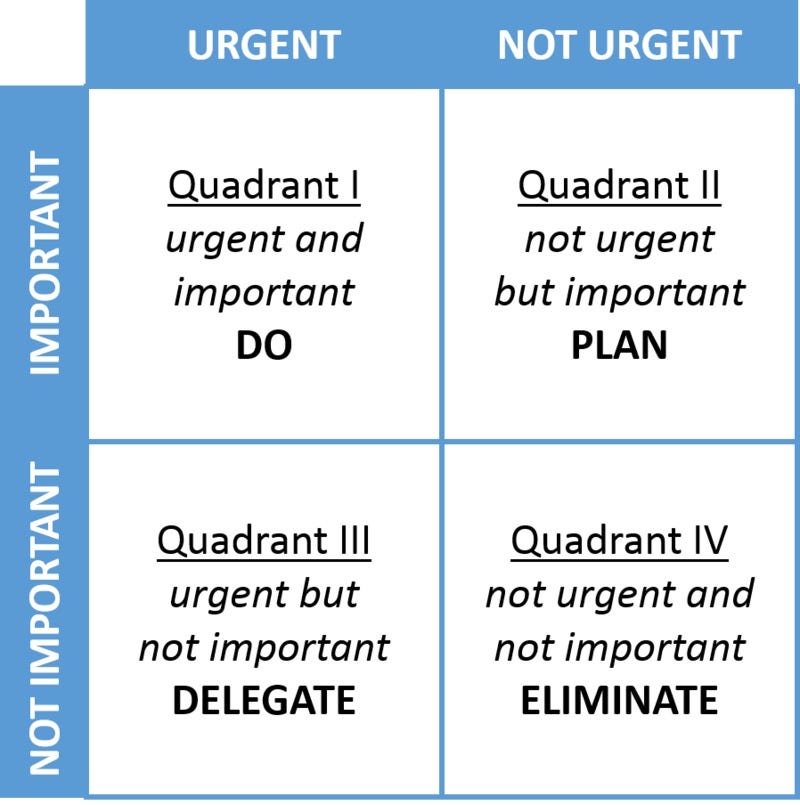
Photo from Wikipedia

This template is life altering if used properly. I recommend that you sit down with your individual work load and place it into these quadrants, I can assure you that it is a clear route to the right level of delegation and potential success of the planning quadrant is prioritised.

In theory, quadrant 1 can become unnecessary if quadrant 2 is carried out in the correct manner.

In summary, if you can’t manage yourself you can’t manage others. If you can get this right and find a format in your busy schedule to make yourself available, then I expect you will find success.

Happy managing!

Business
Management
Work
Time Management
Proactivity
Recommended from ReadMedium