
Three films about…singers: Yesterday (2019), Patti Cake$ (2017) and A Star is Born (2018)
Why am I writing about these movies now?
Well, I’m moving my back catalogue of movie (and occasionally TV) reviews from another site to Medium — covering many of the best-known releases of the last decade, as well as more obscure fare. To make it a bit more fun, I’ll be grouping them thematically (as here), but unless I spot actual errors I’m not doing any editing…so my opinion may have changed since I first wrote them!
My reviews of new cinema, streaming and disc releases, as well as retrospectives on old (and not-so-old) classics, will mostly continue to appear on the Medium publication Frame Rated.
Anyway, here goes. Enjoy…
Yesterday
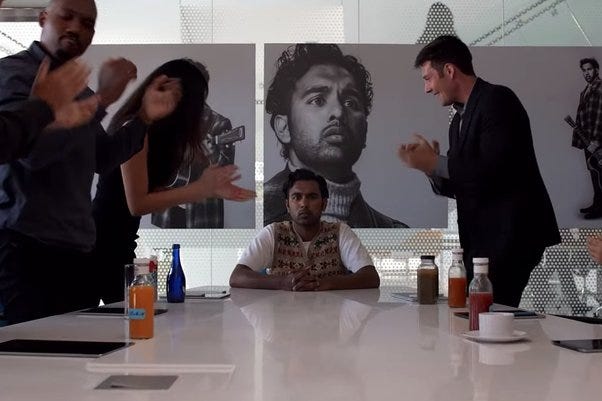
“Will you still need me, will you still feed me, when I’m sixty-four?” supermarket shelf-stacker and pub crooner Himesh Patel jokingly asks his not-quite-girlfriend when she visits him in hospital, and she looks at him like it’s a weird question.
Later, discharged, he’s at the pub with pals; they present him with a guitar to replace the one ruined when he was hit by a bus. He picks it up and starts to strum Yesterday. They love the song. They’ve never heard it before.
And this, famously by now, is the premise of Richard Curtis and Danny Boyle’s new movie also entitled Yesterday — that after Patel’s encounter with the bus, during a 12-second worldwide power blackout, he awakens in a parallel universe very much like ours, except that The Beatles (and a few other household names and familiar objects) never existed.
It’s a grabbing concept, and even if the trajectory of this happy, smiley, song-packed romcom is about as obvious as the precise role of the bus and the blackout are vague, it’s carried off with inevitable panache thanks to the slick script from Curtis (best known for Four Weddings and a Funeral, Notting Hill and Love Actually, although thematically 2013’s About Time is maybe a closer relative of Yesterday) and direction by Boyle.
The director is a little more restrained visually than usual, although the power-cut sequence itself is characteristically flashy and he can’t restrain himself from some typical Boyleisms: for example the outsize DayGlo typography of locations and song titles floating into the action, or the big washes of colour (especially red and sunshine-yellow) that fill the screen.
Still: there’s something mechanical, something soulless, about the writing and direction (ironically for a film that claims concern about the commercial packaging of art). If you were hit by a bus and whisked to an alternate reality where the movie didn’t exist, and you were asked to imagine this story as written by Richard Curtis and directed by Danny Boyle in a positive mood, you would come up with something very like Yesterday. It’s all very deft and very smart without ever surprising us.
So, on a human level, it’s much more carried by the performers. Patel may have been largely cast for goofiness, but he appears at virtually every moment without us doubting the reality of his character, as well as singing all the Beatles covers, and must take some credit for keeping the thing afloat. More memorable, all the same, are some smaller roles.
Kate McKinnon as his uber-focused, ruthlessly avaricious American agent has most of the best lines; Sanjeev Bhaskar is amusingly underwhelmed by the whole thing as Patel’s father; Joel Fry’s cheerfully gauche new-agey roadie is a recognisable caricature of someone we’ve all met; there’s a nice cameo from (I think) Vincent Franklin as the ill-tempered manager of a supermarket where Patel works before his encounter with the bus, and another surprising cameo from Robert Carlyle (an old Boyle favourite) toward the end.
Not a cameo — although oddly it’s been described as one by many reviewers — is the appearance of Ed Sheeran as himself; Patel, bringing The Beatles’ music to the Fab Four-less world as if it were his own, starts off as Sheeran’s support but soon eclipses him.
The real-life singer is very amiable in a significant role where the script constantly, if humorously, puts him down (it falls to him to make the inane suggestion that Hey Jude be renamed Hey Dude, and at one point he has to admit “you’re definitely Mozart, mate, and I’m definitely Salieri”). Probably he is largely playing himself, but he has a screen presence and perhaps a future.
Consistently entertaining, Yesterday verges at times on being interesting too. It’s almost the antithesis of a BoRhap/Rocketman-style musician biopic; here we have the songs completely without context, in a world stripped of it, and however familiar they are, this helps us — like Patel’s audiences — hear them afresh. (In the parallel universe Oasis, without its obvious musical model, also never existed; but The Rolling Stones did.)
Yet the point being made, I think, is that it is often context which elevates a piece of music from being just good to being great. Cover versions work because we know the original; they are reminders, not substitutes.
Though never quite explicit about it, the movie seems to acknowledge — as Patel does, secretly, to himself — that a song is not just made up of words and notes; the era and the circumstances where it originated are important too; so there is something dishonest about his pretence to have written the Beatles classics, and not just in the sense that he didn’t do the work himself.
This is made most obvious in a sequence where he pays a flying visit to Liverpool simply so he can plausibly claim to have been inspired to write Eleanor Rigby, Penny Lane and Strawberry Fields Forever. Here Yesterday is forcing us to face the question that Patel knows he cannot carry on ignoring: how could they possibly be the same songs, in terms of meaning and value, if they were written by a south Asian lad from Suffolk in the 2010s, a man whose world and life had been so different from the Liverpudlians’ half a century earlier?
Unfortunately, while Yesterday raises these intriguing questions and hints at some answers, Curtis is often content to leave central issues unexamined. Most glaringly, someone observes that “a world without The Beatles is a world that’s infinitely worse”, but there’s no evidence of this at all in the film; the world without The Beatles seems perfectly fine in every other respect.
Moreover, when Patel’s deception is finally revealed to this world — and by this point he’s a superstar — nobody at all seems interested in investigating who the hitherto unheard-of master songwriters were, or the universe where they existed.
There’s also a conveniently abandoned love triangle which involves some cruelty to a sympathetic character, and that’s rather at odds with the feelgood tone; we might even wonder, for a minute, if Patel and Lily James (rather bland as his girlfriend, seemingly only there to relate to him rather than to exist in her own right) are quite as lovely as they seem.
Still, Yesterday is so lightweight that it’s difficult to take such concerns seriously, any more than the movie really takes its characters or premise seriously. The best thing to do might be to follow Patel’s example: enjoy it while it lasts, then come clean and admit it was all nonsense.
Patti Cake$
There aren’t many movies that have me singing to myself about bad muthafuckas on the #91 bus home (very discreetly, of course).
Yet if Patti Cake$ is not ultimately quite as upbeat as the Rocky-like trailers might have you believe, it is nevertheless charming and life-loving much as Baby Driver was earlier in the year, and all the more so because it does not overly celebrate its characters or point neon arrows at Issues.
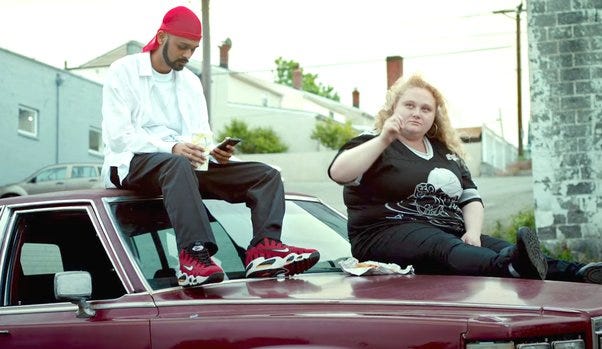
In this tale of a plain, overweight New Jersey white girl who lives to rap, her rather dramatic difference from the genre’s typical artists is left mostly to speak for itself; her friendship with an airhead Asian boy and her romance with a doomy black loner are not allowed to become metaphors for larger racial themes, either. They’re just people.
Danielle Macdonald (Every Secret Thing) controls the screen as Patti, only receding a little in the presence of her mother, Bridget Everett. The older woman mourns her own brief musical career and, by implication, the loss of all youth’s possibilities; she cannot help cherishing Patti, but her support is soured by envy; her blue-collar blues and Patti’s rap are musically at odds, as irreconcilable, maybe, as their generations.
Everett conveys all this with no big speeches, just looks and offhand words in a performance of great subtlety, internal conflict and mostly-hidden sorrow.
Where the film does stray much further into caricature is with O-Z, the successful (black, male) rapper who is the closest thing it has to a villain. His name is no coincidence: his lavish home is suffused with green, and for a long time Patti is enchanted by the wonderful things that he does.
How this turns out will come as no surprise, given the past form of viridescent wizards; what’s more interesting, in a nerdy way, is the possibility of mapping not only Patti onto Dorothy but also her companions onto their Oz equivalents (the doomy loner must be the Tin Man, though the Asian lad has aspects of both the Scarecrow and the Cowardly Lion).
This is fun, and it reminds us that even if Patti Cake$ is not quite a fable, it is not to be taken as social realism either.
Still, the fantasy is rooted in a good deal of honesty, both emotional and in terms of setting: a character says “the world is ours”, and the camera cuts to a Subway and a gas station.
It is this which makes Patti Cake$ such a rounded and human film, feel-good not because it bathes you in syrup but because it reassures you that people are okay really, and that a happy-for-now is achievable: even if it leaves carefully open the question of whether that, for Patti, will lead to happy-ever-after…and if so, whether it takes the shape of rap stardom somewhere over the rainbow, or the warmth of friends in New Jersey.
Is there, perhaps, no place like home after all?
A Star is Born
Just when you’re starting to worry that 2018 has had plenty of decent movies but no real stand-outs, along comes the first obvious contender for the Film of the Year slot.
A Star is Born is not innovative or challenging in any way — it is a remake of a remake of a remake, after all — but is simply one of the best-made movies and most consumingly watchable dramas for a long time; the nearly impeccable cast, a great soundtrack, and accomplished, unpretentious direction from first-timer (and co-star) Bradley Cooper make every moment fresh.
Much of Cooper’s skill is in giving us a movie that (rather like many musical performances) feels, on the surface, free-flowing and spontaneous — but, underneath, is constructed with precision.
Consider, for example, the first few scenes. We see Cooper’s character, the slightly washed-up country-rock star Jackson Maine (his surname is a nod to his equivalent in the 1930s and 1950s versions), in frenetic concert. We see him afterwards, drinking in his car, clearly a routine. Already, we are gathering quite a bit about him.
We then see Lady Gaga, a waitress, in a big white empty restaurant bathroom — an environment as arid and depressing as Cooper’s concert was wild and hedonistic — breaking up on the phone with her lawyer boyfriend.
The phone tells us that it’s the present day (we need reminding because the movie so often feels 1970s, Streisand/Kristofferson-era, with its typewriters and diners and Sinatra references). And the fact that the dumped guy is a lawyer suggests that just maybe Gaga’s character isn’t so buttoned-down herself.
We see her in the restaurant kitchen; her waitress uniform underlines enforced anonymity, conformity; but here we learn that she’s performing tonight: her other existence.
She still has to take the garbage out, though: reality at odds with her dreams.
And then we see her walking away from the garbage, through an alley, out into the city, and we hear music — the music in her head? — and the title fades in: and we have learned so much about the characters and their lives, in just a few minutes, that (even if we haven’t seen the Janet Gaynor or Judy Garland or Barbra Streisand versions) we can pretty much guess where the movie is going to go.
This is capable, well-controlled film-making. Not a shot or a line wasted, and yet we never feel we’re being spoon-fed exposition; the briefest of sequences never seems hurried.
Before long, we’re in a club where Gaga is singing La Vie en Rose. This is where they’ll meet, of course, and Cooper marks that moment with an astonishing extended close-up of Gaga’s face (the first of several in the movie, which indeed will end with one). It’s a rare jump out of the naturalistic into the poetic, and yet it doesn’t jar either.
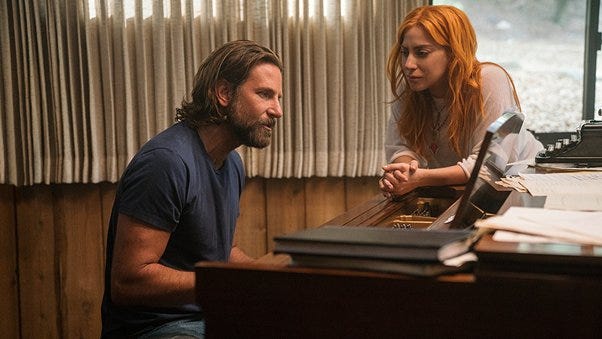
Even so, however helpful the direction, love stories live or die on the strengths of the two lead actors. Here it is difficult to fault either Gaga or Cooper (who you never think of as Gaga or Cooper while you’re watching A Star is Born).
In this chemistry-of-opposites situation, they both deliver broad-brush portrayals of instantly recognisable types (the heavy-drinking older man with heartbreak buried deep; the seemingly diffident, inwardly strong younger woman) but also temper these with enough of the unexpected and the contradictory that they avoid stereotype.
Gaga can be violently angry, for example; Cooper can be artistically serious when you least expect it; there is a gripping scene where he finally cries. Their deepening relationship is plausible but never cute, the arguments as believable as the good times, and fleshed out by little details that speak volumes — like the rock-star hotel breakfast, three of everything from room service: normal for him, sheer novelty for her.
Exceptionally strong in the high-quality supporting cast are Sam Elliott, in a smallish but Oscar-worthy role as Cooper’s brother; and Dave Chappelle as a friend now retired from music.
Both are significant for what they represent, as well as what they say. While Gaga is just starting to find out what she might do with her life, Cooper is at the stage where he’s realising how many avenues are now closed off, and these two characters are poignant representations of other lives he might have had. They are honest, too: something that he needs to be.
His signature song, suggesting that it’s “time to let the old ways die”, comments unintentionally on the one thing he seems unable to do, and (although this is fundamentally a film about people and not music) perhaps also on the way that the aesthetic of younger stars like Gaga’s Ally rejects his old-school male rock.
Even the title is, surely, hinting that just as stars can be born so they can die, professionally: the dramatic heart of the movie is the difficulty that Gaga and Cooper have in managing a relationship of equals, given that his star is drifting downward while hers soars.
There are just a few wrong notes. The ending would be sad enough without a mawkish dog; Rafi Gavron’s music producer, the closest thing the movie has to a villain, is a little too satanic in appearance (and, needless to add, English).
And of course — though this is true of all four Star is Born movies, and not to be laid at the door of Cooper or his co-writers Will Fetters and Eric Roth (Forrest Gump, The Insider) — it could be argued that the final act, though effectively tragic, also allows the film to artfully sidestep the Gaga character’s dilemma: the choice she would otherwise have to make between her love and her career.
But these are details, and in any case, A Star is Born does not pretend to be a subtle movie, for all that there is care and intelligence in the way it’s put together.
It’s big, passionate, and just on the right side of melodrama; it’s never less than compelling, and so far it’s the film of the year. The songs are good, too.