
Three films about…business: Molly’s Game (2017), Phantom Thread (2017) and Le Mans ’66 (2019)
Why am I writing about these movies now?
Well, I’m moving my back catalogue of movie (and occasionally TV) reviews from another site to Medium — covering many of the best-known releases of the last decade, as well as more obscure fare. To make it a bit more fun, I’ll be grouping them thematically (as here), but unless I spot actual errors I’m not doing any editing…so my opinion may have changed since I first wrote them!
My reviews of new cinema, streaming and disc releases, as well as retrospectives on old (and not-so-old) classics, will mostly continue to appear on the Medium publication Frame Rated.
Anyway, here goes. Enjoy…
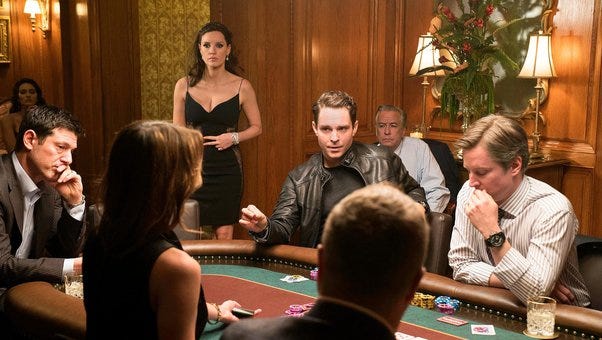
Molly’s Game
A curious thing that Molly’s Game and Phantom Thread have in common (along with Darkest Hour, which I also reviewed recently) is their lack of exterior shots. They are films about lives of indoor work, lives lived under a sense of threat, lives lived hidden that find expression in particular kinds of creativity: fashion design, event organisation, politics.
The people and the environments could not be more different, of course. Molly’s Game takes place in Los Angeles and New York earlier this century, tracking the rise and inevitable fall of Molly Bloom, the young queen of the underground poker world: no player herself, but the creator and host of high-stakes games for very wealthy, sometimes very obnoxious, men.
If Aaron Sorkin (in his directorial debut) is a bit self-consciously Danny Boyleish for the first half of the movie, as snappy visually as he always has been with dialogue, he nevertheless keeps what is essentially a business story, devoid of physical drama or expressed emotion, moving well; and he manages to convey the gist of poker itself very effectively without slipping into tedious didacticism.
Perhaps the movie gets a tad predictable later on when it starts to over-emphasise its feminist theme (Molly as the victim of the “unfair whims of men”), but even then it is saved by some outstanding performances: Jessica Chastain in the title role, Idris Elba as her lawyer, Michael “Arrested Development” Cera as a selfish, cocksure Hollywood star who joins the games, and above all — unexpectedly — Kevin Costner as Molly’s father.
They are not quite enough, though, and we are left with the impression that we have just seen a very clever exercise in film-making, rather than anything heartfelt or any rounded portrait of a real person.
As so often, Sorkin (who of course also writes as well as directs) seems more fascinated by power and success than interested in believable human nuance; an opportunity is missed to exploit the contrast between the characterless luxury of five-star suites and the fierce, controlled emotions of the poker players.
But it’s nevertheless absorbing, both in its overall trajectory and in the way individual scenes unfold.
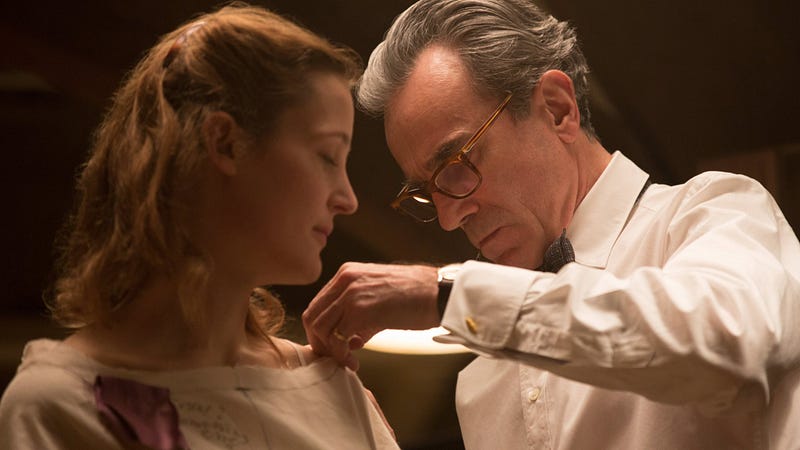
Phantom Thread
As distant as it could be in its setting — the world of haute couture in late 1940s London — Paul Thomas Anderson’s Phantom Thread is nevertheless, like Molly’s Game, all about the pursuit of power. But here it is of two subtler kinds.
There is the way that Daniel Day-Lewis’s irascible, ruthlessly obsessive dressmaker seeks power over materials (and perhaps women, and society) through his creations, trying to reduce the world to measurements and designs.
And then, taking the film in directions we sometimes don’t expect, there is the three-way struggle for ascendancy in his household among Day-Lewis, his new assistant Vicky Krieps, and his sister Lesley Manville.
All of them are compelling, especially Manville, and they lift what could otherwise be a slightly over-theatrical melodrama.
Anderson creates a claustrophobic, inward-looking world (the recently-concluded war is barely mentioned) that reflects the characters and their conflicts; the most important scenes in the movie are built around the idea of disrupted perfection, perhaps most strikingly when the word “fucking” seems to tear the cold politesse to shreds.
But by and large he lets the people speak for themselves, and the result is a strange and memorable film that leaves us intriguingly unsure whether we have just witnessed a meeting of monsters, or a love story.
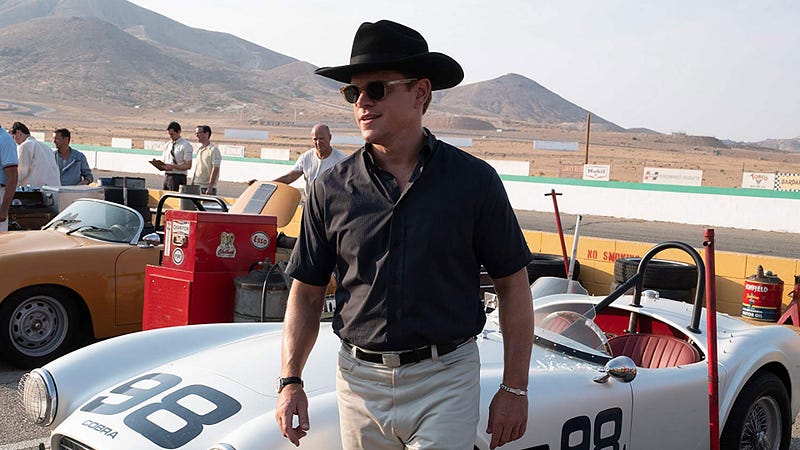
Le Mans ’66
Motor racing has been so outstandingly presented at the cinema in the last decade by Rush (2013) and the documentary Senna (2010) that the bar is raised high for Le Mans ’66, James Mangold’s tale of late-1960s drivers and auto designers.
Disappointingly, though, this well-turned-out but largely flat and superficial movie falls quite a way short not only of those two, but also of previous work by Mangold (3:10 to Yuma, Walk the Line) and lead screenwriter Jez Butterworth (Black Mass).
In its combination of carefully-crafted period detail with sporting tension it reminded me, in fact, of nothing more strongly than the Billie Jean King movie Battle of the Sexes, only without the nuanced performances or the social commentary.
Misleadingly also known as Ford v Ferrari, Le Mans ’66 does indeed take as its starting point the Ford Motor Company’s abortive attempt to acquire the Italian carmaker and its racing team, hoping that such glamorous associations will rub off on its more everyday products and strengthen their appeal to young consumers.
When the takeover is rejected, Ford decides to produce and race its own cars, and it is the discord between the executive suits and the (predictably) maverick, (predictably) sympathetic team assembled for the project — rather than the rivalry with Ferrari — that really forms the meat of the film.
That team is led by Matt Damon, even blander than usual; much more magnetic is Christian Bale as the loose-cannon driver. He overdoes his Englishness for an American audience, and can verge on caricature, but he gets far more revealing solo moments than Damon is allowed, and he’s always eminently watchable. So are a very Mad Mennish John Bernthal as Ford VP Lee Iacocca, Tracy Letts as Henry Ford II (not quite the stick-in-the-mud he seems), and Caitriona Balfe as Bale’s wife.
Of course, a film like this lives or dies on its driving sequences more than on any one character, and they don’t fail to satisfy. But even so, there’s something ineluctably trivial about the whole movie (underlined by a jolly, often twangy score by Marco Beltrami which certainly doesn’t take proceedings too seriously).
Conflicts are never quite as tense as they should be; comedic moments tend to defuse dramatic potential; the fact that the underdogs and the big corporation are ultimately on the same side makes it difficult to get very passionate about their disagreements; for long stretches Mangold and Butterworth dole out one unsurprising turning point after another, rather than giving us any sense of events progressing organically, of cause and effect genuinely arising from the characters and the situations.
None of this is helped by the cinematography, which throughout has the aura of Disney live-action features a few decades ago: strong colours, concentrated lighting, and a very flat depth of field which seems to confirm Mangold’s lack of interest in the details (both visual and thematic) that surround his lead characters.
Wholly competent, agreeable enough, occasionally exciting, Le Mans ’66 nevertheless lacks both the depth of insight and the epic grandeur that its two-and-a-half-hour running time suggests it might have aspired to. It’s easy to conclude that a more modest tale, allowing itself space to explore a few characters and situations rather than rushing around sketching in a lot of them, would have made a better movie.