
Three Books About the Romans That I Read and Loved
Ars longa, vita brevis
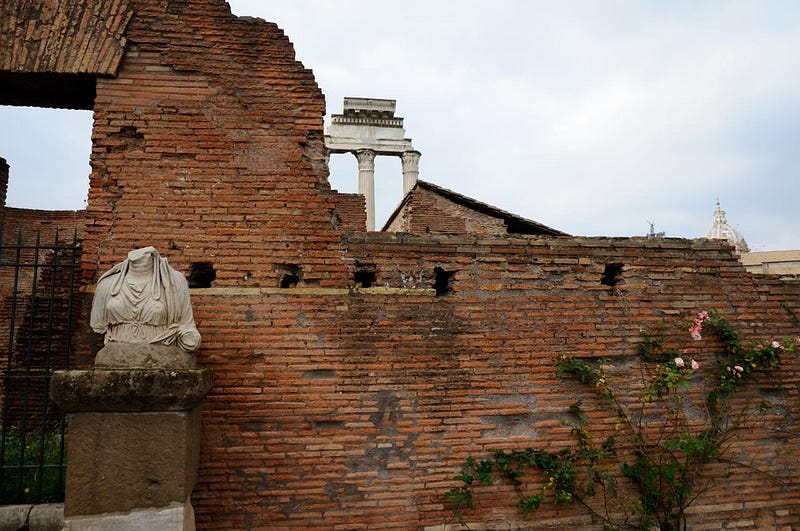
Carpe diem! (Seize the day!)
Cogito, ergo sum! (I think, therefore I am.)
In vino veritas! (In wine, there is truth.)
I’m sure you knew if not all, at least two of the sayings above. These are almost as famous as Emperor Augustus himself. Or maybe I should say Caesar as he was the more famous of the two. We use them in all kinds of contexts nowadays: in conversations with friends, in philosophical discussions, in plays, in politics, and so on. They are ubiquitous.
They are echoes of another era and we have somehow managed to keep them alive and gracefully integrate them into our current discourses. They also remind us of bygone times of glory and God knows how much we humans crave to find sources of wisdom in the much-romanticized past.
But how much else do we actually know about the Romans?
We know the story of Pompeii for sure as it was so very tragic and finding the remains of such a catastrophe as that 2000-year-old eruption presents endless fascination nowadays. We know that senators wore white togas and that after winning wars Romans used to build columns to depict their fights on them.
What else?
We know that Caesar had an affair with Cleopatra and that Marcus Aurelius was a philosopher and maybe some other random bits and pieces that we can’t really put together to have a more comprehensive vision of Roman times.
There are however a few people who took their passion for the Roman times further and they decided to write books about them. So, if you want to add some of the missing pieces to the puzzle called “The Romans”, you can try reading any of these three books that I am going to recommend below:

‘SPQR: A History of Ancient Rome’, by Mary Beard
Goodreads rating: 4.04 stars
My Rating: 5 stars
Genre: Non-Fiction
“[…] spanning nearly a thousand years of history, this “highly informative, highly readable” (Dallas Morning News) work examines not just how we think of ancient Rome but challenges the comfortable historical perspectives that have existed for centuries.” (Goodreads)
Mary Beard’s book is a real gem. Not only does she explore the stories and the myths, but she also comes up with her own interpretations of some of the controversies. Since she is a real connoisseur of the history of the Romans, it is a real pleasure to explore that age through her writing.
This is an excerpt from what I wrote on Goodreads immediately after finishing this volume:
“I truly enjoyed learning details that I have not heard about anywhere, like the fact that the Latin term for wolf (“lupa”) was also a colloquial term for prostitute.
Mary Beard is wondering in a very humorous and clever way whether it could be that Romulus and Remus were actually rescued by a whore and not by a wolf (which seems to stand to reason more than the version we know now) and whether it cannot be that the story was not translated well or just misunderstood at some point and dispersed so.
Also, she writes about Roman words that are famous nowadays still (and what they meant in the Roman context when they were first said), she talks about graffiti on the walls of bars, about how using Alexandrian know-how, Caesar established a year with 365 days, with an extra day inserted at the end of February at the end of every four years, adding humorously that “this was a far more significant outcome of his visit to Egypt than any dalliance with Cleopatra”.
She also talks about the masses, the poor, and the women even though there are not many records about them. And about so much more.”
Some quotes I liked:
And togas were white, with the addition of a purple border for anyone who held public office. In fact, the modern word ‘candidate’ derives from the Latin candidatus, which means ‘whitened’ and refers to the specially whitened togas that Romans wore during election campaigns, to impress the voters.
Child labour was the norm. It is not a problem, or even a category, that most Romans would have understood. The invention of ‘childhood’ and the regulation of what work ‘children’ could do only came fifteen hundred years later and is still a peculiarly Western preoccupation.
‘Memoirs of Hadrian’, by Marguerite Yourcenar
Goodreads rating: 4.23 stars
My Rating: 5 stars
Genre: Fiction (Historical Fiction)
In it [“Memoirs of Hadrian”], Marguerite Yourcenar reimagines the Emperor Hadrian’s arduous boyhood, his triumphs and reversals, and finally, as emperor, his gradual reordering of a war-torn world, writing with the imaginative insight of a great writer of the twentieth century while crafting a prose style as elegant and precise as those of the Latin stylists of Hadrian’s own era. (Goodreads)
Unlike my first choice here, this book only focuses on the reign of Hadrian, the emperor known for his interest in art and literature.
Yourcenar’s prose is poetic and there are turns of phrases that are highly likely to stop one in his tracks. She decided to write this book after seeing some of Piranesi’s etchings of Rome, one of which was depicting Hadrian’s Villa.
We have no way of knowing if emperor Hadrian was very much or very little alike to the version that this French writer has imagined, but her book definitely sheds some light on the atmosphere of the times. It also makes one’s imagination travel back in time and live among Roman citizens, understand some of their foibles and their way of seeing life.
Some quotes I liked:
Our great mistake is to try to exact from each person virtues which he does not possess, and to neglect the cultivation of those which he has.
I knew that good like bad becomes a routine, that the temporary tends to endure, that what is external permeates to the inside, and that the mask, given time, comes to be the face itself.
‘Augustus’, by John Williams
Goodreads rating: 4.23 stars
My Rating: 4 stars
Genre: Fiction (Historical Fiction)
Sprung from meticulous research and the pen of a true poet, “Augustus” tells the story of one man’s dream to liberate a corrupt Rome from the fancy of the capriciously crooked and the wildly wealthy. (Goodreads)
Augustus was the first Roman emperor. He was Julius Cesar’s nephew and the founder of the Roman Empire. The month of August was named so after him.
If you go to Rome and you take a guided tour of the Roman Forum, you will definitely get to hear a lot of interesting details about his palaces situated on Palatine Hill, his marriage to Livia Drusilla, and his disappointment in regards to his daughter Julia.
This book will get you acquainted with Augustus, the emperor, but also with Augustus, the father, and Augustus, the human being.
He had ambitions just like any other mortal, but also flaws, and he was constantly under the mighty power of memories, just like any one of us. He is depicted by John Williams as both a God and a torn man, and this portrait makes him more palpable, more devastatingly real.
Some quotes I liked:
One does not deceive oneself about the consequences of one’s acts; one deceives oneself about the ease with which one can live with those consequences.
A man may live like a fool for a year, and become wise in a day.
Conclusion
By the time you turn the last page of any of these books (especially the first one), you’ll have a more complete picture of the Roman times than ever before. By reading them you’ll get to find a lot of details that you have not stumbled upon before and you’ll also get to understand the contexts in which the sayings I started this article with were uttered for the first time.
If you enjoy reading stories like these and want to support me as a writer, you can sign up for Medium using my referral code.