
Thoughts on Anna Karenina
Does the classic hold up as one of the greats?
Leo Tolstoy’s Anna Karenina was first published in 1878 and still tops lists of recommended classics. Looking for something new to read, I decided to try my hand at one of the supposed greatest literary novels of all time.
The novel was originally written in Russian, and both Moscow and St. Petersburg feature prominently. While I try to steer clear of spoilers, the story deals with themes like family, the relations between spouses, the differences between city and countryside, contemporary politics, and religion.
This is a broad range of subjects and I found not every part resonated with me in the same way. That of course has to do with the fact that I am from a completely different time and society, so, as an example, I do not have strong feelings about the techniques employed in 19th-century agriculture.
The above is not necessarily intended as a slight against the book, but there being so much in it, means there is simultaneously a lot to enjoy and a risk that a plot element doesn’t quite hold your interest. Initial expectations might be that the book is only about the love life of the titular Anna Karenina, but there is far more to it.
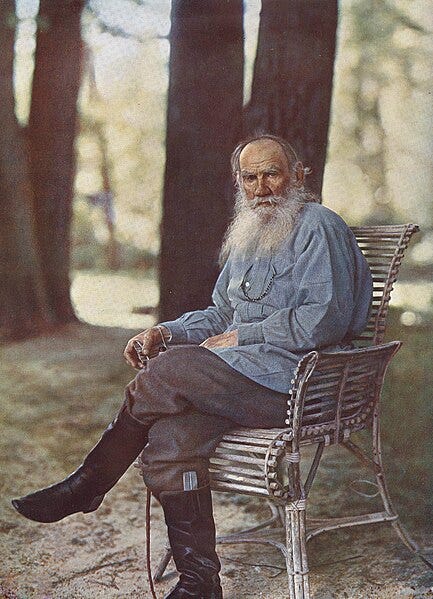
Contrary to what the title suggests, there are close to 10 “main” characters, meaning their perspective is taken and they feature prominently in the plotlines of other characters. The most important one, besides Anna, is Konstantin Levin, who in particular represents the attitudes of the author (Tolstoy’s first name in Russian is actually “Lev”).
Keeping track of all characters is probably the biggest challenge the book poses for non-Russian readers; both for a lack of familiarity with Russian naming conventions and the fact that characters can be referred to by their first name(s), their family name or a nickname.
The characters are however also where the enduring strength of the book lies: the way they are fleshed out with all their thoughts, emotions, and flaws is remarkable. None of them are entirely likable or unlikeable, and most of them go through some form of development in their thinking or circumstances.
The main characters tend to be wealthy and hold high positions, so their time is often spent on social events, long discussions, and keeping up appearances. This is especially poignant when it comes to matters of religion and extramarital affairs, with Anna Karenina’s relationship with Count Vronsky being a central plotline.
Because the viewpoints are varied and any subject tends to be discussed with arguments both for and against, I found the ideas presented overall quite nuanced. You get a sense of how people back then used to think and it is often clear what the author ultimately landed on, but the considerations usually did not feel dogmatic or limited.
What does feel outdated is how the women in the story tend to be on the emotional side, though of course their very position in society was restricted to having children and managing the household. It does speak for Tolstoy that his female characters are at various times quite intelligent and insightful, and aware their position isn’t always fair.
It also bears mention that I was pleasantly enjoyed by the actual readability of the work. Though my copy was over 800 pages and it took me some months to complete it, the reading sessions were enjoyable. The book is split into 8 parts and more than 200 chapters, meaning it’s easy to segment your reading.
The translation obviously matters a lot, I purposely chose a modern one by Pevear and Volokhonsky (from 2000). It came with a list of notes and references in the back, to help make sense of particularly the political and ideological references made.
Another translation that might be worth considering came from Louise and Aylmer Maude, who were personal friends of Tolstoy and published their translation in 1918. In that sense, it probably is the translation the author would support the most.
I came out of the book feeling that I had spent time with its characters, as their thoughts and feelings are set to paper so intimately. That time has now come to an end, but I expect to think back to them from time to time. I might seek out one of the novel’s many film adaptations, though I do not see how its full scope can be done justice in that form.
In any case, I ultimately found reading Anna Karenina a rewarding experience.


