
Those With the Biggest Balls
Nature’s Iron Man
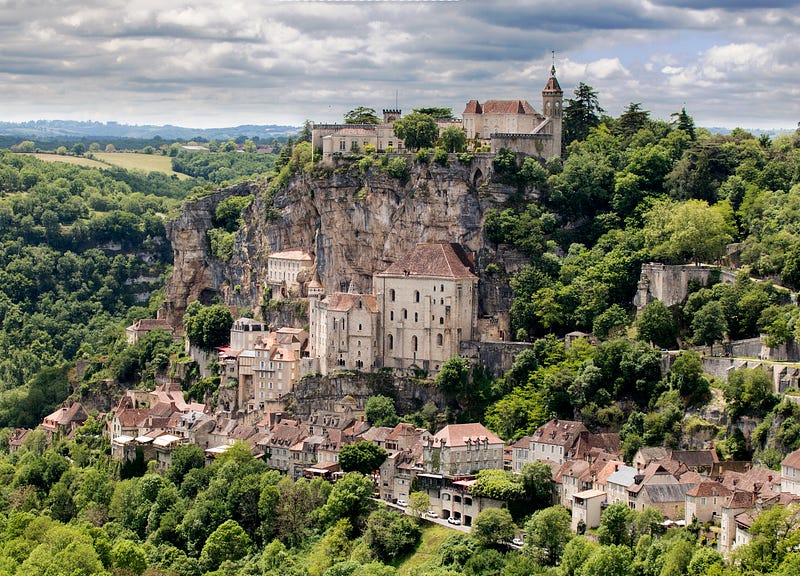
From my home, it is an eight-mile walk along the famous St Jacques de Compostelle pilgrimage to the ancient monastery of Rocamadour. It is a route that has been trodden by pilgrims for over a thousand years.
Along that eight-mile section, the path winds through a steep-sided valley that looks like it was sliced by a giant with a very large knife. The valley is dotted with ruined flour mills that would once have enabled their owners to make a good living selling bread to passing pilgrims.
For those a little more in the know, there is an alternative route to the medieval monastery village. Instead of following the traditional trail, one can skirt it along the tops of the cliffs, and though a fall would probably prove fatal, the views are far more breathtaking than those afforded in the depths of the valley.
Second-Hand Dreams
When my daughter was a child, I would take her along the cliff tops on wildflower counts. In spring, the trail is bejeweled with wild orchids, lilies, and dozens of members of the daisy family. Like many parents, I hoped that my daughter would pick up on some of the dreams that I had failed to fulfill.
In my case, anything with the letters ‘ist’ at the end. Botanists, herpetologists, or entomologists all held equal appeal. In my mind, I had visions of myself acting as a porter for my daughter’s equipment as she wandered into the Amazon jungle in search of rare tree frogs or obscure insects.
My daughter humored me to a certain extent, but she wasn’t buying into my dreams. The selfish little bugger had dreams of her own, and they revolved around the world of fashion.
Somehow, the idea of trailing after her to fashion shoots carrying boxes of stilettos or gorgeous dresses wasn’t quite as alluring as the rain forests of Brazil. The divergence of our dreams was brought home to me on one of our wildflower quests along that clifftop trail.
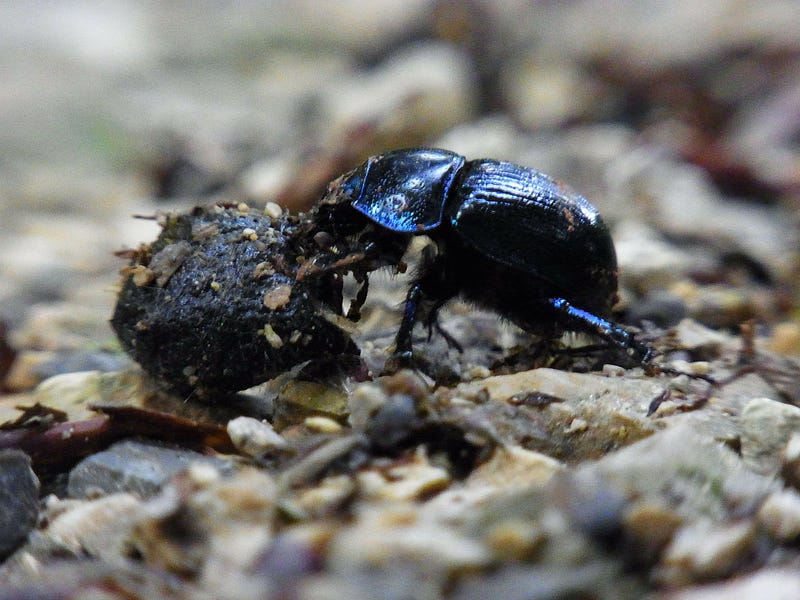
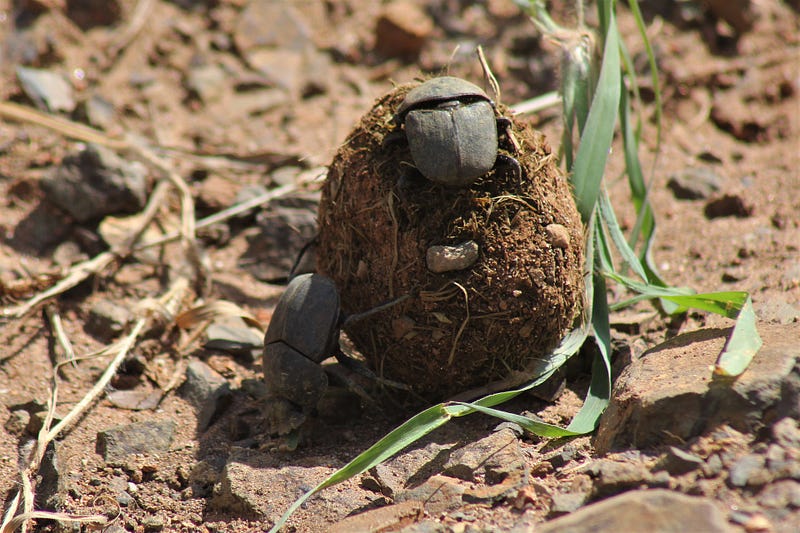
To my delight, I spotted a pair of dung beetles heroically pushing a ball of dung along the same trail that we were traveling. Dung might be an overly polite word in this case. What they were pushing was, in fact, a balled-up dog turd.
My ecstasy was short-lived once my daughter came to see what it was that was making me so animated. Little girls have a way of saying ‘eww’ that is so gloriously descriptive that even the greatest poets would curl their toes with jealousy at their eloquence. I knew then and there that an ist career was unlikely.
The Strong Man on the Planet
To say that dung beetles are amazing creatures is an understatement. They exist on every continent except Antarctica, and they play a crucial role in recycling excrement.
The introduction of cattle to Australia, for example, proved too much for their local dung beetles, who were accustomed to processing much smaller deposits. This soon led to a deterioration of the soil, a massive increase in the number of flies, and the wearing of really ridiculous looking hats.
The introduction of larger African dung beetles has helped turn that situation around considerably.
In Texas, up to eighty percent of cattle dung is recycled by these industrious creatures. That is critical to keeping the fly numbers low and the pastures healthy. There are even studies suggesting that their efforts contribute to keeping down greenhouse gasses.
Rollers, Tunnelers, and Dwellers
There are three types of dung beetle. Rollers roll a ball of dung, and when satisfied with its size and shape, they bury it, lay their eggs inside, or use it as a food source.
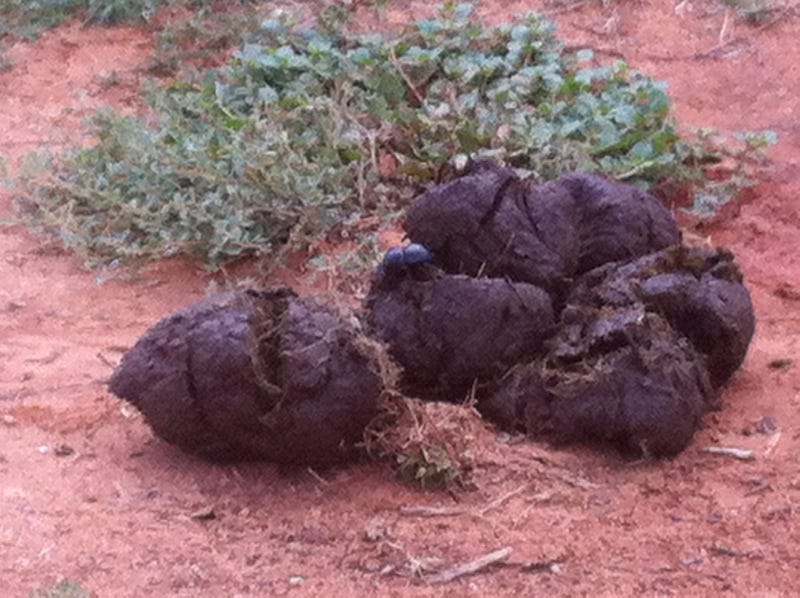
Dwellers burrow into the dung and take up residence. Tunnelers bore through the dung and create chambers underneath. There, they lay their eggs and actually remain with the larvae until they mature. It’s such a type of parenting that is extremely rare in the insect world.
Perhaps even more amazing still, the beetles can navigate using the sun and the stars. If they get lost, they climb onto the ball they have been wrestling with, and eye the sky to regain their sense of direction, before continuing their journey.
Getting lost is a bit of an occupational hazard when walking backward with you, head down while pushing a giant rolled up turd. They are also extremely strong, and their efforts make Atlas appear something of a wussy.
The Taurus dung beetle can move a dung ball up to 1141 times his own body weight. This easily wins him the award for being the strongest insect on the planet.
Often the beetles will find a mate at a pile of fresh dung. Here, the females tend to hang out, making small talk and surreptitiously eyeing out the talent. Of course, they are attracted to the males with the biggest balls. Once a female pairs with a male, the two move off with their dung ball.
She either helps him with rolling it, or she just sits on top as he does all of the hard work. No doubt, while doing so, she offers useful navigational tips, which may be why they get lost so often.
They prefer feces from omnivores, probably, because they locate it by the sense of smell, and that poop of omnivores is stronger than boring old herbivore dung.
To Conclude
You would think that once exposed to such a fascinating creature, my daughter would not be able to help but consider one of those ist-type careers. Nope. All she saw was a smelly little ball made from dog poop.
Today, she works in the fashion industry while I marvel at nature alone, still dreaming of hunting tree frogs in the Amazon.


