
Thomas Jefferson’s Four-Percent Solution
How To Maximize Production Of Domestic-Bred Enslaved People
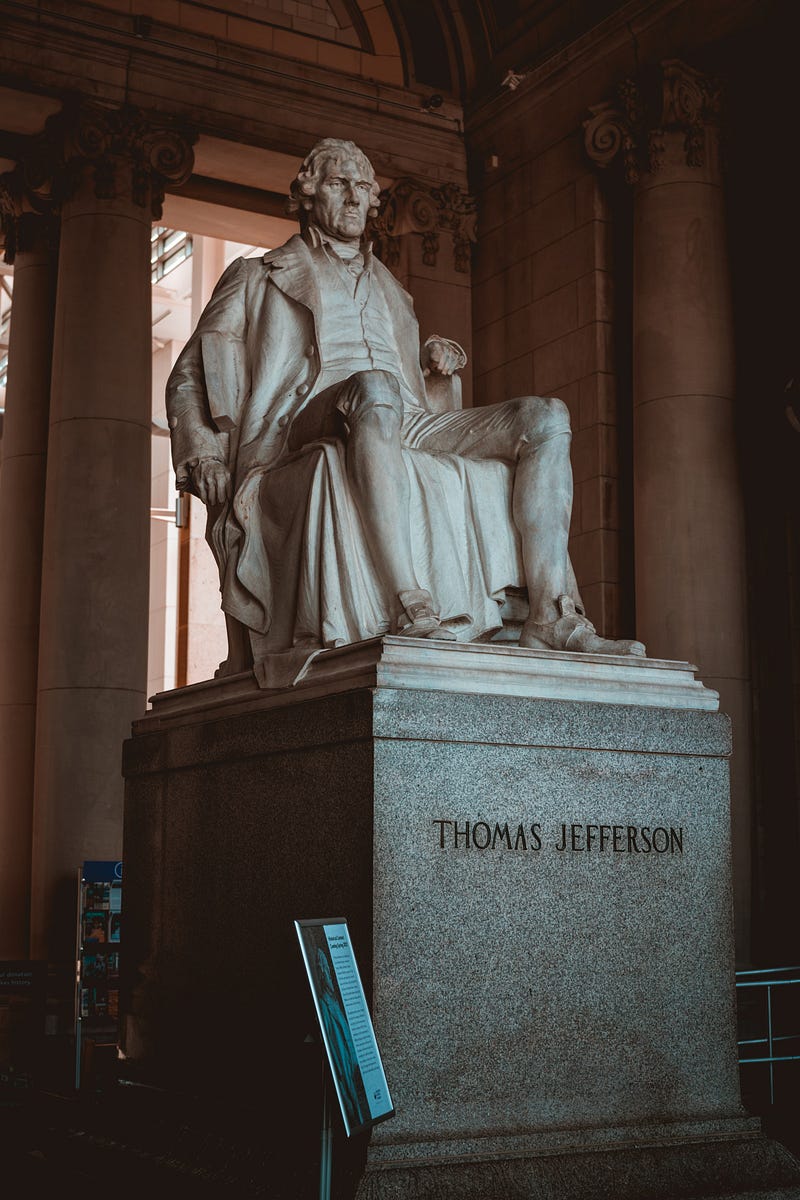
“I allow nothing for losses by death, but, on the contrary, shall presently take credit four percent. Per annum, for their increase over and above keeping up their numbers.” — Thomas Jefferson.
Fictional character Sherlock Holmes often injected himself with a seven-per-cent solution of cocaine to put himself in a certain frame of mind. The real-life Thomas Jefferson had a four-percent solution, four percent being the annual increase in profits he could make from breeding enslaved people.
It should be noted there was a time when Jefferson spoke and wrote of the elimination of slavery. Jefferson regarded the slave trade as “execrable commerce …this assemblage of horrors,” a “cruel war against human nature itself, violating its most sacred rights of life & liberties.” There were passages he intended to include in the Declaration of Independence that called for the same, but slave states South Carolina and Georgia rejected his words. Within the next decade, Jefferson became silent on the subject.
“One cannot question the genuineness of Jefferson’s liberal dreams. He was one of the first statesmen in any part of the world to advocate concrete measures for restricting and eradicating Negro slavery.
But in the 1790s, the most remarkable thing about Jefferson’s stand on slavery is his immense silence.” And later, Jefferson’s emancipation efforts virtually ceased.” — Historian David Brion Davis
So what happened between Jefferson’s desire to end slavery gradually in 1776, when he wrote most of the Declaration of Independence and when the Constitution of the United States was signed in 1787? Jefferson had significant input into the Constitution, including writing letters to James Madison, who penned most of the Constitution and refusing (along with Patrick Henry) to accept it unless a Bill of Rights was added, which it was. Given his advice on slavery to others, including George Washington, it’s clear that the thoughtful Jefferson observed how profitable slavery was; in particular, the breeding of enslaved people to have every enslaved woman produce a child every two years.
“I consider a woman who brings a child every two years as more profitable than the best man of the farm; what she produces is an addition to the capital, while his labors disappear in mere consumption.” Thomas Jefferson
Jefferson did more than notice the profitability of breeding slaves (many forcibly, i.e., via rape). He did more than any other human to make the domestic breeding of enslaved people more profitable. The Constitution included a clause that guaranteed the International Slave Trade could not be eliminated for at least twenty years. That clause was a deal-breaker for South Carolina in particular, where Charleston imported more enslaved people than any other port in the nation. Jefferson ended the International Slave Trade in America on the very day the twenty years expired, claiming it was based on humanitarian reasons.
“I congratulate you, fellow-citizens, on the approach of the period at which you may interpose your authority constitutionally to withdraw the citizens of the United States from all further participation in those violations of human rights which have been so long continued on the unoffending inhabitants of Africa, and which the morality, the reputation, and the best interests of our country, have long been eager to proscribe.
Jefferson’s concern for the violations of human rights of African slaves didn’t extend to those already in America. He had no plan to eliminate enslavement in America when demand was higher than ever before. How would America meet that demand? By forcibly breeding female slaves to meet the market with his goal being a child produced every two years. While many enslaved people selected their mates, many more were subjected to the process of pairing “bucks” and “breeders.” There was also the established practice of masters mating with those they owned. The light-skinned offspring of these men became “house-niggers.” Some of the girls became “fancies” to meet the sexual needs of white men. Jefferson believed in the friends and family plan, allowing his younger brother Randolph who lived twenty miles away at Snowden Plantation, to roam Monticello’s slave quarters at night, playing the violin, drinking, dancing, and sleeping with whomever he chose. Thomas Jefferson himself had six children with the mulatto he started raping at age fourteen, Sally Hemings. Four of those children lived to adulthood.
Plantation owners in Virginia, Delaware, and Maryland were finding tobacco production wasn’t nearly as possible as before, and they hadn’t rotated crops and had ruined the soil. Raising tobacco is labor intensive, and they found they had excess slaves based on reduced tobacco production. The solution was to sell those slaves further South, meeting the needs of cotton, sugar, and rice producers who needed all the slaves they could get. They followed Jefferson’s model, “growing” slaves and then tearing children from their families to work elsewhere. The value of a child was based on height and weight, which is why the biggest and strongest of the enslaved were selected to have big and strong kids.
The abnormally high birth rate of enslaved people in America is well-documented. Many historians called it “natural increase: when there was nothing natural about it.
If I haven’t made it clear, much of the economy of the United States was based on the rape of Black enslaved women. The exportation of enslaved people surpassed that of tobacco, with slaves becoming the leading export of Virginia. Don’t be fooled by the fact that Thomas Jefferson was broke when he died. He overextended himself with the continual additions to Monticello, the purchase of books, and the construction of the University of Virginia. Jefferson got very rich from slavery; besides tending to his fields, they operated a nail factory at Monticello where teen boys were whipped to ensure profitability. Historian Edwin Betts tried to hide the documentation, but it eventually came to light.
In 1988, oddsmakers and television commentator Jimmy the Greek got in trouble for saying,
Blacks are better athletes than whites because they have been bred to be that way; the only thing left for the whites is a couple of coaching jobs.” — Jimmy the Greek.
I submit what he said wasn’t all that wrong; he got in trouble for calling out an inconvenient truth that wasn’t to be examined.
“I should have expressed myself a lot better than I did today.” — Jimmy the Greek.
Thomas Jefferson would have understood what Jimmy meant, and the economics behind it.


