
This Year I’m Not Setting Goals: I’m Creating Practices
How to make sure you get where you want to be by focusing on the process instead of on the outcomes
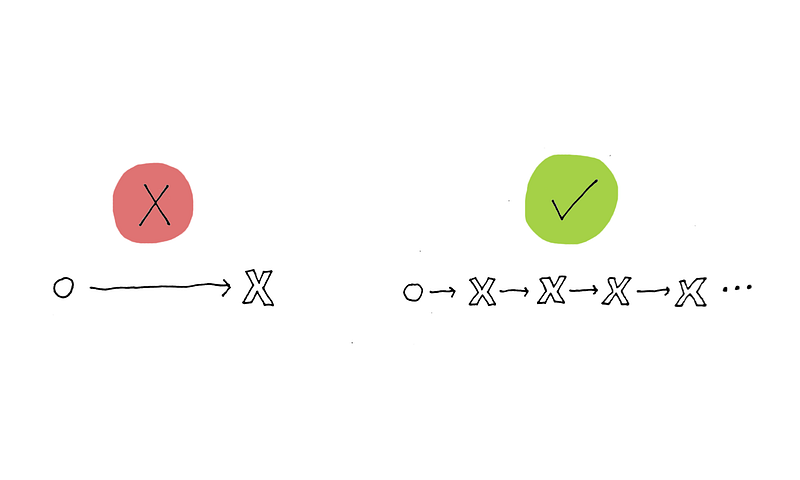
Every time I set yearly goals, I end up either forgetting them, changing them, or quitting them altogether.
Why does this happen?
My theory is that my goals are either too complex, too many, not clearly actionable or not completely under my control.
I remember setting goals in past years such as “earn X amount of money” or “get X amount of email subscribers”. When you first look at these goals they might seem clear and specific; but when you take a closer look, you find they are problematic because of the following reasons:
- They are outcome-focused. What are the steps required to “earn X amount of money”? If this isn’t clear from the beginning, there will be resistance.
- They are dependent on external factors. No matter how much work I put in, I ultimately can’t decide how many people will join my email list.
When you focus too much on outcomes, it’s easy to get overwhelmed by unexpected complexity or lost without clear next steps. When success and failure depend on something outside your control, it’s easy to get demotivated and frustrated.
So, what’s the alternative?
It’s Not About the Weight You’re Going To Lose: It’s About What’s for Lunch Today
That is why this year I’m not setting goals.
Instead, I am focusing on building practices.
More than that: I am only going to focus on building three of them for the whole year — one every three months (with three extra months at the end for maintenance and consolidation).
What Are Practices, and Which Ones Am I Building in 2021?
Practices are habits. They are activities you choose to dedicate time to every single day or with a set frequency of your choice. They are actions instead of goals. They are process-focused, and their completion is 100% within your control.
My three practices for 2021 are:
- Embodiment: Spending time every day engaging in activities that bring me back to my body and the present moment (eg. meditation, walking, playing music, yoga, etc.)
- Content creation: Dedicating time every day to focused learning, effective note-making, and writing
- Kindness: Engaging in daily activities that help me develop empathy, listening skills, and the ability to be kind (such as brahmavihara meditations, practicing nonviolent communication, helping friends out with their projects, etc.)
Actionability Over Specificity
If you’re used to setting SMART goals (or any other specific goal-setting framework), these practices may seem incredibly vague to you.
But the truth is, at this point in time, I don’t need them to be more specific because in their nature they are already actionable. As for other details — when, where, for how long, etc. — I prefer to leave space for exploration and experimentation as I progress on my path.
As an example, here is how my embodiment practice might develop:
Some days I might end up walking and doing yoga, others meditating and running. I might decide it’s OK to change activities every day as long as I do it for a set amount of time (eg. three hours a day), or I might decide on a specific set of habits related to embodiment and presence (eg. meditation and yoga every day).
My content creation practice, however, is much clearer. I’m quite sure I want to be dedicating time for learning, note-making, and writing every day, and I want to have an effective PKM system in place to make the process better and faster. I know I want to do it in the mornings, and I know it’s probably going to last anywhere between 1.5 to 2.5 hours.
My point is, when it comes to building practices, each case is different. Sometimes it’s good to be specific, other times it’s healthy to leave space for agility and discovery. Just make sure you focus on actions (eg. write 1,000 words a day) more than on outcomes (eg. finish my book).
How Did I Choose My Practices?
Here’s the thing: they all stem from goals I want to achieve or problems I want to solve, and that’s how I know they are worth pursuing.
For example: being in front of the screen too much and neglecting my body; wanting to develop my meditation practice; wanting to produce more content and expand my business; wanting to have better relationships and a more relaxed attitude towards life.
Knowing these, I asked myself: “What can I do to achieve/solve these things? What is the process? What are the actions I need to turn into habits?”
And then, I turned the answers to those questions into my actual goals.
How I’m Making My Practices Stick
The first principle I’m following is to start really, really small.
I’m already working on my first practice, and my first step was as small as taking ten daily conscious breaths. Then one sun salutation. Then a short walk. And then gradually, one small addition after another, I slowly grew it up to 30 minutes of meditation, 30 minutes of yoga, and a 1.5 hours daily walk (apart from other optional activities that I add occasionally and spontaneously like short HIIT sessions, breathing, and running).
Apart from starting really small, I am taking a playful, experimental approach.
I started by doing yoga in the morning, but lately, it’s been feeling better in the evening. I’m playing around with different techniques and getting feedback from my meditation teachers, which allows me to change things around when something doesn’t work. Basically, it’s not a “success vs. failure” approach, but a curious discovery of what works and what doesn’t.
Finally, I am balancing persistence and intention with gentleness and awareness.
On most days, I am meditating for 30 minutes. But when I really don’t feel like it, I just do ten. However, ten is my minimum, and I never go below that anymore. It took me a while to accept that ten minutes is enough, that I don’t have to be perfect every day. So now I listen to what my body is telling me, and I adjust accordingly.
By the End of 2021, I Want to…
The best and most surprising thing about these practices is that, if I manage to stick with them, I will make bigger progress towards my goals than I’ve ever made before.
How?
Because I’m focusing on action. Moving my body gently but consistently will bring me more results than working out super hard but irregularly. Learning and writing every day, no matter for how long, will bring me more readers and grow my business more than relying on short-lived bursts of inspiration.
It’s not about choosing a direction and randomly engaging in actions that might or might not lead you there. It’s not about doing more and bigger: it’s about choosing the right habits, and then patiently and consistently repeating them.