

This Week In The Economy: Impeachment Update, Govts Ramping Up Response To COVID Resurgence, China GDP Growth, Central Banks’ Caution
Welcome to a regular snapshot-review of U.S. and international economic news that aims to 1) provide a window into the challenges and decisions facing businesses today, 2) determine the direction of economic policy — such as the speed at which central banks decide to raise interest rates, and 3) assess what the impact will be for consumers.
U.S. Impeachment Update: February Trial?
Negotiations continue between new Senate Majority Leader Chuck Schumer and Republican Leader Mitch McConnell over the scheduling of ex-President Donald Trump’s impeachment trial. The U.S. House of Representatives voted to last week to impeach President Donald Trump over his role in events that led to the rampage through the Capitol building by his supporters on Jan. 6.
House Speaker Nancy Pelosi is expected to send the articles of impeachment to the Senate next week. A major concern for Senate Democrats is they do not want the proceedings to interfere with confirming President Joe Biden’s cabinet nominees, or legislating on his policy proposals to tackle the COVID-19 pandemic.
News reports indicate McConnell wants to give Trump’s legal team two weeks to prepare for the trial, meaning it would not take place until mid-February. It is not clear yet if Democrats will agree to the plan.
Given the 50–50 split in the Senate, Republicans continue to control the committees under the rules of the last Congress — until an agreement on power-sharing is reached — giving McConnell some leverage in the negotiations.
Approaching 100 Million COVID-19 Infections Globally, Over 400K Dead In U.S.
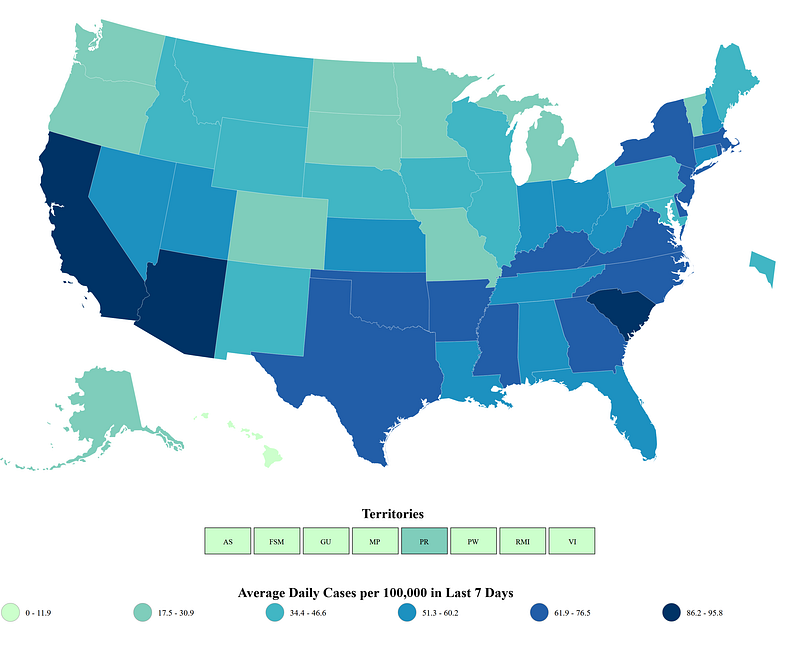
This week made for grim reading in the fight against the COVID-19 pandemic, pushing governments around the world to tighten restrictions on movement and business activity in an effort to extinguish rising infection rates that is keeping the number of confirmed COVID-19 cases uncomfortably high.
Globally, there have been 97,592,137 confirmed cases globally, with 41,668,339 active cases and 2,093,387 fatalities. The situation in the U.S. remains severe, causing President Biden to declare this week that “the Federal Government must act urgently and effectively.” At the time of writing there were 24,861,388 confirmed cases, 13,602,691 active and 413,259 deaths.
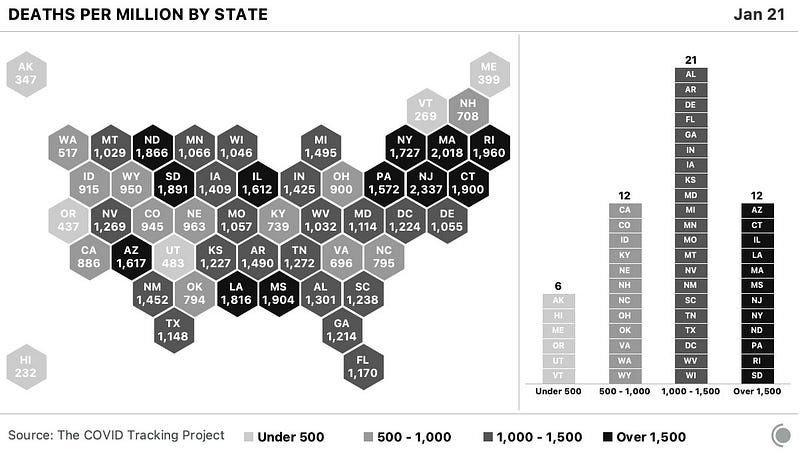
So far this week (from January 17–21), total new cases are below the 1 million mark, after being above in each of the prior two weeks. There have been 793,114 new COVID-19 cases in the United States, compared to 1,009,423 during the same five-day period last week. On Thursday alone, the U.S. reported 168,484 new infections — compared to 203,432 new cases on the same day last week.
This week President Biden signed an Executive Order mandating mask wearing byon-duty or on-site Federal employees; on-site Federal contractors; and anyone in Federal buildings or on Federal lands. He also directed the Department of Human and Health Services to develop a testing plan for the Federal workforce.
The White House also released the President’s ‘National Strategy’ for combating the pandemic, with the goal of ramping up testing, vaccinations, and tackling the shortage of critical medical supplies by expanding domestic production.
On to the outbreak rankings. India remains in second place, with its number of confirmed cases now at 10,626,586. Of that number, 190,277 are active and there have been 153,069 fatalities.
Brazil, where a more contagious mutation of the coronavirus has emerged, is in third with 8,699,814 cases at time of writing — 904,845 active and 214,228 deaths. Russia is fourth place with 3,677,352 confirmed cases, with 527,404 active and 68,412 deaths.
The United Kingdom, which is also dealing with the rapid spread of a new variant of COVID-19, continues in fifth place with 3,543,646 cases — 3,449,066 active and 94,580 fatalities.
France is in sixth place with 2,987,965 cases — 2,725,781 of that number are active, and there have been 71,998 fatalities. Spain has jumped up to seventh place with 2,456,675 confirmed cases, of that 2,401,634 are active cases and 55,041 deaths.
Italy is in eighth place with 2,428,221 cases — 516,568 active and 84,202 deaths. The country narrowly avoided yet another political crisis this week, with the governing coalition led by Prime Minister Giuseppe Conte holding to its narrow majority in Parliament, for now.
Turkey dropped down to ninth place — 2,412,505 cases, with 97,833 active and 24,640 deaths.
Germany is still tenth with 2,108,895 confirmed cases, 296,404 active and 51,151 fatalities. The German government announced this week that strict lockdown measures will remain in place until at least February 14, with the one change being that medical masks, like N95, not cloth masks are now mandatory for public transportation and in shops.
Economic Activity In China Ended 2020 On A Somewhat Positive Note
It looks like China will be the only major economy to have ended 2020 with positive growth, although the country is now battling its worst coronavirus outbreak since early last year.
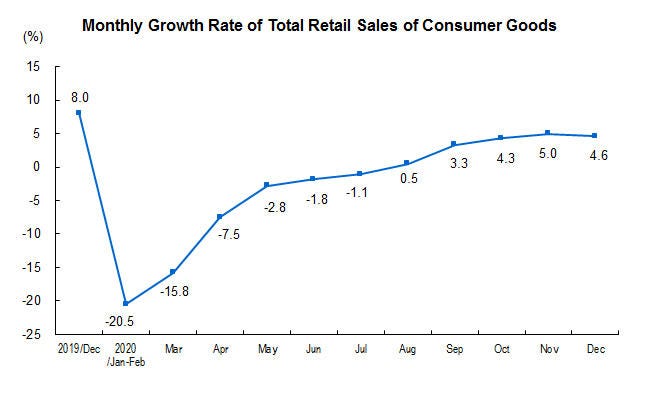
Gross Domestic Product (GDP) grew by 2.3% for all of 2020 compared to 2019. GDP for the first quarter fell by 6.8% while the country was in the midst of a massive lockdown, before rising by 3.2% for the second quarter, +4.9% in the third quarter and +6.5% for the fourth quarter.
Industrial production increased by 2.8% in 2020 compared to the previous year, and manufacturing activity surged 7.1% y/y. The recovery in the services sector was not as strong, with the pace of activity in 2020 unchanged from 2019. It did end the year on a positive note, increasing by 7.7% y/y in the fourth quarter.
Retail sales grew by 4.6% y/y in December, the same rate of increase for Q4, but were down by 3.9% for all of 2020. However, ecommerce sales jumped 10.9% y/y.
It remains to be seen how much the current COVID-19 outbreak will impact economic activity in the first few months of 2021, with millions of people back in lockdown and massive testing underway ahead of February’s Lunar New Year.
Elevated U.S. Unemployment Claims Level Does Not Bode Well For January Jobs Report
The number of Americans filing for state unemployment support continues to flood in at a worryingly-high level, with 900,000 first-time applicants reported for last week.
Last week is also when the establishment and household surveys for the Bureau of Labor Statistics’ employment report were conducted, meaning we can expect another weak jobs number for the entire month.
The number unemployed who continue to receive state unemployment assistance for the week ending January 9 was 5,054,000, compared to 5,181,000 the week before that. The federally-funded Pandemic Unemployment Assistance program, aimed at gig economy workers, reported 423,734 initial claims last week, +138,848 from the previous level.
The total number of Americans claiming some form of unemployment insurance for the week ending January 2 was 15,994,519, a decrease of 2,412,508 from the previous week, but compared to 2,278,239 weekly claims filed for benefits in all programs in the comparable week in 2020.
ECB Reaffirms Monetary Policy Support, Predicts Q1 Weakness
The European Central Bank’s Governing Council met this week and kept its very low interest rate policy and €1.8 trillion bond purchase program in place.
“The renewed surge in coronavirus (COVID-19) infections and the restrictive and prolonged containment measures imposed in many euro area countries are disrupting economic activity,” ECB President Christine Lagarde warned during a press conference after the meeting.
“Overall, the incoming data confirm our previous baseline assessment of a pronounced near-term impact of the pandemic on the economy and a protracted weakness in inflation,” she added.
Lagarde said incoming economic data, surveys and high-frequency indicators suggest the pandemic’s resurgence and the related ramping up of containment measures have likely led to a decline in Q4 2020 activity and are also expected to weigh on activity in Q1 2021.
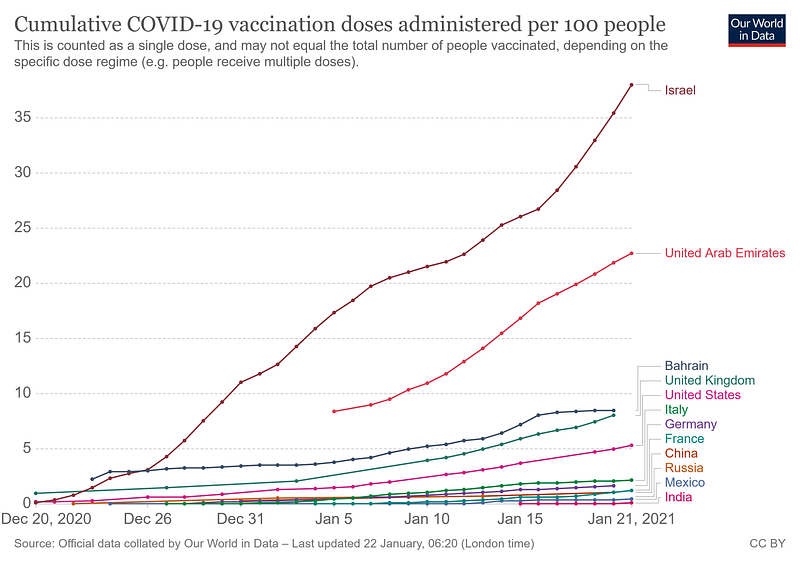
And while the rollout of vaccines means the downside risks to the eurozone economy are less pronounced, “it will take time until widespread immunity is achieved, and further adverse developments related to the pandemic cannot be ruled out,” Lagarde said.
Global Central Bank RoundUp: Cautious Optimism About Vaccine Rollout, With Wary Eyes on Resurgent Outbreaks
- The Bank of Canada left its interest policy unchanged this week, noting the continued “severe human and economic toll” from the pandemic in Canada. It cautioned that while the arrival of vaccines will save lives and livelihoods, “uncertainty is still elevated, and the outlook remains highly conditional on the path of the virus and the timeline for the effective rollout of vaccines.”
- The Bank of Japan’s Policy Board met this week and made no change to interest rates, its bond purchases, or its program to provide financing to businesses impacted by the pandemic. In its Outlook Report published after the decision, the BOJ said that while the economy is improving at a moderate pace, “downward pressure stemming from the impact of a resurgence of COVID-19 is likely to remain strong for the time being, particularly in face-to-face services consumption.”
- Brazil’s Central Bank also left its target interest rate unchanged, warning in a statement following the meeting this week that “indicators regarding growth at the end of last year have been better than expected, but they do not capture the effects of the recent increase in the number of COVID-19 cases.” Furthermore, “uncertainty about economic growth remains larger than usual, especially for the first quarter of this year, concurrently with the expected unwinding of the emergency transfer programs,” it said.
- Norway’s Central Bank is another monetary policymaker standing pat, declaring that “the sharp economic downturn and considerable uncertainty surrounding the outlook suggest keeping the policy rate on hold until there are clear signs that economic conditions are normalising.” The recovery is now being held back by higher infection rates and stricter containment measures, it noted, but added that with vaccinationwell under way, economic growth is expected to pick up further out in 2021.