
This Week In The Economy: Fed Signals Possible Rate Cuts Later This Year, Trump-Xi To Meet But Will It Make A Difference? ECB Promises Additional Monetary Stimulus
Welcome to a regular snapshot-review of U.S. and international economic news that aims to 1) provide a window into the challenges and decisions facing businesses today, 2) determine the direction of economic policy — such as the speed at which central banks decide to raise interest rates, and 3) assess what the impact will be for consumers.
Federal Reserve Signals Possible Rate Cut(s) This Year
The Federal Reserve’s policymaking body, the Federal Open Market Committee, met this week and signaled a possible rate cut in coming months over concerns about future economic growth and the slow rate of price inflation.
In its statement following the two-day gathering, the FOMC left interest rates unchanged but noted that uncertainties “have increased” about its expectations for sustained economic activity, strong job creation, and consumer prices rising by close to 2% annually.
“In light of these uncertainties and muted inflation pressures, the Committee will closely monitor the implications of incoming information for the economic outlook and will act as appropriate to sustain the expansion,” the FOMC said.
In a press conference after the meeting, Fed Chairman Jerome Powell laid out the factors that prompted the Fed to adjust its stance, including concerns about the strength of the global economy — with greater uncertainty as escalating trade tensions weigh on business confidence. Sentiment in financial markets has also deteriorated, he noted.
Fed officials are also worried about the sluggish pace of inflation, Powell said, with the slow rate of wage increases not enough to spur a return to 2% inflation. “Moreover, weaker global growth may continue to hold inflation down around the world,” he added.
“ My colleagues and I will be looking to see whether these uncertainties will continue to weigh on the outlook. And, we will use our tools as appropriate to sustain the expansion.” — Fed Chair Jay Powell
Trump-Xi To Meet At G20, U.S. Manufacturing Struggles Continue
The Fed cited uncertainties fueled by trade policies as one of the primary risks to its outlook for the economy. The main players in this saga, President Trump and Xi Jinping, are now expected to meet on the sidelines of the G20 leaders summit in Osaka, Japan next week.
The last face-to-face meeting between the two leaders — on the sidelines of the G20 gathering in Argentina last year — resulted in a temporary truce in the trade war. The hope is that this conversation will also lead to a pause in the tit-for-tat imposition of punitive import duties, policies that have been especially damaging to the manufacturing sector.
To underscore that point, data released this week showed activity in the manufacturing sector remains weak, as demand plunges and business confidence nosedives. Markit Economics’ widely-watched U.S. Purchasing Managers Index fell to its lowest level for over three years, with the group noting that “private sector output growth has lost momentum in each month since February.”
Activity in the manufacturing sector was the slowest since mid-2016, Markit said, with many respondents to its survey citing less favorable domestic economic conditions and greater risk aversion among some of their customers.
ECB Chief Promises More Monetary Stimulus If Sluggish Eurozone Growth Continues
The head of the European Central Bank this week vowed to maintain its aggressive efforts to encourage stronger economic growth within the euro area, and to do even more if needed to ensure price stability.
ECB President Mario Draghi warned the risks to the outlook for bloc’s economy remains tilted to the downside, with forward-looking data for the coming quarters pointing to “lingering softness.”
“ The risks that have been prominent throughout the past year, in particular geopolitical factors, the rising threat of protectionism and vulnerabilities in emerging markets have not dissipated. The prolongation of risks has weighed on exports and in particular on manufacturing,” he said.
“ In the absence of improvement, such that the sustained return of inflation to our aim is threatened, additional stimulus will be required,” Draghi added.
Financial markets reacted positively to the speech, but there was one individual who was less-than-happy:
The ECB’s Governing Council will hold its next monetary policy meeting on July 25th.
Japan, UK Central Banks Leave Rates Unchanged — Warn of Growing Risks
The Bank of Japan, central bank of the world’s third largest economy, said it will maintain its highly accommodative monetary policy for a prolonged period, citing a growing list of downside risks to the outlook for the global economy.
Key drivers of Japan’s economy, exports and industrial production, have shown some weakness due to slowdowns in other countries, the BoJ noted, and growth is likely to remain moderate.
“Downside risks concerning overseas economies are likely to be significant, and it also is necessary to pay close attention to their impact on firms’ and households’ sentiment in Japan.” — Bank of Japan
Its laundry list of risks include: U.S. macroeconomic policies and their impact on global financial markets; the “consequences” of protectionist moves; developments in emerging and commodity-exporting economies such as China, including the negative impact of higher tariffs; developments in global adjustments in IT-related goods; Brexit negotiations; and geopolitical risks.
Speaking of Brexit, the Bank of England’s Monetary Policy Committee also met this week, and the central bank warned the outlook for the UK economy will depend on a hard or soft Brexit.
Downside risks to growth have increased, the BoE said, with trade tensions intensifying on the global stage, while “the perceived likelihood” of a no-deal exit from the European Union has risen.
The UK economic outlook will continue to depend significantly on the nature and timing of Brexit, it said, particularly what the post-exit trading relationship between the EU and the UK looks like, whether the transition to is abrupt or smooth, and how UK households, businesses and financial markets respond.
Interest rate policy will depend on how this affects demand, supply and the value of the British pound, with the BoE stressing that its policy response to Brexit, when it finally happens, will not be automatic and could be in either direction.
Interestingly, the MPC gave a hint that it might be leaning towards raising interest rates should the UK government successfully pull off Brexit without any negative side-effects:
“Were the economy to develop broadly in line with its May Inflation Report projections that included an assumption of a smooth Brexit, an ongoing tightening of monetary policy over the forecast period, at a gradual pace and to a limited extent, would be appropriate to return inflation sustainably to the 2% target at a conventional horizon.” — Bank of England
U.S. Housing Sales Rebound, But New Home Inventory Growth Remains Sluggish
The National Association of Realtors this week reported a rebound in the sales of existing homes, up for the first time in two months. Falling mortgage rates are said to be fueling demand and encouraging more buyers to enter the housing market.
Total existing-home sales, including single-family homes, townhomes, condominiums and co-ops, jumped 2.5% from April to a seasonally adjusted annual rate of 5.34 million in May. Total sales, however, are down 1.1% from a year ago. The median existing-home price for all housing types in May was $277,700, up 4.8% from May 2018 ($265,100).
In terms of the construction of new homes, however, the news is less positive. Privately‐owned housing starts in May were at a seasonally adjusted annual rate of 1,269,000 — 0.9% below April and 4.7% below May 2018. Single‐family housing starts in May were at a rate of 820,000; 6.4% below the April figure of 876,000.
Germany Business Sentiment Continues Downward Spiral
The dark mood created by the negative effects of the U.S.’ protectionist trade policies continues to weigh on German businesses, especially its manufacturers and those who rely on exports to grow their business.
The ZEW Indicator of Economic Sentiment released this week fell sharply, reflecting worsening prospects globally as well as on the domestic front.
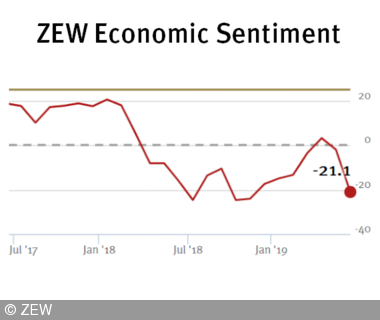
“The sharp drop in the ZEW Indicator of Economic Sentiment coincides with an increased uncertainty regarding the future development of the global economy and substantially worsened figures for the German economy at the beginning of the second quarter,” the group said in a statement.
“The intensification of the conflict between the USA and China, the increased risk of a military conflict in the Middle East and the higher probability of a no-deal Brexit are all casting a shade on the global economic outlook. On top of this, German industry has been reporting worse than expected figures for production, exports and retail sales for April,” it added.