
This Website Is Ripping Off Everyone’s Writing (Yes, Yours too)
No, we can’t sue.

Judging my writing career so far I’d say I’m still a few banger best-sellers away from becoming mandatory middle school reading — well I did write this one article about sex that made the first page on Hacker News (it was a smart take, for I am salacious, but also an intellectual) yet aside from that I wouldn’t call me famous. I’m more of a literary Batman. I operate in the shadows.
Still, I went and searched my stuff on this website¹, because I’ve heard they had no paywalls and more knockoffs than a Chinese sweatshop and, lo and behold, there I was.
For the delectation of the half a million people that visit it every month:
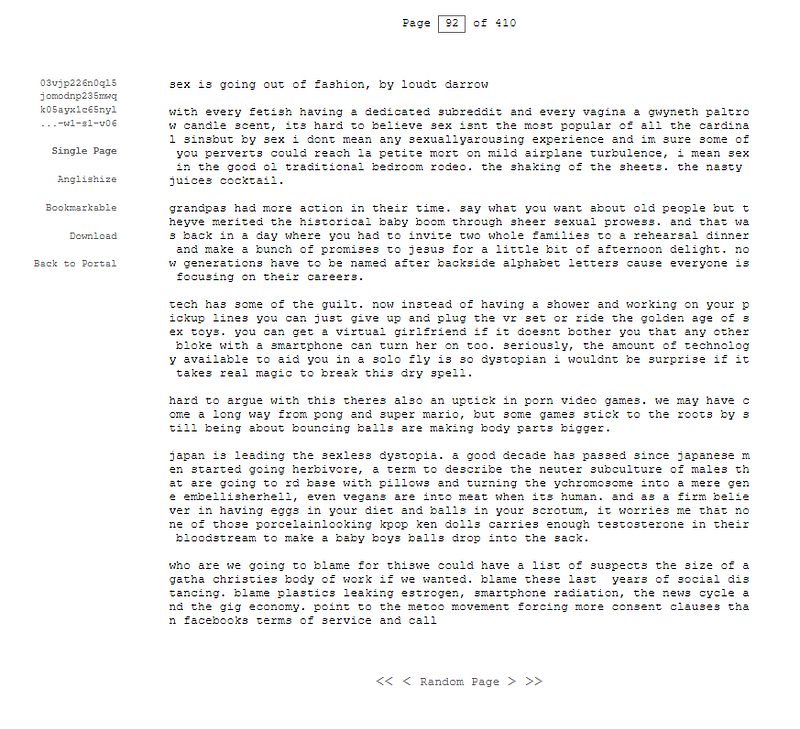
So if an unsung quip typist like myself was ripped off, I assumed the enchanting absurdism of Smillew Rahcuef was too. And the satirical wordmancy of Andrew Rodwin. And of course all of Sean Kernan and Felicia Sullivan and all the insert-big-name-here’s.
And they all are.
But worry not. This is not a code red. In fact, this is very very exciting, for reasons I’m going to disclose right about now.
Who are these people and why do they have everyone’s writing?
The good news is that no one’s placing pop-up casino ads all over your haiku poetry. Breathe.
In fact, the creators of the site had a pretty wholesome intention: to recreate the Library of Babel in web form.
For those of you who are not library connoisseurs, I am talking about the fictional library that Jorge Luis Borges imagined in one of his short stories. A universal library of inexhaustible dimensions, made of interminable halls and galleries containing every book that has ever been written. And every book that could ever be written.
So literally every piece of writing can be found on that website. From Shakespeare’s plays to shampoo instructions. Elon Musk’s entire body of work on Twitter and a faithful counterfeit of all those paywalled Washington Post articles.
But oh well, they didn’t ask for our permission to put our stuff in there, did they?
So why can’t we sue?
See, they aren’t ripping off our stuff by telling a guy to maliciously copy-paste everything into their servers. That would mean ungodly costs in Upwork fees and oh, a storage capacity so large it would make Dropbox’s entire server farm look like a floppy disk.
Instead, the site uses an algorithm that generates every permutation of the 26 letters of the English alphabet plus the space, the comma and the period. It doesn’t store anything on disk, it just organizes these permutations into virtual “books” of 410 pages, each page 3,200 characters long.
So every time you search for a piece of text, the site gives you a list of all the books that have an identical quote. And there are a lot of books, about 10⁴⁶⁷⁷ of them (for contrast, the observable universe only has 10⁸² atoms).
And now for the real mind-bending “aha” shock: the site has been up since 2002. So whatever you search for has been sitting there for 20 years. Including the stuff you think you wrote last week.
Wait — are we the ones ripping them off?
I know that sounds like a case not even Amber Heard’s legal team could make you lose, but I mean — look at the music industry.
Katy Perry almost had to Venmo $2.8 million to a random rapper and Led Zeppelin has had more lawsuits than Monsanto’s product line. They’re all jumping at each other’s necks over 12 musical notes and the patent rights to say “I put them in this order before you.”
Having 26 letters might give you the illusion that you have enough wiggle room to find “your voice” somewhere between The Great Gatsby and an assembly instructions pamphlet from Ikea, but we’re just like musicians. Everyone copies everyone, and the genius is whoever holds the ®.
Now, fortunately, even though the owner of the Library of Babel’s website could go full fuckwad, embrace the character arc of a trademark supervillain and start messing with your subscription referrals, that was not his intended effect.
So what’s the real purpose of the site?
Well, there are a lot of philosophical and identity crises to choose from.
You can, for example, ponder on the fact that fortune cookie writers use the same 26 letters to make $100K a year whilst your royalties balance is still saving for that Starbucks Macchiato.
You can also marvel at the possibilities. Somewhere in the Library, there’s a version of Hamlet starring the Teenage Mutant Ninja Turtles. The contents of your private journal. Erotic fan fiction inspired by your private journal. The perfect sequel to Inception. The true ending of Game of Thrones as the author will eventually write it. The true story of your death.
Even this piece you are reading right now has been sitting there since 2002, scattered across several books shelved galaxies away from each other, waiting for me to put it together from the right lot of nonsense it was previously hidden amidst. That nonsense is, according to the creator of the site, the “most important experience” the Library has to offer. That of being overwhelmed by irrationality, as you slowly reconcile with the fact that the pages of rational text within it are rarer than a single grain of sand among all the shores on planet Earth.
But instead of overdosing on metaphysical contemplation, here’s a quote for a happy, joyous, fun-filled writing career:
Everything has been said already, but not by you.
1: The website. Play for yourself.


