
This Unremarkable Book Sells 11,000+ Copies per Month
A case study and how you can do it too.

For the past year or so, I’ve been obsessed with growing my publishing business.
To be clear, my goal is not to become a best-selling author or to write the next great American novel.
It’s to build a publishing company that sells a lot of books.
Selling a lot of books on Amazon comes down to 3 things:
- Finding keyword phrase(s) a lot of people are searching for on Amazon that ALSO have a high sales conversion rate,
- Creating a competitive product that is relevant to the keyword phrase(s) — so, good quality books are a must, and
- Getting your book in front of people searching for the keyword phrase.
Oddly enough, this does NOT require you to be a well-known author or to have a large following on social media or an email list with thousands of subscribers.
Those things obviously help but are not a requirement for making a lot of book sales on Amazon.
In this post, I’m going to show you an example of a book that is doing these three things and selling more than 11,000 books on Amazon each month.
Case Study
There is an unremarkable book on Amazon that I’ve been obsessed with for a while.
Note: This is NOT my book. It’s just one I’ve been stalking for a while.
The title of the book is “Life Skills for Teens.”
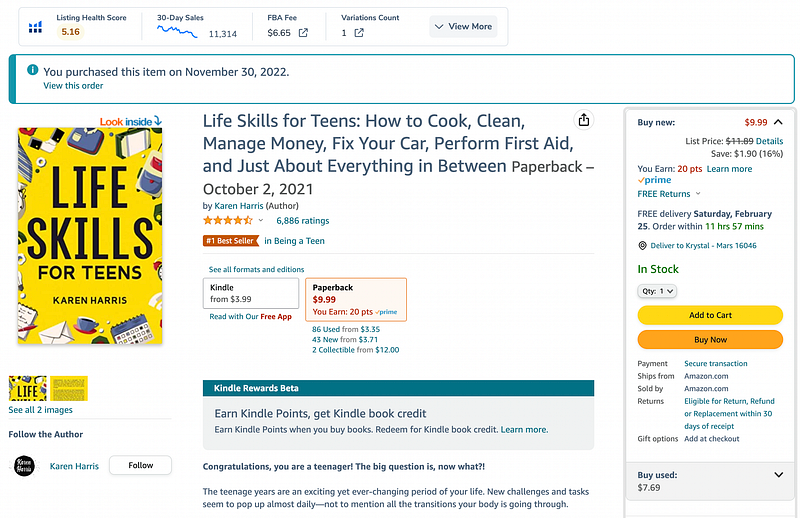
It was written about a year and a half ago by someone named “Karen Harris,” who, to the best of my knowledge, is not a famous author, doesn’t have a website, and isn’t on social media.
The fascinating thing about this book, is that it sells over 11,000 copies per month and earns over $113,026 in revenue.
I got this data from a tool I pay for called Helium 10.

Now, to be fair, revenue does NOT equal profit.
However, based on my royalty rate with Amazon, I would estimate that this book is earning somewhere around $3.50 per paperback copy sold, which works out to roughly $39,599 in royalties per month…
… for just this ONE BOOK.
That doesn’t include ebook sales.
However, to add an odd twist to the story, this book doesn’t appear to be selling many digital copies.
And I think I know why.
More on that in a bit.
Initial Observations
I’d like to point out a few things about this book:
- The topic is generic. “Life skills for teens” is not groundbreaking or award-winning content by any means.
- The product is decent (nice cover, okay writing)
- The author isn’t famous (no website, no socials)
So why is this book selling so many copies?
Let’s dive a little deeper, shall we?
Uncovering the Most Profitable Keywords
At the beginning of this article, I mentioned there were three things that you need to do if you want to sell a lot of books on Amazon.
The first on the list was to — find keyword phrases a lot of people are searching for on Amazon that ALSO have a high sales conversion rate.
When analyzing this book for the first time, I thought maybe the keyword phrase “life skills for teens” had a lot of demand.
Let’s take a look using Helium 10 —
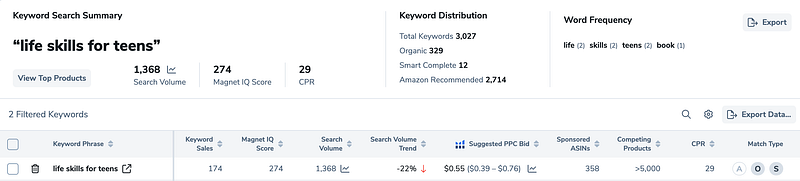
Here’s what this tells me about the keyword phrase “life skills for teens” —
- 1,368 people search for this exact keyword phrase on Amazon each month.
- 174 people purchase a relevant product on Amazon after searching for this keyword.
Those are decent numbers.
But that doesn’t exactly add up to 11,000+ book sales per month, does it?
For that, we’re going to have to dive even deeper to see what other keywords this book is ranking for on Amazon.
Try to stick with me here.
Below is a snippet of the keyword report on “Life Skills for Teens” from Helium 10.
It tells me:
- ALL of the keywords this book is ranking for on Amazon
- how many sales are attributed to each ranked keyword per month
- the total number of searches for each keyword
- keywords the book is running Amazon ads on
- and the estimated “cost per click” or “CPC” for each keyword (if you were to run Amazon ads)
- plus more.
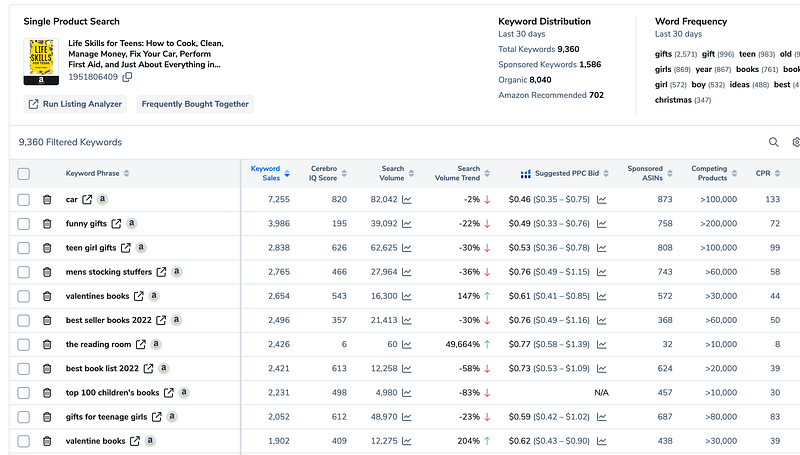
From this initial report, I can see that this book is showing up for 9,360 total keywords on Amazon.
- 8,040 of them are organic rankings — which is really good. It means the book is probably getting a lot of organic sales.
- 1,586 of the keywords are “sponsored,” — which means they are being used in Amazon ads.
One other thing I want to draw your attention to is that the keywords that this book ranks for that have the most sales per month are things like “funny gifts, teen girl gifts, men's stocking stuffers, etc.”
For example, the keyword phrase “teen girl gifts” is pulling in over 2,838 actual sales per month on Amazon even though it’s searched over 62k times.
If you had a book or product that would make a good gift for a teen girl, you could potentially take some of those sales.
Now can you guess why this book sells so many paperback copies as opposed to ebooks?
Here’s the answer:
Most of the people that buy this book are getting it as a gift for their child or grandchild.
However, here is the big takeaway —
If you know which specific keywords are leading to sales on Amazon, you can create books that are relevant to those keywords and tap into existing demand.
You don’t have to guess or wonder if the book you are creating will sell.
You can know the answer before you even write the first word.
There are a number of tools that you can use to do this.
However, I prefer to use Helium 10 to do Amazon keyword research because it’s so powerful and gives you so much data.
It’s pricey, but if you want an unfair advantage, this is it.
Tip: I usually pause my Helium 10 subscription when I’m not actively using it and reactivate it when I want to do keyword research to save on the cost.
I also have a discount code if you want to try it out using my referral link.
In theory, one could create a very similar book aimed at teens, like “money management for teens,” for example, then target the same keywords that this book is running ads on to get similar results.
Pretty cool, right?
Write to Rank
I could probably end this here, but I want to share one more strategy with you.
This one is a little more advanced.
I like to call it “write to rank.”
The idea is to find keywords where you have the opportunity to rank on the first page of Amazon results organically — then create a book around those keywords.
Most people do it the opposite way. They write whatever they want, then scramble to find keywords. It rarely works.
The reason why ranking your book on the first page for your keywords is important is that very few people make it to page two.
If your book isn’t on the first page for the keyword they searched, you’re probably not going to make many sales.
Here’s an example:
Helium 10 has a metric called “CPR” — this is the number of sales you would need to make per day over an 8-day time period to get ranked on the first page of results for the keyword organically.
The goal is to find keywords with a low CPR number and high monthly keyword sales.
For example, the keyword “crossword book” sells around 60 books per month.
It has a CPR value of 9, which means you would need to sell 9 copies of a relevant “crossword” book for 8 days to get organically ranked on the first page for this keyword on Amazon.

The next logical question is, “How can you get to 9 sales per day?”
You could do your own outside promotion or wait to see what Amazon does with the book.
Or…
You could use my preferred “fast track” method, which is to run Amazon ads.
For this example, I would run Amazon ads on the keyword “crossword book” until I made 9 sales per day for 8 consecutive days.
Then I should be able to stop the ads (or reduce spend) once the book starts to rank on the first page of results and continue making organic sales for that keyword over time.
If the rank starts to slip, I’d start the ad again until I made it back to page one.
Each case will obviously vary.
However, I’ve been testing this strategy with some of my books, and it’s been working for me.
If you want to know how to make a “crossword book” so you can try to rank it, read this post next:
Affiliate Disclaimer
The links in this article for the Helium 10 Amazon keyword research tool are my referral links. If you use them to purchase a subscription, you will get a Helium 10 discount.
I will also receive a small commission at no additional cost to you. I only promote tools that I actively use in my own business.


