
This Unknown Book Praised by Ryan Reynolds Has Changed My Life Forever
‘An Astronaut’s Guide to Life on Earth’ deserves more 5-star reviews

.jpg)
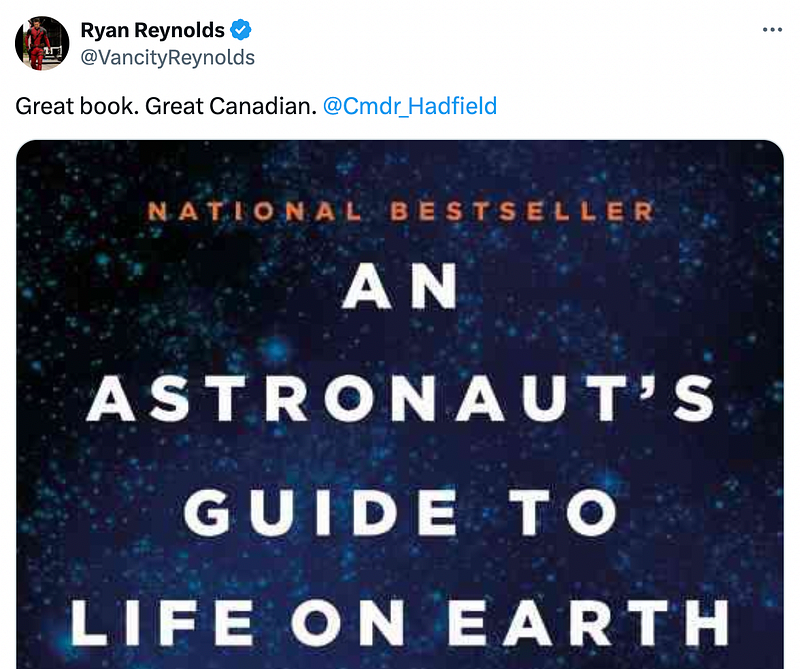
Ryan Reynolds is not one to talk about books.
But when he recommends one, it is bound to be an amazing pick. ‘An Astronaut’s Guide to Life on Earth’ by Chris Hadfield is one of the lucky few.
Published in 2013, this book does a wonderful job of combining space with earth. Through his life story, Hadfield brings amazing life advice for everyone to apply.
The question arises, what qualifies an astronaut to give advice?
The answer is ‘his experience’. Once you read this book, you’ll realize exactly how.
Following are some of the takeaways from this unique book.
A dream come true
Many of us have dreamt of being an astronaut.
Most of us haven’t become one. Chris Hadfield is the lucky one who was able to fulfill his childhood dream.
He was only 9 years old when he decided he wanted to be an astronaut. But the journey wasn’t as smooth as we’d like to imagine.
“I wasn’t destined to be an astronaut. I had to turn myself into one.”
The author gives the analogy of ‘square astronaut, round hole’. He managed to fit through regardless. But it took him 21 years to do so.
He tells us how became an engineer, a fighter pilot, and then a test pilot. Eventually, he was accepted into the Canadian Space Agency.
“On paper, my career trajectory looks preordained: engineer, fighter pilot, test pilot, astronaut. Typical path for someone in this line of work, straight as a ruler. But that’s not how it really was.”
Hadfield tells us how hard astronauts have to study all the time. This is not how he envisioned his life as an astronaut when he was little.
Life in Space
How do astronauts pee? How do they shower? How do they sleep?
These are many questions that enter the mind of a non-astronaut when space travel is mentioned. We are intrigued by how such simple tasks become complex upon leaving Earth.
This book enlightens us about many of them.
Did you know that astronauts prefer to write with a Sharpie?
“Sharpie — the preferred writing utensil on orbit since you can hold it any which way and it still works.”
The mechanics of sleeping are fascinating. There is no mattress or pillow needed.
“In zero gravity, there’s no need for a mattress or pillow; you already feel like you’re resting on a cloud, perfectly supported, so there’s no tossing and turning to find a more comfortable position.”
The author tells us how they didn’t need to change much because there was no sweating. Instead of showering they used a wet cloth. For shampooing, they used a shampoo that didn’t need to be rinsed.
Bones deteriorate in space. So, a 2-hour exercise is mandatory for all astronauts. There is special equipment for that too.
Think like an astronaut
What can we learn from Hadfield’s experience?
The author invites us to ‘’think like an astronaut.’
“…you don’t have to go to space to learn to do that. It’s mostly a matter of changing your perspective.”
But what does it actually mean?
In a space shuttle, or on the ISS (International Space Station), everything matters. Even the small stuff.
The situation is risky. It’s a matter of life and death.
However, astronauts are trained to handle risk, uncertainty, and unforeseen situations. That training helped Hadfield not only in space but also on Earth.
And he wants all of us to benefit from it.
“An astronaut is someone who’s able to make good decisions quickly, with incomplete information, when the consequences really matter.”
In the coming headings, we will cover many different aspects of ‘thinking like an astronaut’.
The Powerful Duo
Fear is natural.
But it can be mitigated.
There are two important ingredients for that. Knowledge and experience.
“Knowledge and experience have made it possible for me to be relatively comfortable with heights, whether I’m flying a biplane or doing a spacewalk or jumping into a mountain of corn.”
Hadfield tells us that fear is the result of not knowing what can happen and not having any control over the future.
Learning facts helps us become less fearful. When we know what can happen, we are better prepared. We also know what is in our control and what isn’t.
“If you’re not sure what to be alarmed about, everything is alarming.”
Space is scary. Some might think that astronauts are super-humans. But they are not. It’s just that they have the right knowledge.
And they have practiced numerous times using that knowledge.
“…in order to stay calm in a high-stress, high-stakes situation, all you really need is knowledge”.
This reminds me of my dad. He always told me that I needed to practice my math as much as I could before my exam.
‘Sweat the small stuff’
Hadfield’s advice goes against the modern trend of don’t care, won’t care.
He tells us to do the smallest tasks diligently. In the grand scheme of things, even the smallest things matter.
For example, once, the author’s task was to change the garbage bags. It might seem like a small task but it was important for the smooth functioning of ISS.
“Always strive for excellence, even in the smallest tasks.”
Astronauts have to fine-tune everything. If they don’t, missions can fail, billions of dollars can go to waste, and lives can be lost.
“This is why, individually and organizationally, we have the patience to sweat the small stuff even when — actually, especially when — pursuing major goals. We’ve learned the hardest way possible just how much little things matter.”
By worrying about the minute details, an interesting virtue is developed in a person. Patience.
Come to think of it, nothing can be achieved without patience. You have to be patient to study. You have to be patient to practice. You have to be patient in order to stick to the path.
“That’s one good thing about habitually sweating the small stuff: you learn to be very, very patient.”
This patience will lead you to success.
You cannot be overprepared
For me, being over-prepared means packing 10 pieces of underwear for a 3-day trip.
But for an astronaut, it is a matter of life and death. There is no such thing as over-preparedness, says Hadfield.
He says that if you are playing by the dice, preparedness doesn’t matter. But if you want ‘excellence’, you have to be more than prepared.
“But if you’re striving for excellence — whether it’s in playing the guitar or flying a jet — there’s no such thing as over-preparation. It’s your best chance of improving your odds.”
Being prepared also allows us to savor the moment.
When we have dotted our i’s and crossed our t’s, we can rest assured that there is nothing more we can do.
As my mother used to say, do your best and don’t worry about the results. I guess the worry is elevated only when we do everything in our power.
“‘Be ready. Work. Hard. Enjoy it!’ It fits every situation.”
Behold the unknown!
Despite doing our all, there is no guarantee that something won’t go wrong.
“No matter how much preparation is done, there will always be an element of the unknown.”
Astronauts have to prepare for and rehearse for every possible thing going wrong.
At the ISS in 2013, the team had to repair an ammonia leak. For that two astronauts had to go on a spacewalk. The team practiced and prepared to the best of their ability.
Various things could go wrong including ammonia contamination. They prepared for the worst and did their best.
Luckily the 5-and-a-half-hour walk was successful.
“Rehearsing for catastrophe has made me positive that I have the problem-solving skills to deal with tough situations and come out the other side smiling.”
Being prepared gave them the right skills to survive the unknown when it came knocking at the door.
Think negatively, become positive!
Can negative lead to positive?
Hadfield tells us about a question that astronauts are taught to think, ‘What’s the next thing that will kill me?’
It sounds like a recipe for paranoia. But only it isn’t.
“While play-acting grim scenarios day in and day out may sound like a good recipe for clinical depression, it’s actually weirdly uplifting.”
We learn about the ‘power of negative thinking’.
As a part of the job, Hadfield had to think about his death. Because he had to prepare and decide everything about it, he didn’t live in fear of it.
It doesn’t mean he wanted to die. It’s just that his mind was at ease knowing what would happen in case it happened.
“While I very much hoped not to die in space, I didn’t live in fear of it, largely because I’d been made to think through the practicalities: how I’d want my family to get the news, for instance, and which astronaut I should recruit to help my wife cut through the red tape at NASA and the CSA.”
The author’s words remind me of facing one’s fears head-on. The more we run from something, the more we fear it. But if we face it, that thing loses its power over us.
That stands true for everything in life.
The author’s experience has also motivated me to write my will.
I did write my will once, many many years ago, when I was about 20. I should do it again, given that my life circumstances have changed a lot since.
Welcome criticism with open arms
No one likes being wrong.
Don’t take feedback as a personal attack, advises Hadfield. He says that it is a skill if you can view the negative feedback as advice.
“In any field, it’s a plus if you view criticism as potentially helpful advice rather than as a personal attack.”
Many miles away from Earth, astronauts rely on each other for survival. This means they should be open to giving and receiving every kind of feedback.
This not only strengthens teamwork and bonding, it also allows for the best possible solution to emerge. This in turn leads to efficient problem-solving.
Appreciate Your Loved Ones
Being an astronaut means being away from your family.
Hadfield relied on the support of his wife and loved ones to continue his career. But this means he couldn’t spend time with them as much as he would like to.
“Was I neglecting my family? The problem of being an astronaut was that you don’t get to control your schedule.”
Here is the thing. Some people have all the time but they don’t appreciate their family enough.
Even if you are in a career that requires you to be away, you can make up for lost time. By making sure that the time you spend with your family is worth it.
“Prioritize time for your family.”
It’s the little things.
For example, the author scheduled a Valentine’s delivery for his wife when he knew he would be away on the day.
Why should you read this book?
Space is mystical.
It leaves us wondering about how and why. This book is a good way to get some of those answers.
Beware! It will fill you with a longing for space travel.
There is a way though.
“These days, anyone who has deep enough pockets and good enough health can go to space. Space flight participants, commonly known as space tourists, pay between $20 and $40 million each to leave Earth for 10 days or so…”
Space travel aside, the insights in this book are well worth your time and money.
You’ll learn how to do your best, prepare for the worst, and enjoy the moments. Make this a philosophy of your life and you’ll be happier and more content.
If you do read this book, we’d like to hear your thoughts. Comment below!
I hope you have found this article useful. If you did, it would be awesome if you gave me a clap or left a response!
If you enjoyed this article and want to support Novel Nest, click this link to get notified whenever I publish something new.
If you enjoyed these book recommendations, check out the rest of my book lists on my blog- https://www.thenovelnest.com/blog
Affiliate Disclaimer: This post features Amazon affiliate links, which means I may earn a small commission if you make a purchase through these links.