avatarAugust Birch

Free AI web copilot to create summaries, insights and extended knowledge, download it at here

3500

Abstract

n></figure><p id="06a0"><b>I believe progress tracking is important. We’ve got to see where we’ve been and what we’ll lose if we have to start over.</b></p><p id="7c69">Not only is the tracking a good reinforcer, but it’s also a tiny, daily reward. But the best part of the daily writing is the accumulated pile of progress. I’ve written so much. I clock over a million words per year of published material and emails.</p><p id="20b6">None of that progress would happen, nor would I be able to build my publishing business to the success it’s been, without the daily habit of writing. Because it’s not just the books and courses we need to work on. We’ve also got to market our work every day if we want to stay recognized and relevant.</p><p id="6a56"><b>I have daily writing to thank for all of it.</b></p><div id="8e09" class="link-block"> <a href="https://readmedium.com/how-to-get-started-as-an-indie-author-in-ten-steps-5c9006fbbbe0"> <div> <div> <h2>How to Get Started As An Indie Author in Ten Steps</h2> <div><h3>Take control of your writing destiny and choose indie publishing</h3></div> <div><p>medium.com</p></div> </div> <div> <div style="background-image: url(https://miro.readmedium.com/v2/resize:fit:320/0*lILopV3iVIlBjOMM)"></div> </div> </div> </a> </div><h1 id="76ec">Phase two: How I loop-write for one-draft manuscripts</h1><p id="3127">OK, now we’re writing daily. We know we’ve got to connect with our readers where they hang out, if we want to keep them engaged. This means a lot of articles, email, and social posts. If we want to sell books as indies, that’s the world we live in.</p><p id="d1fe">So, how to we find the time to go through all the revisions necessary to write the book that’s supposed to keep the roof overhead?</p><p id="d80f">Enter, the one-draft manuscript. Not everyone will like this idea. Many will hate it. I’ve got plenty of tomatoes introducing this idea before. But if you pay attention, this is the way many best-selling authors write their books. They just don’t talk about it, because it doesn’t make them sound like starving artists, toiling-away at their novel for years.</p><p id="8b1a"><b>It’s time to try loop-writing.</b></p><p id="5bf7">I got this concept from a pulp writer named Dean Wesley Smith.</p><p id="b47b">I’ve modified his method where I think it needs a little help, but here are the basics. This method is geared towards pantsers, but plotters can use it too.</p><h2 id="dc2f">Loop Writing:</h2><ol><li><b>Write your premise</b>, so you know what the book is about.</li><li><b>Write the end first</b>. This comes from John Irving. If it’s good enough for him, I’m cool with it too.</li><li><b>Start at the beginning. Write until you hit 500–800 words</b>, or until you run out of momentum. Stop.</li><li><b>Loop back to the beginning</b> and re-write over what you just wrote.</li><li>When you get to the end of the 500 words, <b>write the next five hundred</b>. Stop.</li><li><b>Loop back to the beginning,</b> and repeat the process until you’re done for the day.</li><li><b>Keep re-writing the beginning of the book with each writing session</b>. Re-write and loop back over the previous day’s work, writing-through to today’s work.</li><li>Each section of the book is re-written 3–5 times</li><li><b>Once you reach the end, re-write the end at least

Options

a dozen times</b>.</li><li>This way both the beginning and end are polished like a diamond. These two places make the biggest impact on the reader.</li><li>If you uncover a whodunit or an Easter egg you want to plant, <b>loop back into the manuscript and write the set-up for it</b>. You’ll look like genius.</li><li><b>Outline as you write</b>, not before. Keep small notes of the contents of each chapter, so you have a document you can flip to, should you have to go back and add something earlier to make a later scene work.</li><li><b>Once you’re done, you’re done</b>. The entire novel has been re-written and drafted as you wrote.</li></ol><p id="5d7d"><b>Try it. It’ll change your life.</b></p><div id="6a13" class="link-block"> <a href="https://readmedium.com/ten-indie-publishing-mistakes-ive-made-and-what-i-d-do-differently-9811b0eb26ab"> <div> <div> <h2>Ten Indie Publishing Mistakes I’ve Made and What I’d Do Differently</h2> <div><h3>How to avoid the pitfalls of a new indie writer</h3></div> <div><p>medium.com</p></div> </div> <div> <div style="background-image: url(https://miro.readmedium.com/v2/resize:fit:320/0*aKWbuFpM23PhRHOw)"></div> </div> </div> </a> </div><h1 id="fc4c">Productive writing starts with great infrastructure</h1><p id="fecb">We need the habits and processes in place if we want to be successful, commercial writers. Whatever shape that answer looks to you is a personal one, but the entire backbone starts with daily writing and a writing process.</p><p id="e88c"><b>Once we have the bones in place, the writing isn’t as much of a struggle.</b></p><p id="6eae">We take <a href="https://readmedium.com/the-book-mechanics-manifesto-212f374fb7a8">a blue-collar approach</a> to the work. We punch-in every day and turn the crank until our shift is over. We play hurt (and any other motivational platitude you’d like to insert here).</p><p id="8a5b"><b>No one’s coming to help.</b></p><p id="c41e">We’ve got to sit and do the work or nothing happens.</p><p id="b480">Daily writing and writing systems make the process more enjoyable, more predictable, and less stressful. We want more of your work, but we can’t read it until you finish it.</p><p id="af37"><b>It’s time to write every. single. day.</b></p><p id="acfb">We’re waiting for you.</p><p id="ed7d"><b>(<a href="https://www.subscribepage.com/tribe1K">Enroll in My Free Email Masterclass. Get Your First 1,000 Subscribers</a>.)</b></p><p id="a567">August Birch (AKA the Book Mechanic) is both a fiction and non-fiction author from Michigan, USA. A self-proclaimed guardian of writers and creators, August teaches indie authors how to write books that sell and how to sell more of those books once they’re written. When he’s not writing or thinking about writing, August carries a pocket knife and shaves his head with a safety razor.</p><figure id="ca42"><img src="https://cdn-images-1.readmedium.com/v2/resize:fit:800/1*7ChLiSh9wWZBUjD136kyeA.png"><figcaption></figcaption></figure><p id="4888"><b>You just read another exciting post from the Book Mechanic:</b> the writer’s source for creating books that work and selling those books once they’re written.</p><p id="05d2">If you’d like to read more stories just like this one <a href="https://medium.com/the-book-mechanic"><b>tap here to visit our page</b></a>.</p></article></body>

This Two-Phase Writing Routine Will Shave Months Off Your Next Book

How to finish your next book faster than you thought (with high quality)

Photo by Art Lasovsky on Unsplash

I’ve been blessed with the gift of never-ending content-generation. For some reason I never run out of writing ideas, no matter how hard I try to drain the proverbial tank. Writer’s block has never been a thing with me either. But I do know there are a lot of stuck writers out there who want to get more done in less time, but don’t have the tools to get there.

Now, finishing what I start? That’s where I have trouble.

But I do have a writing routine that has helped me create more content than I ever thought possible. Not only has it helped me finish manuscripts, but I also use this routine to write emails, publish articles, develop courses, and all other writing projects that keep my publishing business on the rails.

As nice as it would be to take my time with every writing project I start, I’ve got to have tight, self-imposed deadlines or I’ll never finish anything. But this story isn’t about deadlines, waking-up early, or learning to type faster.

This two-phase writing routine has changed my writing life more than anything else I’ve done.

Phase one: How I developed a daily habit of writing

I’ve written all my adult life, but developing a daily writing habit is recent. Tomorrow I will hit 300 consecutive writing days without a skip. I accomplished this, not by punishing myself into compliance, but by allowing myself stupid-easy goals.

I write at least one word per day.

That’s it. The goal is (and always will be) one word per day. If you can’t go 24 hours without writing a single, deliberate words towards your next project, you don’t want to be a writer.

I never write a single word, however. I’m already there. I might as well write five. Or fifteen-hundred. Why stop at one when I’m already behind the keyboard. A single word takes a lot of restraint once you’re committed to a writing session.

I track my progress with a Seinfeld-like, one-X-per-day tracking app (called Don’t Break the Chain). I still track my progress.
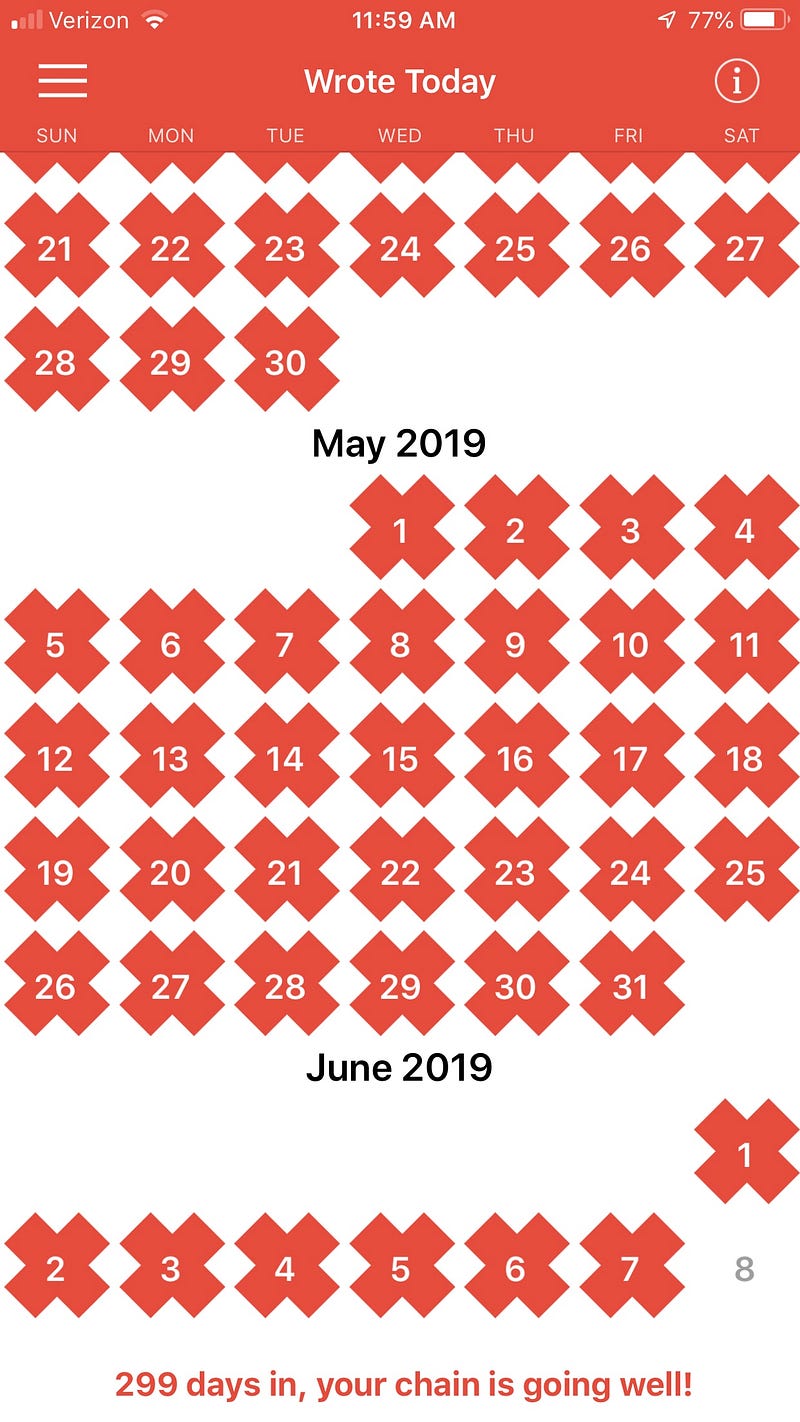
I believe progress tracking is important. We’ve got to see where we’ve been and what we’ll lose if we have to start over.

Not only is the tracking a good reinforcer, but it’s also a tiny, daily reward. But the best part of the daily writing is the accumulated pile of progress. I’ve written so much. I clock over a million words per year of published material and emails.

None of that progress would happen, nor would I be able to build my publishing business to the success it’s been, without the daily habit of writing. Because it’s not just the books and courses we need to work on. We’ve also got to market our work every day if we want to stay recognized and relevant.

I have daily writing to thank for all of it.

Phase two: How I loop-write for one-draft manuscripts

OK, now we’re writing daily. We know we’ve got to connect with our readers where they hang out, if we want to keep them engaged. This means a lot of articles, email, and social posts. If we want to sell books as indies, that’s the world we live in.

So, how to we find the time to go through all the revisions necessary to write the book that’s supposed to keep the roof overhead?

Enter, the one-draft manuscript. Not everyone will like this idea. Many will hate it. I’ve got plenty of tomatoes introducing this idea before. But if you pay attention, this is the way many best-selling authors write their books. They just don’t talk about it, because it doesn’t make them sound like starving artists, toiling-away at their novel for years.

It’s time to try loop-writing.

I got this concept from a pulp writer named Dean Wesley Smith.

I’ve modified his method where I think it needs a little help, but here are the basics. This method is geared towards pantsers, but plotters can use it too.

Loop Writing:

  1. Write your premise, so you know what the book is about.
  2. Write the end first. This comes from John Irving. If it’s good enough for him, I’m cool with it too.
  3. Start at the beginning. Write until you hit 500–800 words, or until you run out of momentum. Stop.
  4. Loop back to the beginning and re-write over what you just wrote.
  5. When you get to the end of the 500 words, write the next five hundred. Stop.
  6. Loop back to the beginning, and repeat the process until you’re done for the day.
  7. Keep re-writing the beginning of the book with each writing session. Re-write and loop back over the previous day’s work, writing-through to today’s work.
  8. Each section of the book is re-written 3–5 times
  9. Once you reach the end, re-write the end at least a dozen times.
  10. This way both the beginning and end are polished like a diamond. These two places make the biggest impact on the reader.
  11. If you uncover a whodunit or an Easter egg you want to plant, loop back into the manuscript and write the set-up for it. You’ll look like genius.
  12. Outline as you write, not before. Keep small notes of the contents of each chapter, so you have a document you can flip to, should you have to go back and add something earlier to make a later scene work.
  13. Once you’re done, you’re done. The entire novel has been re-written and drafted as you wrote.

Try it. It’ll change your life.

Productive writing starts with great infrastructure

We need the habits and processes in place if we want to be successful, commercial writers. Whatever shape that answer looks to you is a personal one, but the entire backbone starts with daily writing and a writing process.

Once we have the bones in place, the writing isn’t as much of a struggle.

We take a blue-collar approach to the work. We punch-in every day and turn the crank until our shift is over. We play hurt (and any other motivational platitude you’d like to insert here).

No one’s coming to help.

We’ve got to sit and do the work or nothing happens.

Daily writing and writing systems make the process more enjoyable, more predictable, and less stressful. We want more of your work, but we can’t read it until you finish it.

It’s time to write every. single. day.

We’re waiting for you.

(Enroll in My Free Email Masterclass. Get Your First 1,000 Subscribers.)

August Birch (AKA the Book Mechanic) is both a fiction and non-fiction author from Michigan, USA. A self-proclaimed guardian of writers and creators, August teaches indie authors how to write books that sell and how to sell more of those books once they’re written. When he’s not writing or thinking about writing, August carries a pocket knife and shaves his head with a safety razor.

You just read another exciting post from the Book Mechanic: the writer’s source for creating books that work and selling those books once they’re written.

If you’d like to read more stories just like this one tap here to visit our page.

Writing
Creativity
Art
Productivity
Freelancing
Recommended from ReadMedium