
This Small Secret Company Made $505 Billion Trading Energy in 2022
It’s called Vitol and you’ve probably never heard of them.
I was looking at the biggest companies in the world per revenue when I saw this:
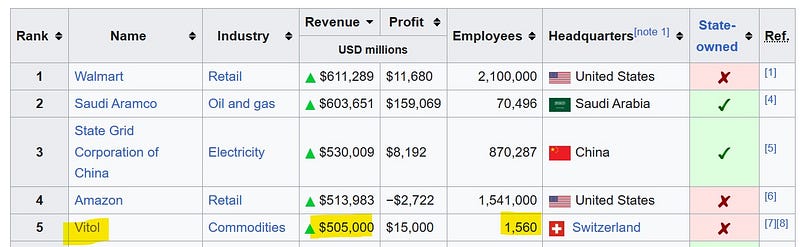
A company I had never heard of named Vitol earned $505 billion in 2022 with 1,560 employees.
So I investigated.
The result is exactly what you’d expect: lies, theft, corruption, tax evasion, lawsuits, bribery, shady links with governments, militia groups support, and hunger for money.
Here’s the story of one of the most secretive companies in the world.
The Birth and Rise of Vitol
Vitol was created in 1966 in Rotterdam by two Dutchmen, Henk Viëtor and Jacques Detiger.
Their idea was to buy and sell refined petroleum products transported by barges on the Rhine.
They borrowed $2800 from Viëtor’s father and reached profitability a few months later.
The 1960s and 1970s saw big changes in the oil market which Vitol intended to profit from.
The entire industry was moving out of the hands of “the Seven Sisters”, a group of companies that exploited, moved, refined, and sold 85% of all oil on the planet (Exxon, Shell, BP, Socony, Chevron, Gulf Oil, Texaco).
The end of the colonialization period led producers to take back control of their resources and the OPEC was established in 1960, ending the reign of the seven companies.
Meanwhile, oil was discovered in new regions of the world which enabled smaller players like Vitol to get a part of the pie.
Trading oil was a dangerous job.
There were no futures (contracts to buy oil at a fixed price and time in the future), no options (contracts that give the rights, but not the obligation to buy or sell at a certain price), and no swap contracts to hedge against volatility.
Traders bought and hoped to sell for more later on.
The fast-changing geo-political context and the globalization of the world made the system more fragile. Any conflict on the planet could result in oil prices soaring or dropping, threatening the solvency of the trading offices that didn’t have enough cash to cover the loss.
But Vitol was skilled at what it did. “Opportunities are defined externally”, they say; they never shied away from sending executives to the most dangerous places on earth to sign deals, like in Libya in 2011.
As the civil war raged, Vitol was asked by Qatar if it could provide oil to the rebel Libyan government in the east of the country.
Within 24 hours, then-CEO Ian Taylor took a jet for Benghazi, flying along a NATO drone for sole protection. The plane had to dive to land in order to avoid anti-aircraft missiles from Qaddafi’s forces.
Taylor signed the deal and Vitol changed the course of Libyan history (the rebels would have likely lost otherwise).
With such a culture, business grew fast and Vitol opened offices all around the planet.
By 1976, the company was moving 450,000 barrels of oil per day — a significant number, yet half of what the biggest players handled.
In 1990, Detiger, Viëtor, and the rest of the shareholders got out and sold Vitol to 40 of their employees for roughly $150 million.
The structure of the company changed and became a partnership spread among 450 partners as those lines are written. They own the shares through various shell entities enabling Vitol to pay fewer taxes (14% in 2015).
No shareholder owns more than 5% of the company either, so everyone’s skin remains in the game.
Competition is tough and Vitol doesn’t hesitate to secure talent by paying them an average yearly salary of…$785,000.
!!
The sale of Vitol to its employees gave fresh momentum to the company.
They expanded their trading activities to crude oil and signed contracts with refineries. Then they began to buy refineries altogether (they own six today).
They win contracts by financing oil producers in the billions of dollars in exchange for exclusive rights over the oil extracted (Eg: Vitol loaned $5.2 billion to a Kazakh oil company in 2015).
And they bribe.
An investigation by Public Eye found out that Vitol created a secret joint venture in Switzerland in the early 2000s whose shareholders were businessmen close to the Kazakh president. The joint venture made billions of profits since then.
This story is only one of the many scandals that emerged during the last three decades.
- In 1995, Vitol paid US$1 million to a Serbian war criminal to settle a deal with Orion, a Serbian Oil company.
- In 2007, they pleaded guilty to paying surcharges to Iraq’s national oil company which was not allowed under the UN oil-for-food program.
- In 2012, it was revealed that Vitol used subsidiaries to buy and sell Iranian oil despite the embargo.
- In 2018, a French energy regulator fined Vitol for market manipulation.
- In 2020, Vitol paid $135 million for bribing officials in Ecuador, Brazil, and Mexico.
The 1990s saw Vitol aggressively investing in infrastructure.
They bought and built tankers, terminals, and storage facilities in over forty countries which enabled them to wait for oil prices to go back up after a crash.
Their towering storage tanks in Rotterdam, for example, have enough fuel for 22 million Volkswagen golfs.
This strategy helps them lessen the impact of oil prices on their bottom lines.
When oil reached $30 in 2009 and everyone in the industry saw their profits diving, Vitol reported its highest profit ever (not even the negative prices of 2020 lost them money).
Today Vitol moves 6.5% of all oil each year.
But as the sector is digitalizing and getting more transparent, the company is finding it increasingly harder to make a profit.
So, they’re transforming.
First, they increased the number of commodities they were trading.
From refined oil in 1966, they are now trading bitumen, gasoline, ethanol, methanol, coal, naphtha, base oils, natural gas, LNG, LPG, power, iron ore, and carbon emissions.
Second, they’re adding production and B2C distribution to their transportation business.
They own 3900 petrol stations in Africa across 27 countries and began to produce (clean) energy like in the UK where they own five power plants through a subsidiary.
Vitol’s revenue doubled from $225 billion in 2021, to $505 billion in 2022.
Who knows how much they’ll earn in 2023?
What Does Vitol Do Exactly?
They buy and sell stuff, which means they mainly move the stuff they buy.
Let’s say that a company named National Oil owns a bunch of oil fields in Somewheristan.
All National Oil does is pump the oil and sell it. They’re not interested in transporting, refining, or any of those things.
This is where Vitol comes into play.
They send trucks to Somewheristan to buy the oil from National Oil, drive it to a refinery, then move it to a terminal where it will be stored and eventually sold to somebody (to simplify).
At the moment, most of Vitol’s customers are big businesses like airlines or governments. They’re also slowly developing their own gas stations.
While they mostly advertise themselves as an energy transportation enterprise today, Vitol makes the bulk of its money trading those commodities.
Conclusion
The big problem with these companies (and why they can simultaneously get away with anything) is that the world needs them.
When Cuba ran out of sugar to pay for oil imports, they offered the trading companies that sold them the oil to build hotels in order to make their money back.
No one except traders would have taken the risk to supply Cuba with oil. Without them, the country would have collapsed. Quite the irony for a communist regime to deal with an ultra-capitalist company…
Of course, the general public doesn’t know any of that.
We love to hate big companies, but the truth is that they exist for a reason — they work 24/7 to maintain critical infrastructures.
Energy production is insanely complicated. Power companies employ traders and mathematicians whose task is to predict power consumption at all times.
Too much consumption and the grid goes down. Too much production and the grid…goes down. This isn’t an easy job, and the lives of billions of people depend on it.
I don’t want to be in a position where I defend these companies, but let’s consider that while I am comfortably sitting on my butt writing this article on the train, thousands of people are making sure that said train has the power to get me to my destination.
The functioning of the world doesn’t depend as much on governments as it depends on the people who produce food, and energy, and who move these around.
I am sure that local food and energy production would be better for everyone in the end, but when countries like Germany close off their nuclear plants, they must get their energy from somewhere — and in this case, they get it from Vitol.
Did you ever think about what would the world be like if all these people went on strike tomorrow?
No, you only think about yourself (relax, it’s a joke ;)).
The world is a tad more complicated than Greta Thunberg makes it seem to be.
Sometimes, evil is necessary.
But it takes courage and humility to admit that.
For more articles, head to auresnotes.com.