avatarPrince Verma

Summary

This article discusses the discovery and potential applications of metal-organic frameworks (MOFs), a class of new materials made of metal clusters and organic linkers, in gas storage and drug delivery.

Abstract

At the end of the 20th century, Prof. Yaghi's lab discovered a class of new materials called metal-organic frameworks (MOFs). MOFs are nanoparticles that contain pores and are made of two components — metal clusters and organic linkers. By varying the chemistry of these two components, the pores of MOFs can be shrunken or enlarged depending upon the applications. MOFs have been utilized for multiple applications like gas storage and drug delivery. They have been used in industries for storing gases like hydrogen and carbon dioxide. The author, a Ph.D. student at the University of Virginia, is working with MOFs for drug delivery applications and is excited about their potential.

Opinions

  • The author is fascinated by the potential of MOFs and their ability to do "wonderful things" despite their small size.
  • The author believes that MOFs are still in the development phase but are being commercialized.
  • The author is excited about the potential of MOFs and can't wait to discover their cool properties and new applications.
  • The author recommends an AI service that provides the same performance and functions as ChatGPT Plus(GPT-4) but is more cost-effective.

This New Material Has The Potential For Multiple Applications

Nanotechnology is the future
https://www.nanoshel.com/metal-organic-frameworks

At the end of the 20th century, Prof. Yaghi’s lab discovered a class of new materials called metal-organic frameworks, commonly known as MOFs. Since their discovery, MOFs have been utilized for multiple applications like gas storage and drug delivery.

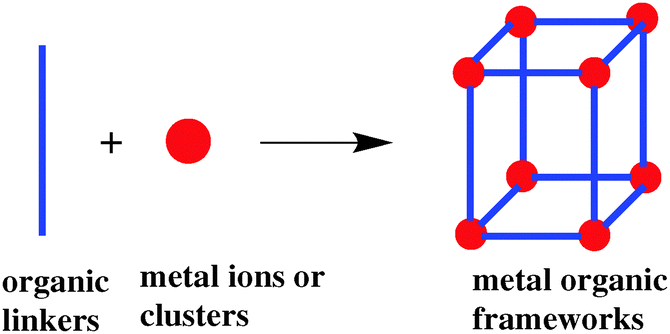
In simple words, MOFs are nanoparticles that are hollow means they contain pores. MOFs are made of two components — metal clusters and organic linkers as I have shown in the above diagram.

By varying the chemistry of these two components, the pores of MOFs can be shrunken or enlarged depending upon the applications.

I am a Ph.D. student at the University of Virginia and I work with MOFs. It’s fascinating to me how a small material like this can do wonderful things. I am mainly working with MOFs for drug delivery applications.

Since the materials are relatively new, they are still in the development phase but people are trying to commercialize them.

So far, they have been used in industries for storing gases like hydrogen and carbon dioxide. To give you some perspective, suppose you store a x amount of gas in the tank. If you put the MOFs in tank, you can store 1.4x gas in the same tank.

I am really excited to work with these materials and can’t wait to discover their cool properties and new applications.

Science
Nanotechnology
Application
Future
Potential
Recommended from ReadMedium