
This Blogger’s Video Went Viral When She Couldn’t Fake It Anymore
She now 759K Facebook followers and a memoir coming out

Kate Swenson tapped the record button on her phone and began talking about being the parent of a nonverbal child on the autism spectrum.
“I try to adequately prepare myself. I think I know what I’m doing. I got this. I take all the precautions; I prepare for autism.”
“We prepare for World War III, we’re ready to go, and then you’re standing, waiting to meet Elmo, and you look to your left while holding your sixty-five-pound flailing, screaming, head-hitting child, and you see all the parents in line holding their adorable babies.”
“And out of the corner of your eye, you can see them whispering to their spouses. And I know it’s human nature. I would stare too. There’s no anger.”
“And then you realize that this is not okay. It’s not. I’m not going to lie to you.”
Acceptance matters
When she tapped the record button, Swenson was in her car in the parking lot of her work. It was time to go to work, but the pressure inside of her was like a volcano. It was just too much to continue to keep all bottled up inside her.
So the Minnesota mom blogger of four kids (11, 9, 3, and 1) spoke into the virtual void, hoping her story would connect with moms like her.
“You know, when Cooper was two and three, we could fake it. My son had severe autism. And I cried the whole way to work today because, somewhere in the last couple of months, I switched from praying that he would be a doctor or a lawyer, and now I just know that we are praying for quality of life.”
She took a breath and continued talking.
“And that is such a hard switch. Because you hate yourself for giving up hope, but it is the fact of the matter. He could be the one in a million. But he’s not. And I know that his joy is supposed to be enough, and it is a lot of times, guys, it really is.”
Then she shared one of her deepest fears.
“But last night I lay in bed and I thought about his funeral. And if I’m gone, and what if no one goes? He’s not going to have anyone.”
Grieving an autism diagnosis
She was a mom grieving out loud her son’s autism diagnosis in a stream of consciousness style. Not grieving that he was autistic, but grieving the loss of expectations she had for him.
The milestones he wouldn’t likely reach like driving a car, having a first kiss, and others.
She had heard people say, “Special kids are given to special people,” because they didn’t know how to relate to her experience. But she had come to see that special kids make special people — and to be thankful for being chosen.
He was diagnosed at three and he was now six, and like most parents of autistic kids, she was going through Elisabeth Kubler Ross’ stages of grief: denial, anger, bargaining in seeking to fix or to support her child, and disappointment.
She was speaking to her growing community of special needs moms who were going through similar emotions to reach acceptance as well.
“As a mom, to know that he’s truly happy, and as I talked to Cooper’s dad last night, I told him this isn’t okay. And he’s like, nope, it’s not. And he told me he’s afraid of when he’s one hundred eighty pounds and kicking us, in line to see Elmo.”
She needed to get all this out before going to work. To free her sadness. To share her sorrow.
“I just feel like we’re never going to be able to leave our home. I sat down last night after a day of dysregulation and hitting and kicking, and I just thought about when I made that switch from being a blissful, happy parent to thinking about the future in a completely different light.”
Tired of faking being okay
What do you do when your home begins to feel like a prison? And you can’t go out and do the things other moms do with their kids because your son can’t regulate his body or emotions?
Or he elopes out the front door?
What do you do when autism has become an all-consuming force like a tornado and it feels like it’s taking over every aspect of your life?
What do you do when autism has become the only subject that you think and talk about?
When it makes it hard to spend time with your spouse because you’re so focused on your son.
Swenson hit the record button because she was tired of faking it. She wanted to be real with herself and other special needs moms, dads, grandparents, and anyone out there who would listen to her sharing her heart with the world.
She uploaded her video and walked into work.
The response to her video
A few hours later, she checked her phone and noticed texts from family and friends who had seen her video and the video had gone viral.
It was seen by hundreds of thousands of people.
She scrolled through the comments of love and support from mothers who told her they felt validated and seen by what she had shared.
Still, that night she felt alone. Her two boys were at her dad’s house. She and her husband had different reactions to her son’s diagnosis, causing them to walk down parallel paths of hope, grief, and reality that never intersected.
They were divorced, but co-parenting their kids.
She opened a bottle of wine. She felt weak, and it was difficult to admit to herself that she was hitting a low point, but she couldn’t ignore it.
Her six-year-old son had severe, nonverbal autism. The kind of autism that non one talks about. The kind that isolates families. The kind that doesn’t sleep. The kind that forces a parent to fight for every possible service and a basic right. The kind that is completely depleting.
The kind that feels hopeless at times.
Admitting her mental health battles
She thought mothers were supposed to be invincible, but she felt exhausted and tired of caring for her son — and it felt like it was gutting herself on the inside from no rest.
It felt like she would never get a moment to rest.
She felt overwhelmed and depressed.
She felt she was mired in a mental mess.
She felt angry at herself. Ashamed at herself for admitting to herself she needed a break and couldn’t carry the weight of parenting her son alone. She was angry at her husband. Angry at God. Why did her family deserve this?
Her depression made her feel invisible and alone — but she realized, a few days after her video went viral, the gift her nonverbal son had given to her, through all she had gone through.
Her voice.
That’s why she posted her video online.
She didn’t want a pat on the back.
She wanted others to know they were alone and to not give up as a parent. She wanted moms who were struggling with depression to know they were not invisible, especially those with kids with severe and nonverbal autism.
She wanted them to be vulnerable, strong, and to have a community where they could belong.
Finding Cooper’s Voice
Her viral video is when her community of moms began to flourish from a small tribe to 759K followers on Facebook and 113K on Instagram.
It is called Finding Cooper’s Voice and, yes, her eleven-year-old son is starting to find his voice.
He is reaching milestones after other kids have, but he is reaching them. He recently initiated play with his brother for the first time. He is going out on successful family outings and has found his grove in his everyday routine as a kid.
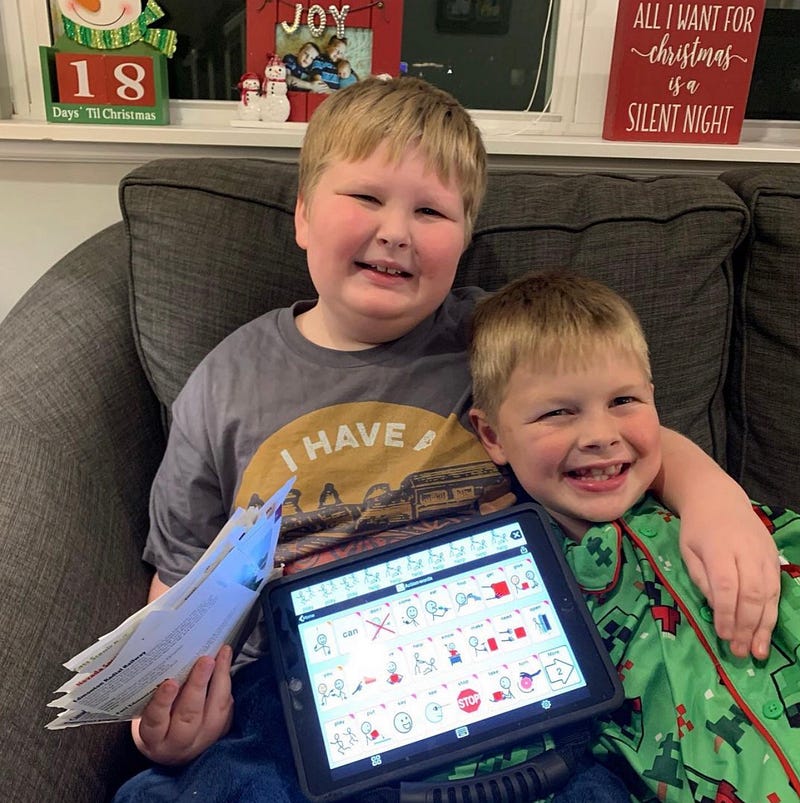
He wrestles with his brothers and they love to dogpile on top of their big brother. He loves to hold his new sister and enjoys time to himself.
He communicates his needs and thoughts with a device and through nonverbal communication with every sound, every squeal, every look, and every gesture — primarily with his mother.
But he and his dad have their own form of communication too. Cooper is a loved, understood, and accepted member of his family, and he is learning to go beyond the walls of his anxiety.
Swenson has a memoir, Forever Boy, out in April. I just finished reading an advance copy. It will take you on a roller coaster ride of emotions of what it’s like to parent a child with autism.
It’s a look into the secret world of autism. She feels her feelings with great force, and you feel them too, every up and down curve in her circuitous journey to accept her son’s autism.
And you will come to see Cooper deserves to have his place in the world like everyone else.
Thanks for reading my story.
You might also like:
Subscribe to Medium and support me and thousands of other writers by clicking here or if you’d like to buy me a cup of coffee, I’d greatly appreciate it.


