
This Mantra Kicks the Ass of All Other Mantras
Move over Dalai Lama. I’ve got this

Mantras have been around for centuries, but they became mainstream in 1991 with this one:
I’m Good Enough, I’m Smart Enough, and Doggone It, People Like Me! — Stuart Smalley
Sure, watching Al Franken performing his alter ego on Saturday Night Live is humorous. While helping his clientele in Children of Rageaholic Parents Anonymous may be fictional, the history, usage, and effectiveness of a mantra are undoubtedly real.
I’ve got science on my side, sort of
C. R. Karnick did a study featured in the journal of Ancient Science of Life about mantras’ effect on human beings and plants. In the study, Karnick found:
“A significant improvement… upon the physiology, healthy, and removal of causative factors… on patients suffering from stomach-ache, fevers, colic.”
- No, I don’t think you can get a colicky baby to repeat a mantra.
- Yes, this is at least some proof of the sound of mantras providing a healing effect.
- Instead of saying, “goo goo gaga” to a baby, try a mantra.
- Yes, this includes healing plants (talking to plants, anyone?)
But wait, there’s more!
In the International Journal of Medical Research & Health Sciences, Malhotra Varun et al. found that listening to (note: not vocalizing, but instead hearing) mantras and music reduced distractions, helped concentration, and delayed fatigue.
“It can be used to heal tinnitus, as an educational tool to develop children with special needs, Alzheimer’s disease, to improve motor skills in Parkinsonism and help alleviate pain after surgery.”
In the Corsini Encyclopedia of Psychology and Behavioral Science (Vol 3, Nov 11, 2002), they found that mantra repetition:
“lowered levels of tension; slower heart rate, decreased blood pressure, lower oxygen consumption, and increased alpha wave production. The benefits experienced in 20 minutes of meditation exceed those of deep sleep, thus indicating the regenerative power of meditation and saving of wear and tear on the body.”
The one mantra to rule them all
“OM” is the most widely used mantra in the world. Many practitioners agree that OM represents the vibrational frequency of the universe, coming in at 432 Hz. (See what I wrote about using frequencies to heal.)
OM is a quick way to kick your third eye’s ass into gear. Try it:
- Close your eyes and say (aloud or silently) “OM” with each exhale.
- As you say “OM” visualize the letters getting brighter throughout the exhale.
- Do ten exhales of saying and visualizing a bright “OM”.
You feel better, don’t you?
Let’s kick it up a notch.
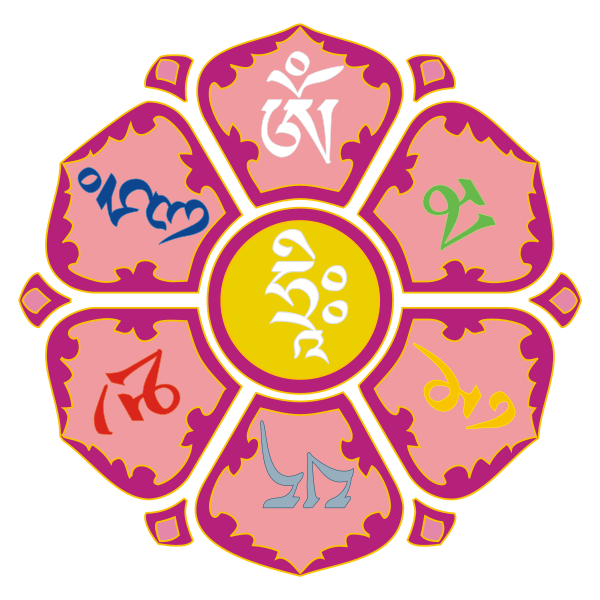
His Holiness the Dalai Lama explains the power of the most widely used Buddist and Hindu mantra: Om Mani Padme Hum.
In Sanskrit, this mantra roughly means “the jewel in the lotus.” But if your Western analytical mind wants to break it down further, this is what YogiApproved says:
- Om = the vibration or sound of the universe; represents divine energy and generosity and purifies the ego
- Ma = represents ethics and purifies jealousy
- Ni = represents patience and purifies want or desire
- Pad = represents diligence and purifies ignorance and judgment
- Me = represents concentration and purifies attachment
- Hum = the unity of all; represents wisdom and purifies hatred
In other words, it’s good shit, okay?

You’re saying it wrong, dufus
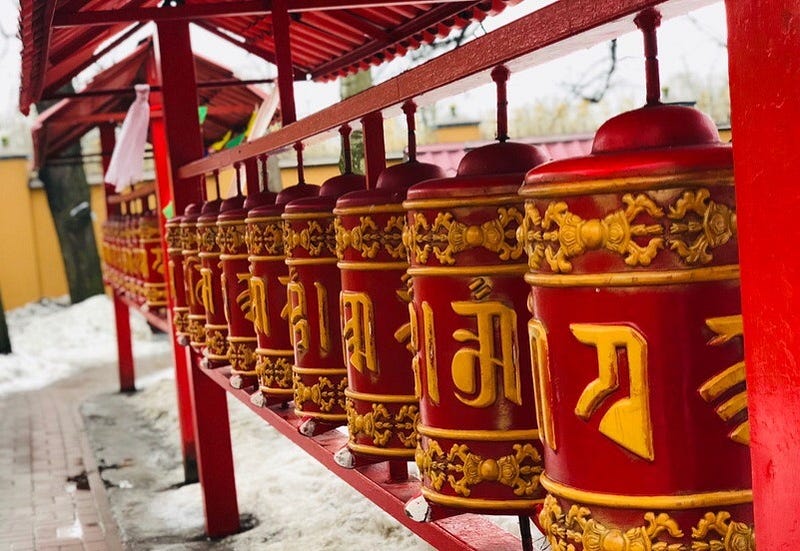
There are prayer wheels and drums inscribed with Om Mani Padme Hum in Tibet, and many other places worldwide. Each wheel or drum contains up to thousands of paper pieces with Om Mani Padme Hum written on them.
One spin of the wheel or drum equates to thousands of recitations of the mantra. Think Hail Mary and Our Fathers on crack. But how do you pronounce it?
That leads me to a story. I’m going to tell it to you from my memory.
The Story of Om Mani Padme Hum
In ancient [country redacted], there lived a holy and revered monk. He would spend his days and nights in a cave on an island outside of the village. For miles around, people had heard stories of this monk’s wisdom.
One day, a young apprentice crossed the water and entered the cave to seek the master monk’s guidance. The apprentice heard the master reciting the ancient mantra: Om Mani Padme Hum.
The apprentice said to the master, “pardon me, your holiness, but I’ve noticed you are saying the mantra in an unusual pronunciation.”
“Oh, thank you, my loved child,” said the master. “How then is this revered mantra enunciated?”
The apprentice instructed the master on the correct way to say Om Mani Padme Hum and then left on his way via his rowboat across the water.
Before the youngster could finish paddling his way home, the master had caught up to him, walking across the water.
The master asked the student, “How again should I be reciting Om Mani Padme Hum? I’m afraid I’ve been saying it incorrectly and want to make sure it is right.”
Walking on water
The point is:
- You don’t need to pronounce it correctly.
- You don’t need to know its meaning.
- You don’t even have to say it (you can listen).
Separate yourself from doom scrolling for five minutes and get your Om Mani Padme Hum going. Do this for a week or two, and come back to let me know how you feel, okay?
Ryan DeJonghe is the owner of YourEnergyHealers.Org, an online collaborative of energy and Reiki healers offering services over video. Ryan is also the author of Energy Healing 101, releasing January 2021.