avatarChristopher P Jones

Free AI web copilot to create summaries, insights and extended knowledge, download it at here

3312

Abstract

uin maintained a studio.</p><p id="f5e5">In October of 1888, Gauguin took Sérusier down to the nearby Bois d’Amour, or “Wood of Love”, a river-side pathway among trees, where he expounded his theories on colour and painting.</p><figure id="960f"><img src="https://cdn-images-1.readmedium.com/v2/resize:fit:800/1*opiatp0Y7vJHgjAi35Mpyw.jpeg"><figcaption><i>The Talisman</i>, also known as <i>Landscape at the Bois d’Amour (1888) by </i>Paul Sérusier<i>. Oil on panel. </i>27 × 21.5 cm. Musée d’Orsay, Paris, France. Image source <a href="https://commons.wikimedia.org/wiki/File:Serusier_-_the_talisman.JPG">Wikimedia Commons</a></figcaption></figure><p id="364d">When Sérusier began making an image of the scene on a wooden panel — an old cigar box cover — Gauguin was on hand to guide his choices.</p><p id="d53b">“How do you see these trees?” Gauguin asked. “They’re green. So, put some green. This shadow, it’s rather blue, paint it with pure ultramarine. Those red leaves? Put vermillion.”</p><p id="7b43">Gauguin’s words encouraged the artist to paint directly and without forethought, using unmixed paints directly from the tubes, in order to arrive at an impulsive design free from a slavish representation of the scene.</p><p id="c753">That morning, Sérusier painted his work <i>Landscape at the Bois d’Amour</i>, later to be known as <i>The Talisman</i>. It shows a view across the river. The water is still and reflects back the line of trees along the water’s edge.</p><p id="82f4">But more than anything else, its priority as an artwork was concerned with compositional harmony and colour resonance. The trees and water were simply a framework to hang his experimental colour palette on.</p><p id="5e88">It was a “passionate equivalent of a sensation received” as Sérusier’s artist-friend Maurice Denis would later describe it.</p><h1 id="f013">A Totemic Painting</h1><p id="7ad6">The importance of Sérusier’s <i>Bois d’Amour </i>painting lies in what happened next.</p><p id="ba83">On his return to Paris, he revealed the image to his fellow art students at the Academie Julian.</p><p id="1410">The incident was remembered by Denis, who told how Sérusier “showed us, not without a certain mystery, a cigar box cover on which could be seen a landscape”.</p><figure id="179f"><img src="https://cdn-images-1.readmedium.com/v2/resize:fit:800/1*BF3x6liG3NH48bMomugnnQ.jpeg"><figcaption>Detail of ‘<i>The Talisman’ (1888) by </i>Paul Sérusier<i>. Oil on panel. </i>27 × 21.5 cm. Musée d’Orsay, Paris, France. Image source <a href="https://commons.wikimedia.org/wiki/File:Serusier_-_the_talisman.JPG">Wikimedia Commons</a></figcaption></figure><p id="5d2f">Denis was initially unmoved: “It seemed crude because of its synthetic formulation in purple, vermilion, Veronese green and other pure colours – just as they came out of the tube — with almost no white mixed in.”</p><p id="d1e9">Yet enthusiasm for the painting soon began to bubble up. Artists like Pierre Bonnard and Paul Ranson, who along with Denis and Sérusier began to see it as a breakthrough in unmediated painting. As Denis recorded, “We were presented, for the first time, in a form that was paradoxical and unforgettable, the fertile concept of <i>a flat surface covered with colours assembled in a certain order.”</i></p><p id="9afc">For th

Options

e group of art students it was the beginning of their journey into modern painting. The bold blocks of intense colour, along with the echoes and rhythms suggested by the reflections in water, constituted a liberation into autonomous and abstract art.</p><h1 id="777c">Ongoing Influence</h1><p id="85d3">Within a short time, led by Sérusier <i>Les Nabis</i> was formed. They included Edouard Vuillard, Pierre Bonnard, Paul Sérusier, Félix Vallotton and Maurice Denis. They took Gauguin as their unofficial mentor and used <i>The Talisman</i> as their creative catalyst.</p><p id="ec7d">They were a collective of artists who exhibited together, promoted each other’s work, and spread the influence of Post-Impressionists such as Vincent Van Gogh and Paul Cézanne. For Sérusier, their task was to reconnect with the origins of art, the untarnished elements of seeing and making.</p><figure id="04a7"><img src="https://cdn-images-1.readmedium.com/v2/resize:fit:800/1*cLeh6fZncshwIF-fsWK97w.jpeg"><figcaption>The reverse side of “The Talisman” <i>by Paul Sérusier, with inscription by Sérusier: </i>“Made in October 1888 under the direction of Gauguin by P. Sérusier at Pont-Aven.”<i> Image source <a href="https://commons.wikimedia.org/wiki/File:The_Talisman_(painting)_by_Paul_Serusier,_reverse.jpg">Wikimedia Commons</a></i></figcaption></figure><p id="fca5">Meanwhile, Sérusier’s pivotal painting took residence in Paul Ranson’s studio on the Boulevard du Montparnasse. It was Ranson who christened the painting <i>The Talisman</i> and proudly displayed it on the wall during <i>Les Nabis’</i> weekly gatherings. Whilst convened, they would recite an opening mantra: “Sounds, colours, and words have a miraculously expressive power beyond all representation and even beyond the literal meaning of the words.”</p><p id="e1c9">On the reverse side of the panel, Sérusier wrote, “Made in October 1888 under the direction of Gauguin by P. Sérusier at Pont-Aven.”</p><p id="a9cf">Adopting a bold simplified style, the assembly of budding artists rejected the conventional realist approach to painting. Instead, they embraced Gauguin’s Synthetist concept — an artistic philosophy that promoted a harmonious blend of external forms with aesthetic unity in line and colour, guided by the painter’s intuitions.</p><p id="1c69">Countless modern artists, working in both the abstract and non-representational realms, have found resonance in their approach, steering art into a new age.</p><figure id="a21c"><img src="https://cdn-images-1.readmedium.com/v2/resize:fit:800/1*igQbKCOI4qGLg6JzYP7H9w.png"><figcaption></figcaption></figure><p id="16d7">If you liked this, you may also be interested in my book <a href="https://www.amazon.com/gp/product/B09BVR3BDN"><b><i>Great Paintings Explained</i></b></a><i>, </i>an examination of some of the most beautiful objects in art history.</p><h1 id="1ad0">Would you like to get…</h1><p id="9980">A free guide to the <i>Essential Styles in Western Art History</i>, plus updates and exclusive news about me and my writing? <a href="https://www.chrisjoneswrites.co.uk/sign-up-art/">Download for free here</a>.</p><h1 id="547f">Join me…</h1><p id="c62c">On <a href="https://www.instagram.com/greatpaintingsexplained/">Instagram</a> for more great paintings on the go!</p></article></body>

Why this Little-Known Painting is One of the Most Influential of the Last 150 Years

Introducing Paul Sérusier’s radical art technique
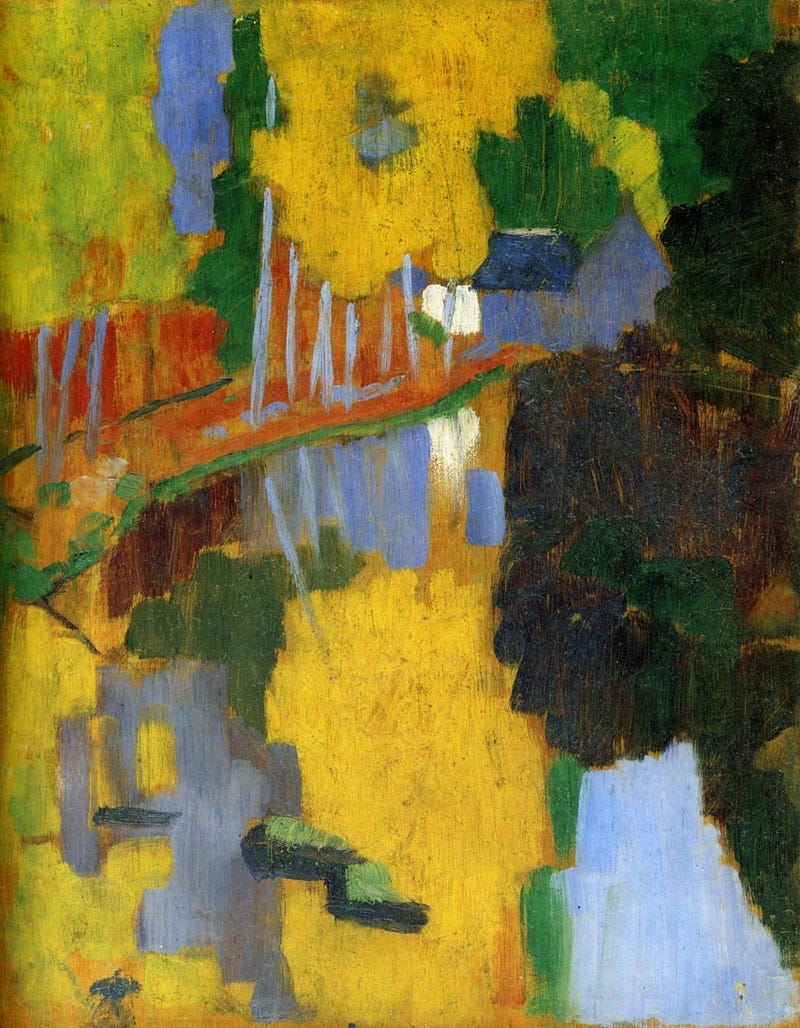
The Talisman, also known as Landscape at the Bois d’Amour (1888) by Paul Sérusier. Oil on panel. 27 × 21.5 cm. Musée d’Orsay, Paris, France. Image source Wikimedia Commons

Some artworks achieve their renown not only for what they depict but also for the effect they have on the story of art.

This painting is one such artwork.

Known as The Talisman, it became an icon of Post-Impressionism, a rallying cry for Synthetism and Cloisonnism, and a beacon for the group of young French painters who called themselves Les Nabis (“The Prophets”).

Despite its modest size — just 27 cm tall — the radicalism of its flat colours and near-abstract appearance made it one of the very first paintings of modern art.

So let’s unravel the circumstances of its creation…

A Journey from Paris

The year was 1888. A 24-year-old man left his home city of Paris, aboard a train on the new westbound line that opened in 1862 and which allowed Parisians to escape to the coast during the summer.

His name was Paul Sérusier, a student from Paris’ Académie Julian art school.

He was travelling to the sleepy village of Pont-Aven in Brittany in northwest France, a journey of about 350 miles, to join a thriving artists’ colony — following in the footsteps of a long list of artists including several from America like Henry Bacon and Robert Wylie.

Most well-known among the artists in residence was Paul Gauguin.

At age 40, Gauguin was considerably older than the young cohort who had recently descended on the village, like Sérusier and the painter Émile Bernard, and because of that, had established himself as something of a teacher figure.

In the Breton village, where he first came in 1886, Gauguin found a place that was consonant with his growing preoccupation with “primitivism” — an artistic creed that looked to the past as a means of resisting the onset of industrialisation and urbanisation. He prized the rural area of France for the fact they still maintained their own language and religious customs.

Room at the Inn

In Pont-Aven, Sérusier found a room at the Pension Gloanec, a local inn where many artists chose to gather on account of its low-cost but abundant food. Large dishes were set up on the dining table for artists to help themselves from. In clement weather, the tables and chairs spilt out onto the street.
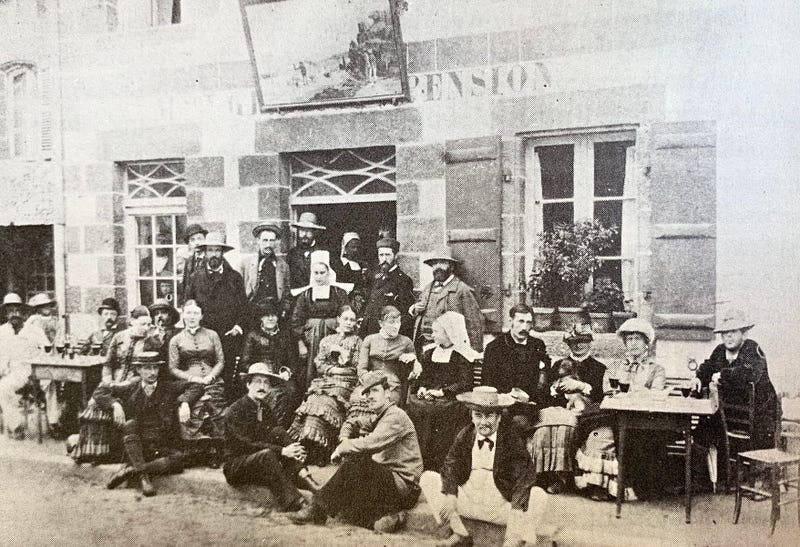
Artistic residents of the Pension Gloanec, Pont-Aven, c.1888

Sérusier proffered a letter of introduction to Gauguin when they met at the Pension Gloanec where Gauguin maintained a studio.

In October of 1888, Gauguin took Sérusier down to the nearby Bois d’Amour, or “Wood of Love”, a river-side pathway among trees, where he expounded his theories on colour and painting.

The Talisman, also known as Landscape at the Bois d’Amour (1888) by Paul Sérusier. Oil on panel. 27 × 21.5 cm. Musée d’Orsay, Paris, France. Image source Wikimedia Commons

When Sérusier began making an image of the scene on a wooden panel — an old cigar box cover — Gauguin was on hand to guide his choices.

“How do you see these trees?” Gauguin asked. “They’re green. So, put some green. This shadow, it’s rather blue, paint it with pure ultramarine. Those red leaves? Put vermillion.”

Gauguin’s words encouraged the artist to paint directly and without forethought, using unmixed paints directly from the tubes, in order to arrive at an impulsive design free from a slavish representation of the scene.

That morning, Sérusier painted his work Landscape at the Bois d’Amour, later to be known as The Talisman. It shows a view across the river. The water is still and reflects back the line of trees along the water’s edge.

But more than anything else, its priority as an artwork was concerned with compositional harmony and colour resonance. The trees and water were simply a framework to hang his experimental colour palette on.

It was a “passionate equivalent of a sensation received” as Sérusier’s artist-friend Maurice Denis would later describe it.

A Totemic Painting

The importance of Sérusier’s Bois d’Amour painting lies in what happened next.

On his return to Paris, he revealed the image to his fellow art students at the Academie Julian.

The incident was remembered by Denis, who told how Sérusier “showed us, not without a certain mystery, a cigar box cover on which could be seen a landscape”.
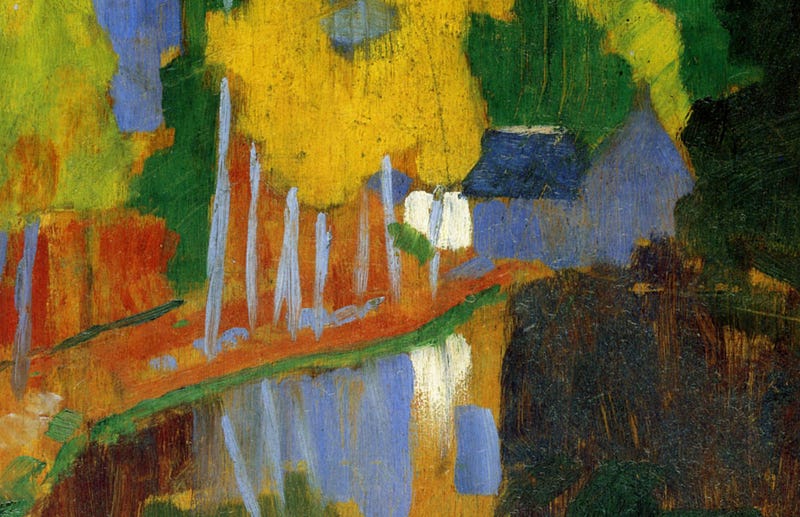
Detail of ‘The Talisman’ (1888) by Paul Sérusier. Oil on panel. 27 × 21.5 cm. Musée d’Orsay, Paris, France. Image source Wikimedia Commons

Denis was initially unmoved: “It seemed crude because of its synthetic formulation in purple, vermilion, Veronese green and other pure colours – just as they came out of the tube — with almost no white mixed in.”

Yet enthusiasm for the painting soon began to bubble up. Artists like Pierre Bonnard and Paul Ranson, who along with Denis and Sérusier began to see it as a breakthrough in unmediated painting. As Denis recorded, “We were presented, for the first time, in a form that was paradoxical and unforgettable, the fertile concept of a flat surface covered with colours assembled in a certain order.”

For the group of art students it was the beginning of their journey into modern painting. The bold blocks of intense colour, along with the echoes and rhythms suggested by the reflections in water, constituted a liberation into autonomous and abstract art.

Ongoing Influence

Within a short time, led by Sérusier Les Nabis was formed. They included Edouard Vuillard, Pierre Bonnard, Paul Sérusier, Félix Vallotton and Maurice Denis. They took Gauguin as their unofficial mentor and used The Talisman as their creative catalyst.

They were a collective of artists who exhibited together, promoted each other’s work, and spread the influence of Post-Impressionists such as Vincent Van Gogh and Paul Cézanne. For Sérusier, their task was to reconnect with the origins of art, the untarnished elements of seeing and making.
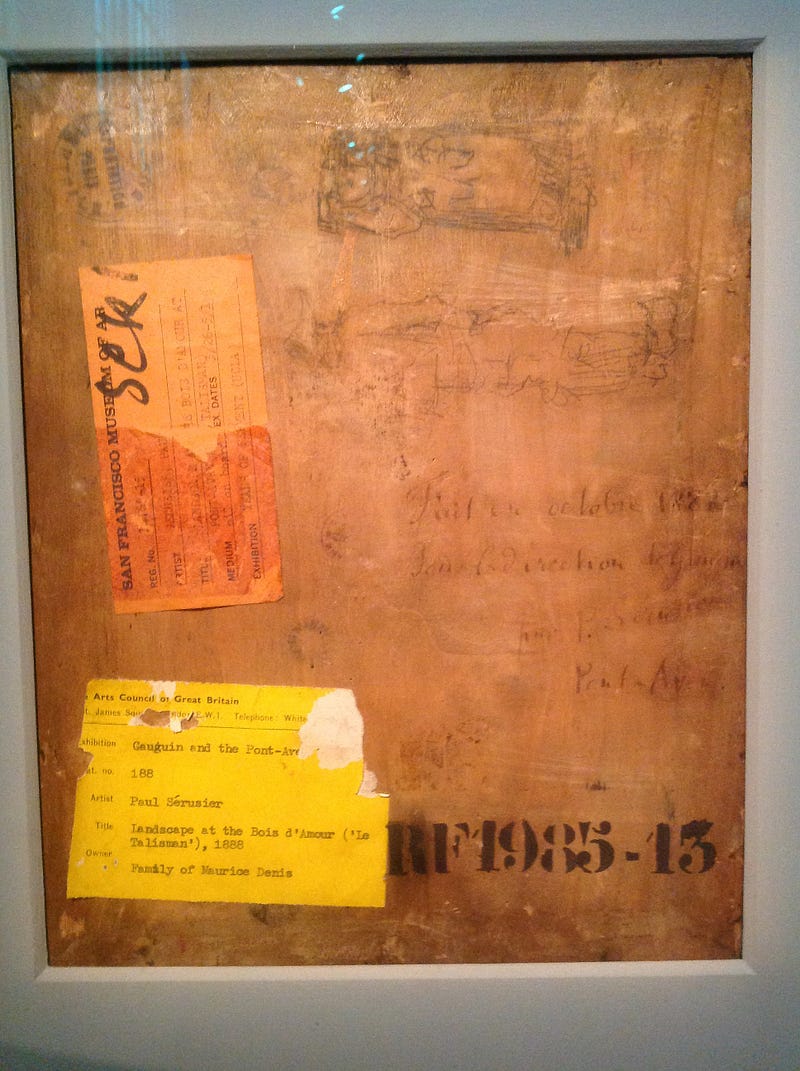
The reverse side of “The Talisman” by Paul Sérusier, with inscription by Sérusier: “Made in October 1888 under the direction of Gauguin by P. Sérusier at Pont-Aven.” Image source Wikimedia Commons

Meanwhile, Sérusier’s pivotal painting took residence in Paul Ranson’s studio on the Boulevard du Montparnasse. It was Ranson who christened the painting The Talisman and proudly displayed it on the wall during Les Nabis’ weekly gatherings. Whilst convened, they would recite an opening mantra: “Sounds, colours, and words have a miraculously expressive power beyond all representation and even beyond the literal meaning of the words.”

On the reverse side of the panel, Sérusier wrote, “Made in October 1888 under the direction of Gauguin by P. Sérusier at Pont-Aven.”

Adopting a bold simplified style, the assembly of budding artists rejected the conventional realist approach to painting. Instead, they embraced Gauguin’s Synthetist concept — an artistic philosophy that promoted a harmonious blend of external forms with aesthetic unity in line and colour, guided by the painter’s intuitions.

Countless modern artists, working in both the abstract and non-representational realms, have found resonance in their approach, steering art into a new age.

If you liked this, you may also be interested in my book Great Paintings Explained, an examination of some of the most beautiful objects in art history.

Would you like to get…

A free guide to the Essential Styles in Western Art History, plus updates and exclusive news about me and my writing? Download for free here.

Join me…

On Instagram for more great paintings on the go!

Art
Art History
Inspiration
Creativity
Painting
Recommended from ReadMedium