
This Isn’t Your Grandmother’s Pandemic
The Evolution of A Solitary Quarantine.
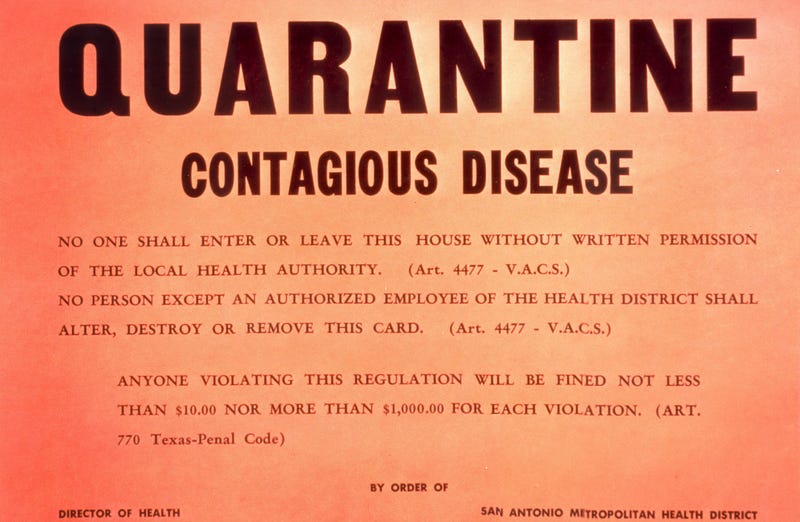
On the theory that we’ll find a pony in this pile of manure, let me just say, I’m glad this isn’t my mother’s or even my grandmother’s quarantine.
I’m not saying coronavirus isn’t the worst virus to ever hit the human immune system. That’s for the scientists to decide. So far, they think it is by a long, country mile. But the winner may still be the diphtheria outbreak in the 20s or various cholera epidemics. Or possibly the Spanish flu. I only worked for doctors, I never got a degree, so I don’t really know.
But my parents and grandparents lived through the 1918–1919 flu pandemic that makes our coronavirus numbers look like a penny-ante marble game you might play on Twitter (It’s a thing. Look it up.)
A third of the inhabitants of the planet caught that virus spread by troop movements in WWI, and roughly 50 million people died. We’re not there yet, and let’s hope we don’t even come close. But in the effort to lose that competition, we are asked and in some places ordered to isolate ourselves to keep from spreading the novel coronavirus.
As we all know by now, the disease it causes, COVID-19, so-called after the year it was named in case you think we have 18 other COVIDs, can make you very sick, maim you, and even kill you.
But I don’t have to go there. If you don’t have that information clocked in your memory bank by now, why haven’t you been paying attention? More to the point, why haven’t you been quarantining?
Even if your state is a holdout, you could take your life and well-being in your own hands and slap a mask on your puss when you need to slip out for some sustenance and stay the hell inside the rest of the time.
Just sayin’.
Oh, you don’t like the idea of isolation and only visiting your friends and family virtually these days? Don’t get me started.
See you at the mortuary, because, newsflash, the virus doesn’t care about your politics, only your dark, warm, moist nasal passages, throat, and lungs where it can settle down and ruin you, for a few weeks if you’re lucky, but likely for life.
But that’s your business if you want to go from healthy to your deathbed in zero to 60. Forgive me for being a little hot under the collar about people breaking social distancing orders in a national emergency.
The longer they stay out and spread the virus, the longer I have to stay inside in my total isolation.
Part of the reason I’m staying inside is to protect my health. The other reason is to protect theirs. If I don’t catch the virus, I can’t spread it. I don’t expect a thank you. It’s my civic and moral duty. But I do expect adults to act like grown-ups and follow suit.
Now excuse me while I step down from my soapbox and get on with the topic of quarantining.
Quit it, Helen. You made your point, now get on with it. What about your grandmother?
Right, sorry. I don’t get out much these days and tend to ramble on when I have an audience, which I expect is what my grandparents did during the 1918–19 pandemic.
Because the only way they had to halt the spread of the so-called Spanish flu, was to stop it in its tracks.
My mother was involved in that campaign. I recall her telling me about it when I was too young to understand what pandemic really meant. She filled the noses of bombs with dynamite for Britain during the war as WREN in the Women’s Royal Naval Service. After the war she battled the Spanish flu doing what was necessary, such as staying inside.
However, in the 1940s, when she explained to me how everyone was dying and afraid to go outside, we were still only a generation away from that horror, so it was still a topic of conversation. Kind of like 9/11 is still alive today for those of us who lived through it back then.
My aunts and uncles were alive during that crisis and, though most of them lived in England and Ireland as teens, they still had vivid memories of the sick and dead. And, being my relatives, they loved nothing more than telling gory stories about that time.
So, how did my ancestors stand isolating themselves back then? All I can say is I’m glad I’m in this viral war and not that one.
I’m able to put up with my own company for these many, many, many weeks–– like, what, it’s been 63 years so far? I’ve lost count. I think I was a young woman when all this started. But I digress.
I haven’t gone completely off the rails because I’ve had a support system my grandmother couldn’t have dreamed about during the Spanish flu pandemic.
Even if the internet had been available back then, she would have batted it down with one of those rug beaters women used to use to clean their carpets before vacuum cleaners were invented. My Uncle James once brought his wife, her daughter, Kate, back to Ireland for a visit, along with his prized Kodak movie camera.
Back in those days of Brownies, owning your own movie camera was like owning your own space ship. Something beyond the hopes and dreams of ordinary, blue-collar families.
Uncle James would film anybody’s body in motion, the way the owners of the first Kindles were starved for content for their devices and would buy any garbage an enterprising “author” would publish.
But when he whipped it out for my grandmother, who still lived in the house where Cassidys had been born since at least the 1850s, she snapped, “Get away from me with that thing.”
If she wouldn’t let someone take her picture, how would my grandmother have managed a Zoom meeting, a Facetime chat with a neighbor, a Wattsapp video lunch with a cousin, or Skype birthday party with the family?
How would she have tolerated learning the computer after a day milking the cows and cooking for her brood of 14 over a wood burning stove in a one-bedroom cottage with “the facilities” outside?
Mariah Cassidy had to be the most resourceful woman on the planet to have ferried her family through that pandemic unscathed. But she wasn’t going to tolerate any nonsense with fancy machines like cameras that whirred, much less iPhones or tablets.
I can just see a Spanish flu virus peeking in the window of the stone house that still stands on the farm where my father was born. The microscopic devil taking a look at the brood of 14 on their knees for the nightly rosary, praying under the watchful eye of my grandmother for deliverance from the pestilence, the kids praying for deliverance from the scolding of their mother if their shoulders slumped or their faces winced from the pain in their knees where they met the stone floor.
That virus would have said, no, this house has enough trouble. I’ll go find some other Irish family to torment.
I have her DNA running through my veins. You’ll see it in my love of nice clothes and a way with snarky remarks.
I hope I have some of her grit, though perhaps not enough. I don’t know how she did it, before and after the dark flu years. Fourteen kids? OMFG. I thank God for all of them. They are my family, but I’m so grateful I didn’t have to bear and raise them.
I’m looking out the window right now as I sit in my solitary quarantine, in my isolated apartment, with a view to a neighbor on his deck in my line of sight. I’m wearing my good clothes, of which my grandmother would approve. The occasion was a Skype lunch I attended for a dear friend’s birthday.
Earlier I had a FaceTime business meeting with a client to help her choose a title for her next book, during which we shared many laughs.
I then texted with my daughter about the pain she’s been having since she knocked her ankle against a hard surface. I was relieved to hear she’d had a good chat with her doctor.
I’ve already planned the Netflix shows I’ll watch after I fix my butternut squash and goat cheese galette I’ll have for dinner, which I’ll prepare in my tabletop steam oven.
I can hear my neighbor upstairs moving about her apartment. We have made arrangements to exercise with each other during this time of sheltering-in-place. One of us will text the other: Want to work out? The other will text back: Let me change my clothes.
And for 30 minutes or so, she will do her thing, and I will dance around my apartment to a Zoomba routine I’ll find on YouTube.
All this technology helps me cope with the disaster swirling outside my door.
My grandmother lived on a farm, so during the time she was with her family, she was self-contained. But she would not have been allowed to walk into town for supplies, to visit friends, to go to church, the mainstay of her life.
How did she distract herself when she didn’t even have an electric light in the house and cooked three meals a day for her crowd on a wood-burning stove. She lived to a great age as they used to say in Ireland, nursed by her son’s wife through her last illness, which luckily was not a nasty virus, milking the cows in the barn for as long as she was able.
That’s how she got through her pandemic, doing her chores, feeding her brood of unruly children, in particular, my father, Jim, who would have just turned twenty. Did she wear a mask? I have no photos of her during that time.
Because my ancestors survived, I am here. And I owe it to them to survive this pandemic.
It’s possible this virus is more deadly. That remains to be seen. I’m not going to take a chance. I’m inside for the duration. I’m lucky enough to have technology to get me through. With my devices keeping me connected to my loved ones, I can isolate until they find a vaccine if necessary.
You want to complain about efforts to save your life through quarantining? Talk to the ghosts of my ancestors about what they saw in 1918 and 1919. A third of the population died before they figured out how to stop it by social distancing.
You know what they say. Those who don’t learn from history are doomed to repeat it. Call me when the pandemic’s over. You know where to find me.
I’m an editor and writer on Medium with Top Writer status. I’m also an editor for the publication, Rogues Gallery. I’ve published 55 titles on Amazon and edit for private clients. If you’d like to hire me as your editor for fiction, non-fiction, or business writing, please contact me here. If you’d like to read more of my work on Medium, click here to sign up for my newsletter. I’ll make sure you don’t miss a word. Thank you for reading.


