
This is Your Brain on Piano
Why learning a musical instrument creates a better brain
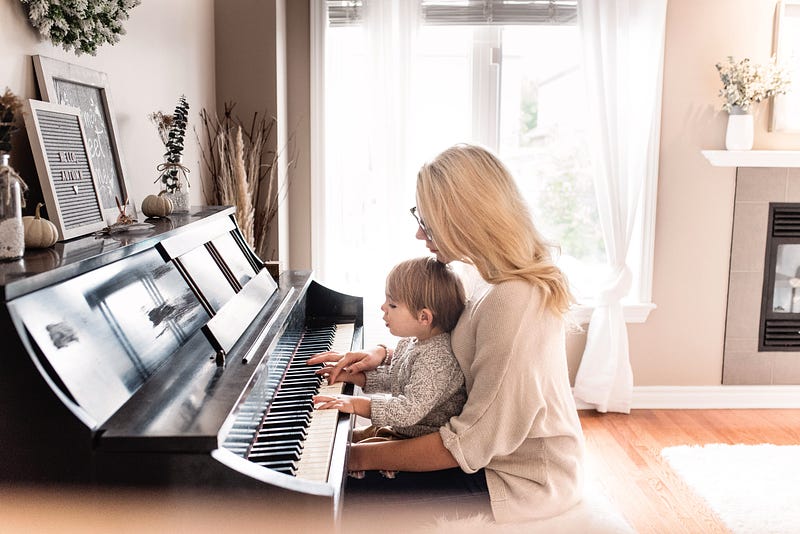
I love the piano. I always have and always will. It speaks to my heart, stirs emotions, and calms my soul. It brings excitement and joy, as well as challenges. It makes me use my brain.
I played a little bit when I was much younger. My godfather bought me a little starter piano when I was about 7 years of age. I had starter sheet music that I learned to read, and was kind of self-taught. This was back in the early 80s, so things like the internet or YouTube did not exist. My mom played guitar and could read music so she would help me from time to time. But she didn’t like the piano very much. So guess where that got me? Not playing piano…
I wanted so much to play throughout my life but was not given the “perfect time” (at least that’s what I told myself).
Fast-forward the tape a bit… I finally bit the bullet in my mid-30s and decided to learn the piano. I bought a used upright Baldwin Hamilton piano, and I started to take private lessons.
Learning an instrument much later in life is not only possible, but it’s highly achievable! The saying ‘You can’t teach an old dog new tricks’ is a bunch of horse plop. If I can learn an instrument later in life… so can YOU!
“When you’re 90… you probably won’t be playing soccer, doing gymnastics, or dancing hip-hop. But you’ll still be able to play the piano” — Unknown.
But first, a little lesson about your amazing brain.
The human brain is the most powerful supercomputer in existence (in my very humble opinion). It’s a fascinating organ that weighs on average at about 3lbs. There are 2 hemispheres (left and right). The left hemisphere controls the right side of the body, and the right hemisphere controls the left side of the body. Weird, right? Within each hemisphere are 4 lobes: Frontal, Parietal, Temporal, and Occipital.
- The frontal lobe is responsible for cognitive function and controls voluntary movement.
- The parietal lobe is the processing center responsible for temperature, taste, touch, and movement.
- The temporal lobe is responsible for processing our memories and integrating them with the sensations of taste, touch, sight, and sound.
- The occipital lobe is responsible for our vision.
The corpus callosum is the bridge structure that connects the hemispheres, which also carries signals one to the other.
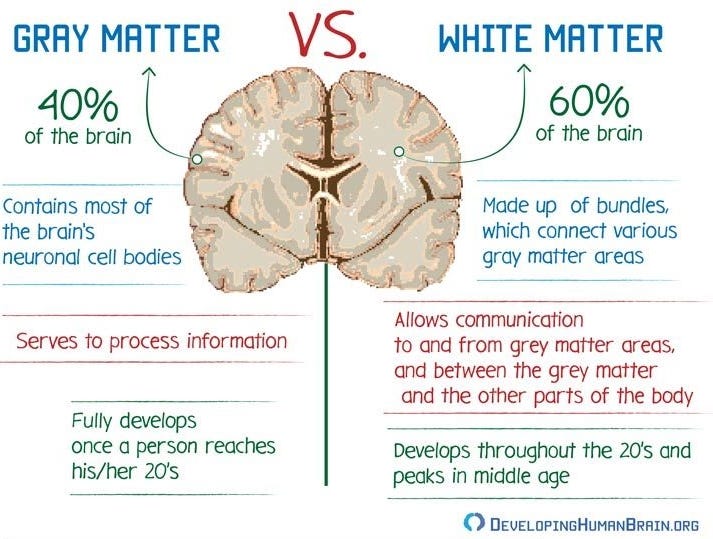
Then there is the grey matter and the white matter. But which matters? Here’s a great visual to describe:
Scientists and researchers have tried to control and replicate the power and energy of the human brain. But they fall short because it is very difficult to recreate something so unique, diverse, and complex as the brain. Not to mention something that adapts and changes to its environment. It’s practically impossible.
In the past, there was a misnomer that the brain was fixed past a certain age; That it was incapable of change and adaptation. And that adults could not learn anything new and behaviors were “set for life”. This is simply false.
Dr. Norman Doidge, A psychiatrist and researcher from the University of Toronto in Canada states, “The brain is not fixed and unchangeable, as was once thought, but can create new neural pathways to adapt to its needs”. Improvise. Adapt. Overcome.
What happens to your brain when you learn an instrument?
It’s called Neuroplasticity. And like the potentials of the brain, it’s very powerful. Check out this brief video to give a quick explanation.
Whether we know it or not, we are exercising our brains every. single. day. Learning a new instrument, a new language, a new habit, a new routine, reading or writing, or whatever it is you desire, is an exercise for your brain. It’s quite healthy to literally ‘stretch your thinking’.
By learning a new musical instrument, you are creating new neural pathways and synaptic connections. You are rewiring your brain in a healthy way.
When you first learn scales, hand coordination and exercises, reading sheet music, and fine-tuning your senses (to name a few), you are rewiring your brain to adapt and successfully play an instrument.
Your brain learns to multi-task the many complex components to play a piece of music, regardless of how simple or complex the composition is. It can be as simplistic as ‘Mary had a little lamb’ up to and including complex masterpieces from Beethoven, Mozart, or Chopin. Your brain will rewire and adapt. And soon you will be playing great music!
If you stop playing the instrument, those neural connections eventually become dysfunctional or broken.
It’s like going to the gym and working your muscles. If you start exercising and toning your muscles, but eventually stop… your muscles will atrophy and lose their tone, and even strength. It’s much the same with your brain.
Use it, or lose it! It’s that simple.
At one point, I took a 4-year hiatus from the piano. When I restarted in January 2019, it was like starting from scratch. I lost most of my mental piano connections. The neural connections I previously created had atrophied. I had to re-learn everything. Thankfully, some things were a little quicker than others. And thankfully, I have a very patient piano teacher.
What happens to your brain when you learn to play an instrument?
When you learn something new, like a musical instrument, there are numerous positive benefits to your brain and body. These benefits include:
- Practically every part of your brain is used
- Increase in grey matter
- Increase in memory capability
- Increase in coordination and dexterity
- Increase in emotional awareness
- Stress reduction
- Boost to your immune system
- Develop patience and perseverance
- Build confidence
- Become more creative
- Better time-management skills
- Increase in discipline
- It’s just so much fun!
As a means of healing
Research also shows that learning a musical instrument helps to refocus and heal traumas. While music in and of itself is very healing (note: there is a whole field dedicated to music therapy), the act of learning to play instrument aids the brain in healing as well.
- It provides a means of expression
- A way of releasing experienced trauma and pain
- A way to refocus and aid in establishing coordination and movement
If you don’t think playing an instrument can help heal or help those with disabilities… I present to you Stevie Wonder and Ronnie Milsap. Both were remarkable musicians, learned and played different instruments, and were blind.
A few other notable musicians include:
- Beethoven, who went deaf, but he still composed music
- Ray Charles, who went blind at the age of 7, became a musician
- Rick Allen, the drummer of Def Leppard, lost his left arm in a car accident. He still played drums
- Jeff Healey was blind and played several instruments, and had a band (and had a cameo appearance in the movie Road House)
“I think music in itself is healing. It’s an explosive expression of humanity. It’s something we are all touched by. No matter what culture we’re from, everyone loves music.” ― Billy Joel
Like any other thing in life, it takes dedication and oodles of continued practice to play a musical instrument. I practice the piano virtually every day, on top of my weekly private lesson. It keeps me mentally fit, energetically charged, and I reap all the benefits. So can you!
Learning a musical instrument, even later in life, has big benefits. But even if you don’t want to play an instrument, that’s okay too.
If there is something you have always wanted to do… I challenge you to learn whatever that new thing is, and pursue it with passion!
Keep on stretching those mental muscles! Your brain will thank you for it.


