
This Is Your Brain On Lucid Dreaming
Research on the people who change the world in their sleep, and how to be one of them.

Lucidity sounds so ridiculous, fantastical and outlandish that the scientific community doubted it actually existed until a 1978 study proved that yes, it’s real.
“Lucidity, noun: The ability to think clearly, especially in intervals between periods of confusion or insanity.”
Lucid dreaming is attaining clarity and awareness inside the confusion of a dream. When a person attains lucidity in a night’s sleep, they are aware that they are dreaming.
There are different levels to this. Perhaps every few weeks, if we are lucky, most of us will have a moment in a dream where we question: wait a second. This isn’t real. Normally this moment slips away just as fast. We go back to accepting living in this city built underground, or that we’re at a Rihanna concert, or our old high school classmate is a lizard. (Knew it.)
A narrow majority of us — around 55% — have experienced at least one lucid dream in our lifetime. The frustrating part to the curious is, this isn’t on command, or regular enough to explore. Just a strange fluke.
Except it doesn’t have to be. There are techniques that can reliably increase someone’s likelihood of a lucid dream. We’ll explore the best of these in this article.
In truly lucid dreams, people can accomplish…well, anything. You can walk through walls or swim without breath. You can conjure up characters to speak to, fly into space, or dance like (literally) nobody is watching. If you’re feeling more serious, it is a blank canvas for confronting fears and traumas to heal from them — what Jungians call “shadow” work.
“Who looks outside, dreams; who looks inside, awakens.” — Carl Jung
There are interesting reports of athletes even using the extra time and space of a lucid dream to train in their sleep.
Personally, after reading some of the research and getting intolerably curious, I’ve experienced around six lucid dreams in the past year. (Note: these were almost all clustered together into a narrower period of 1–3 months, in which I practised and intended to have them. Before intending to have one, I never did. This is trainable.)
I can say lucidity is…bizarre, in the most beautiful way. How did I remember all these strangers’ faces that clearly? How is my mind generating this, making plants grow right before my eyes?
As a psychologist, it put me freshly in awe of the sheer horsepower of the mind to imagine and generate. Far greater than you would expect. I can’t speak of the philosophical or existential implications of being able to inhabit a private place that doesn’t actually exist (though I’m sure there are many wildly compelling conspiracy theories on that!), one which feels subjectively as vivid as reality, but it has to be experienced to be believed.
It raised one urgent, fascinated question. What the hell is going on inside a lucid dreamer’s head?
The neuroscience
In normal periods of rapid-eye-movement (REM) sleep — — aka dreaming — blood flow to the brain and oxygen consumption is accelerated, while the body’s muscles are paralysed to stop you acting out your dreams.
Compared to other periods of sleep, the dreaming brain is busy and active. Brainwaves reach theta (4–7 Hz) frequency, whereas deep, dreamless sleep is in delta (1–4 Hz). The amygdala is particularly responsive, which gives dreams their intense emotional quality, making nightmares that scary.
The least active part of the brain in normal REM sleep is the prefrontal cortex: where our critical thinking occurs.
This explains why we accept all the ridiculous sights and events that happen in dreams and simply “go with the flow”, without a second thought. Think about it: you’ve probably had strong emotional reactions within dreams, where you have ran in terror from a threat, cried with a dead loved one, or laughed at a joke you woke up to realise didn’t make sense. The you in dreams is intensely emotional, but not logical. This makes dreams action-packed, bizarre, violent, fantastical and impulsive. You may have fought strangers, or argued with someone you care about. Unlike real life, you lack conscious control over your actions, or the ability to question the motives and logic of others.
It’s a fairly animalistic and unconscious form of awareness, where emotion rules unchallenged.
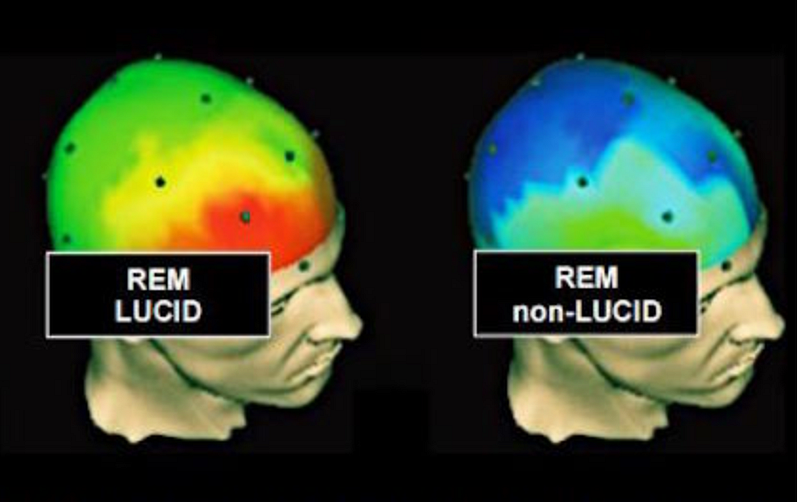
The key difference neurologically between a non-lucid dream and a lucid one is the prefrontal cortex switches on. Brain activity in this most frontal region of the brain lights up as measurably different when a dreamer reaches lucidity.
The prefrontal cortex lets us make logical decisions, reason, and self-reflect — to think about thinking, known as meta-cognition — so when this lights up in the dream, we realise we are dreaming. We also access our waking thoughts and memories, to experience dreams as ourselves in real-time, rather than just a confused, blurred memory afterwards. I think of it like a Simba moment: we “remember who we are”.
The key skill underlying this occurrence is self-reflection: awareness of ourself, and our present surroundings. (This is why, as we’ll see shortly, meditation helps.) The brain area associated with self-reflection is subsequently larger in lucid dreamers. Random occurrences in the dream that prompt self-awareness can trigger this: the lightbulb moments are when something clearly weird or “wrong” happens, especially related to our most familiar subject, our selves. For example, I once became lucid by seeing myself in the mirror, and thinking, wait, my hair isn’t that long anymore — I’m dreaming!
How can I do it?!
First of all, here are three lifestyle hacks that will make finding success with the specific techniques much, much easier. All of them are simple and can take five minutes a day.
- Keep a dream journal. This is the most basic and essential of all steps. Leave a notepad and a pen by your bed. When you wake up in the morning, immediately write down what you remember of your dream(s). If you have time, write in as much sight/smell/hear/touch detail as possible, but no need for poetics: it can just be a scribbled sentence or two before work. The more you write of dreams, the more you will remember, which is crucial for lucidity. Make this a habit.
- Meditate before sleep. This has the added bonus of helping you relax, unwind, and feel sleepy in the first place. Becoming more aware and present in your surroundings is exactly the skill you’ll utilise to become present in a dream. Meditating has been shown to lead to more lucid dreams.
- Don’t drink that night. Alcohol may feel like it helps you drift off, but it actually makes your sleep quality poorer by blocking REM periods of the cycle. That’s where the dreams happen, so we want as much time in REM as possible!

Once you’ve settled into a calm, sober night, and you decide it is one you would like to experience lucidity on, you’re ready to pull out the big guns. The following are tested methods deliberately designed to induce lucid dreams, on that particular night. Like anything, they get better with practice.
- MILD technique. AKA a Mnemonic Initiated Lucid Dream, which is a lot easier than it sounds! Like counting sheep, repeat the sentence “Next time I am dreaming, I will know.” inside your head as you drift off. This simple method is most effective if you have already woken yourself from another dream, and helps you hold onto your conscious intentions, as you slip from one state to another.
- Count your fingers. This is known as a reality check. Remember the spinning top from Inception? Here’s an easier one. Get into the habit of examining the palms of your hands, whenever anything weird happens in real-life. You don’t have to be an obvious oddball in public, but just take a glance. Twice. In real life, they’re just hands. In a dream, for some reason, it’s really hard for your brain to maintain the same number of fingers on two separate looks. Or sometimes they’ll be furry, or rough-hewn squares, something else bizarre. The idea is once you get into the habit of this, you then automatically hand-check when something strange happens in your dream, note that your hands are Off, so this isn’t real — et voilà, you’re lucid!
- WILD technique / The wake-back-to-bed method. By far the most reliable success rate, but also the most intensive on your sleeping pattern. To do this, set your alarm for in six hours. When it goes off, get up. Shake off the cobwebs, stretch, read something, it doesn’t matter. When you’ve been awake for 20 minutes, lie down and let yourself drift back to sleep. Wake-back-to-bed works because this is the time of night where you have the most REM dreams normally, back-to-back. By waking yourself up in the middle, you help blur the boundary between the self-reflective awareness of being awake, and your next dream.
Remember: these will not work instantly, unless you’re a lottery winner. Progress varies. You should notice you’re remembering your dreams with greater frequency and detail within a week or two. From there, the chances rack up and up the more you practise. To maximise odds, combine all of the above techniques. Otherwise, as many as suit your preferences and lifestyle.
My advice is, don’t force it. It’s a weirder skill to pick up than an instrument or a bike. Keep jotting down your dreams. You’re not looking to control them, simply explore and work with them. Appreciate the more vivid dream recall in the meantime, and it will blow your mind when you least expect it.
My first lucid dreams occurred after three weeks of sporadic practice, when I was in a relaxed and happy state…and overwhelmingly when I had a) meditated and b) read from a paperback about lucid dreaming immediately before bed, using MILD. Keep those screens away; the right headspace and focus are important here.
Parting tips
Be prepared to find your first lucid dreams hard to stay in for long. I mean, you’ll be so “I’m doing it! I’m actually doing it!” excited and boggled by the novelty of the experience, that you wake yourself up again.
This is incredibly common — your mind is balancing the tightrope between waking and dreaming for the first time, after all. Be thankful (and a little dazzled) you managed however long you managed, and know you’ll be able to stay up there longer with time and practise. Plus: lucid dream time passes in real-time, so you’ll still feel like you experienced a lot more than the usual blur of a night. There are also techniques that can be used in-dream to stay in the lucidity for longer.
If you’re curious enough for an excellent, paperback-length summary of lucid dreaming and how to do it, I’d recommend reading Charlie Morley, the darling of teaching lucid dreaming in the West. He’s written a lot of books on the subject — I read Lucid Dreaming Made Easy: A Beginner’s Guide to Waking Up in Your Dreams, and it definitely helped.
Sweet dreams.
📚➡ Learn more useful psychology with our research-backed e-book, How to Focus In An Unfocused World.
“I dream my painting, and I paint my dream.” ― Vincent Willem Van Gogh


