
This Is Why You Belong in Paris
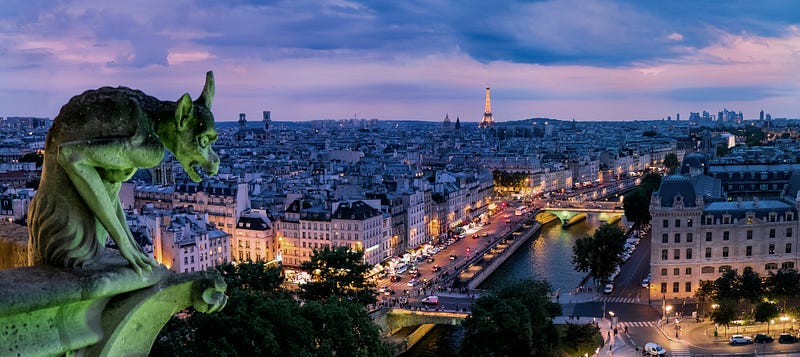
There’s nothing left to say about Paris.
Not now, after a thousand years and more. Half the world’s greatest writers lived here, at one point or another. Their names, etched in stone and stained with traffic fumes, loom on corners above indifferent crowds throughout the city. Books have been written. Torrents of words in a hundred languages have been splashed all over the worn cobblestones. Paris is one of those cities, like London, like Rome, where you feel the past pressing down on you. Time, in quantity, works the same way distance does, turning terror to beauty, the mundane to the profound. The mountain you stand on has nothing to do with the one you saw from the valley. We’ll come back to this.
We’ve been to Paris before. A few years back, now. We rode to the top of the Eiffel Tower, strolled the Champs Elysee, wandered through the catacombs. It was our first time. We swore then that, if we ever came back, we’d do it differently. No tourist attractions. It was November then, and cold, and we were sick and we were tired. We couldn’t shake the cold we shared, any more than we could shake the feeling that we’d missed something. Something subtle but crucial. Paris. You can miss it all, if you don’t pay attention.
While my girlfriend — it sounds funny to call her that now, after the wedding — lay in bed nursing her cold, I pretended I was going to the supermarket. Instead, I found a jeweler. The woman who had the best English of all the staff smiled when I told her it was our first time in Paris. “So you will be back,” she said. A statement of fact, not a question. She was right.
The thing is, if you’re in Paris for the first time, you have to see the sights. Get your photos of the Arc de Triomphe, lit by golden floodlights and a thousand circling cars. Get extorted for a glass of champagne at the top of the Tower, because it will make her smile. Bathe in the gorgeous coloured light of Notre Dame beneath the now-ruined ceiling. Be entirely unashamed. Be a tourist. Don’t apologize for it. And once you’ve done all that, forget it.
Because Paris is massive, in space and in time and in the shadow it casts.
It has room for you, too. And you belong here, just as much as Hemingway and Moliere, Becket and Voltaire, Joyce and Proust. There’s a Paris made just for you. It will work its pernicious charm on you, just as it has on the millions that came before you, the broad streets shining wetly between the humped gray backs of cetacean buildings, the elegant streetlights reflected in glossy piles of fallen leaves.
No sights this time; we barely left the Left Bank. In the Jardin de Luxembourg, I read an essay by Joseph Roth, a few minutes' walk from the vanished hotel he spent his last years in. That was the best part of a century ago. But the children still rent artfully painted wooden sailboats in the park and push them with long poles out onto the pond’s green surface, just the way the long-dead writer describes. Puppets still prance and chatter on a curtained stage. Roth’s world is gone, like so many others, a hundred different Parises slipping away in an infinite curve like the weird space between two mirrors. But the past lives on. The grandchildren of the children Roth described rent their toy boats from the grandson of the man who used to make them. That’s my Paris. Drinking pastis in Cafe Tournon, prowling the shelves at Shakespeare and Company, eating a leisurely lunch on the Boulevard Saint Michel. It doesn’t have to be yours.
Paris is no mirror.
But when it rains — and it often rains, even in August — the streets shine. One of the more profound lessons travel will teach you is that we bring our own world with us. I’ve never come across the famous Parisian rudeness. This is a living city, the proud capital of a powerful nation, and the French feel no need to bow and scrape for tourist dollars. But I’ve always found respect to be a two-way street. Say “Bonjour” to everyone you interact with. That small thing alone will put you ahead of half of Paris’ thirty million annual visitors.
I read once of a cow that walked all the way through Rumi’s Baghdad and saw nothing, other than a bale of hay that fell from a wagon. We see what we look for, in Paris and elsewhere. It’s that simple, and that complex. And in a city as old and as storied as this one, you’d hardly be surprised to find, at the turn of the next winding street, a fin de siecle boulevardier, or a veteran of Napoleon’s Russian campaign, or a medieval monk clutching a rosary against his cassock. The veil between those worlds and ours is almost transparent. That, for me, is part of what gives Paris its melancholy glow. But for you, it’ll be different. Your mountains and your valleys are different from mine. It was my Paris, for a week in 2014 and a couple of days in 2017. When you go, next time you go, it will be all yours.

This story is published in Writers on the Run. If you’re interested in submitting your travel stories please visit our submission guidelines.