
This is Why the US Won’t Be Sending the A-10 Warthog to Ukraine
On paper, the Fairchild Republic A-10 Thunderbolt II was built for exactly the type of warfare happening right now in Eastern Ukraine — that is, killing Russian armor on the open plains of Eastern Europe.
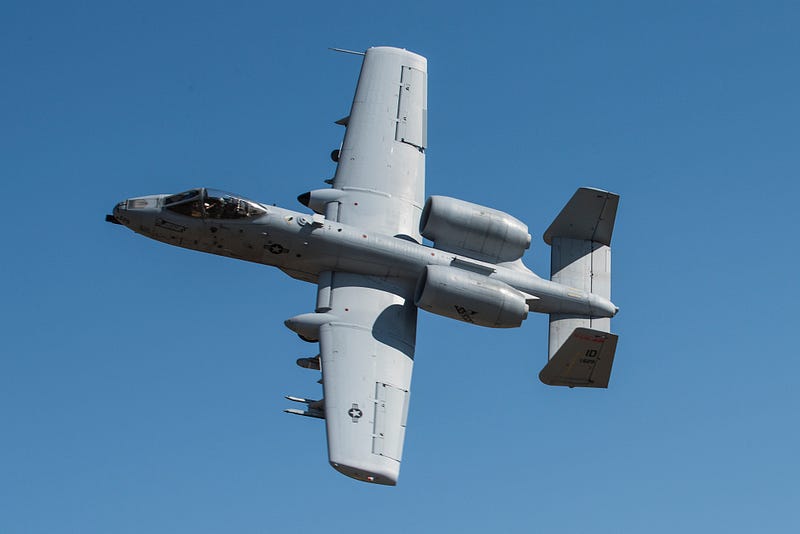
So, why is it unlikely for the A-10 to show up in the Ukraine War?
Let’s discuss.
The A-10 has been many things: A Russian tank buster in Iraq Wars I and II, the savior of the infantry in Afghanistan, a political football in Congress, and my favorite GI Joe toy in the 1980s.
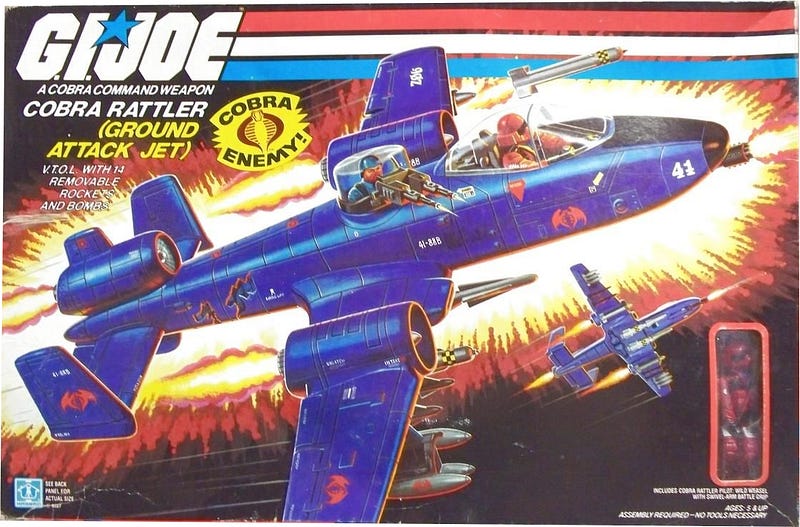
I think there’s a story that needs to be written about why the ’80s action figure “bad guys” always had cooler-looking equipment. Perhaps so that kids would want to play with them, instead of playing the heroes all the time? Seriously, ThunderCats, He-Man, GI Joe, and Transformers — all had cooler-looking bad guys than good guys.
The A-10 Thunderbolt II, also known as the Warthog, or simply “Hog”, is one of the most famous ground-attack aircraft in the world. The jet is a single-seat, twin-turbofan, straight-wing, subsonic attack aircraft operated by the United States Air Force.
Not content to leave Close Air Support (CAS) missions to those near-sighted helicopter pilots in the Army, the Air Force, (specifically General John P. McConnell, Chief of Staff of the USAF), ordered that a specialized CAS aircraft be designed and developed in 1966.
This led to the creation of what we know today, some 58 years later, as the A-10.
From 2005 to June 2011, the entire fleet of 356 A-10s were modernized in what was then called the Precision Engagement program.
These new and deadly jets were redesignated A-10C.
Upgrades included all-weather combat capability, an improved fire control system (FCS), electronic countermeasures (ECM), smart bomb targeting, a modern communications suite, and cockpit upgrades comprising two multifunction displays and a flight stick configuration mixing the F-16’s flight stick with the F-15’s throttle.
Because of the unique mission parameters of CAS, this jet needed to fly low and slow, both for targeting and hitting slow-moving ground vehicles, but also to be able to visually identify friendly infantry from enemy infantry.
As a result, the A-10 needed to be extremely resilient to enemy ground fire. Indeed, the jet is sometimes called a flying tank. The pilot sits in what is essentially a titanium bathtub and A-10s have returned to base missing half of their wings and riddled with bullet holes — but still flying.
Offensively, the A-10 is notorious for its 30×173 mm GAU-8/A Avenger autocannon. Stories that the plane was designed around the gun are not hyperbole. This public domain image puts the size of the weapon in perspective:
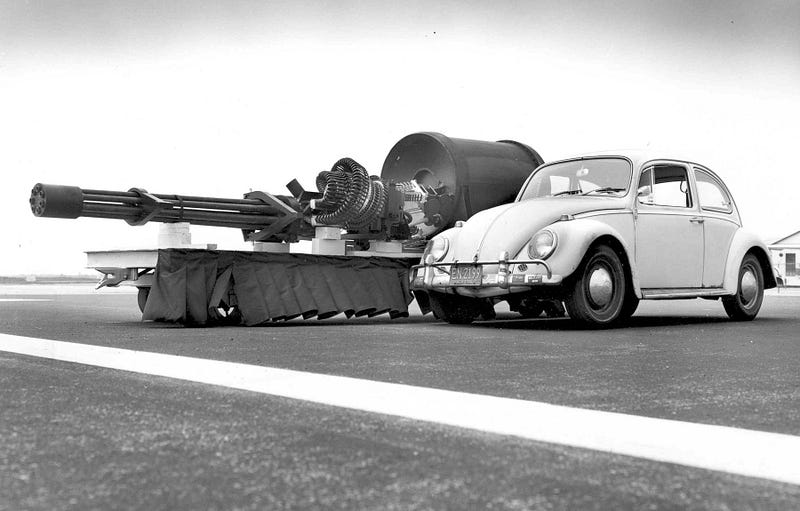
The gun is precise at 80% of rounds fired at a 4,000-foot (1,200 m) range hit within a 40-foot (12 m) diameter circle. It uses armor-piercing incendiary depleted uranium rounds — ideal for cutting through Russian tanks like warm, Kerry Gold butter.
In theory, then, this platform would clean up in Ukraine. Imagine Ukraine’s daring fighter pilots providing Close Air Support in a Warthog in support of offensive ground operations.
It would be glorious.
But to understand why the A-10 is not suited for Ukrainian use, we first have to understand how America fights its wars.
Operation Desert Storm marked the first time in war that America had complete air superiority before commencing ground operations. In fact, the Air Force’s infatuation with how effectively airpower worked during Operation Desert Storm shaped the US’ use of aviation assets throughout the 1990s and heavily influenced the opening stages of America’s post-September 11, 2001 strikes in Afghanistan and, later in 2003, Iraq.
The opening stages of an American invasion, at least over the past three decades, has been the establishment of air supremacy (the highest level of air superiority). Consider this phase 1.
After the initial “shock and awe” bombardments and suppression of enemy air defense missions, the US would then, and only then, commit ground forces with supporting assets — like Apache attack helicopters and A-10s. This is phase 2.
We’ve seen in Ukraine what happens when helicopters try to operate near the contact line — their survivability is abysmal. For the same reason, an A-10 Warthog wouldn’t last long in Ukraine because Ukraine does not yet control the skies.
Russian MiG-29 Fulcrums and Sukhoi Su-35 Flankers would, unfortunately, make short work of any Ukrainian A-10s.
Even if Ukraine did achieve something akin to air superiority, let’s say, thanks to a shipment of F-16 Falcons, there are other reasons why the A-10 likely wouldn’t make its way to the war.
The A-10 stopped production in 1984 and the Air Force has been trying to retire them for years and replace them with the F-35 — which can also be used for CAS missions.
Interestingly, when the Air Force first announced it was going to mothball all remaining A-10s, the public outcry was enough to prompt Congress to block their retirement. This is impressive if for no other reason than to suggest how beloved this jet is in the American psyche.
Last year, however, in the 2023 NDAA, Congress finally allowed 21 of the planes to be retired, which marked the first retirements of that aircraft in the 21st century.
If Ukraine did have the A-10, they couldn’t be replaced after aircraft losses and parts would be extremely difficult to come by.
Not to mention, Ukrainian pilots aren’t trained to operate the A-10, and Ukrainian maintenance personnel are not trained to maintain it. Integrating a completely new aircraft type into the Ukrainian Air Force is not the right move.
Besides, there is a much better option for CAS that Ukraine has at its disposal right now. The Sukhoi Su-25 Grach is the Soviet counterpart to the A-10 and Ukraine has 31 of these birds operational. They even received 14 of them from the Bulgarian Air Force when the war started.
The Ukrainians are already killing tanks just fine. They don’t need a 60-year-old American aircraft to do that.
Once American F-16s become operational in Ukraine and start killing Russian air defenses (and fighter jets) from a standoff distance, there will be opportunities for the return of CAS missions in Ukraine.
When that happens, Ukraine should employ its Su-25s and attack helicopters to support offensive ops.
Now, if you need me, I’ll be on eBay looking for a vintage Hasbro GI Joe, Cobra Rattler.
Слава Україні


