
This Is Why the Japanese Government Cannot Stop the Declining Birthrate
I lost my job because of dysfunctional “hokatsu”

The birthrate in Japan has been falling dramatically in recent years causing the population of the country to decline.
In 2020, the fertility rate (the average number of children a woman will have in her lifetime) in Tokyo was only 1.13, well below the replacement level of 2.07 needed to maintain the population. (The rate was slightly higher across all of Japan at 1.34, though that was down 0.02 points from the previous year).
The reasons are complicated, but one clear cause is the lack of daycare, especially in Tokyo.
As a parent, I have been frustrated with the Tokyo Metropolitan Government because it couldn’t provide me with needed daycare, causing me to lose my job. Let me tell you what it’s like trying to find childcare in Japan.
Local Municipalities Tweak the Availability of Daycare
I hope some local governments in Japan tackle the lack of daycare without deceiving residents, but most local municipalities try to make everything look perfect on paper. As a result, what they announce is nonsense that doesn’t match actual parents’ experience.
For instance, the number of taiki-jidou (待機児童) — children on the waiting list for daycare — is unrealistic. The official number in 2021 was 5,634, which is less than half of the previous year, but that doesn’t reflect reality.
Over 15 times that number of children—86,095 — weren’t able to enroll in licensed daycare in Japan.
Children who found a place at unlicensed nurseries and corporate daycare facilities are not included even if parents wanted to get into licensed daycare.
The government also excludes all the children whose parents give up applying since there is no space, or stop job hunting or extend childcare leave after getting rejected from licensed daycare.
This is not only in Tokyo. Sapporo city, in Hokkaido, boasted in 2018 that it had ZERO children on the waiting list. But in fact, 1,689 children were rejected from licensed nurseries because space wasn’t available.
Working mothers are mad at this misinformation. Japanese media has been trying to spread the truth, publicizing the number of kakure taiki-jidou (隠れ待機児童) — children who were rejected from licensed daycare facilities. Tokyo had over 10,000 kakure taiki-jidou in 2021.
I find it difficult to wrap my head around the government’s apathetic attitude. If you worked at a pharmaceutical company and the firm was struggling to meet consumer demand, wouldn’t you think the company’s potential market is much bigger than the actual number of consumers?
Would you think there was no problem because patients found an inferior solution or stopped their medication? Did the problem disappear if patients died due to the lack of medicine?
Perhaps governors and bureaucrats can’t understand how challenging it is for Japanese women to build a solid career. Or do they believe women don’t mind leaving their jobs because motherhood is all that matters?
Unlike other Asian countries, hiring a nanny is still neither common nor affordable if you work full-time in Japan. When one’s parents live far away, there are few viable alternatives to daycare.
For example, the Tokyo government announced that it would subsidize babysitting costs under certain conditions in 2018. Initially, however, this increased future tax payments for babysitter users. The subsidy program finally became tax-free in 2021, but many parents couldn’t benefit from it when they needed babysitters.
Daycare Hunting Goes Extreme
In general, parents start hokatsu (保活) — daycare hunting — before their child’s birth. Many daycare facilities accept applications only after parents have visited, so the first hurdle is booking a visit.
Furthermore, each daycare center has its own unique rules on how to book a visit, so parents need to look up each one online and make phone calls to make sure they can see the facilities. It’s similar to shūkatsu (就活) — job hunting — but for hokatsu, there’s no big agent to help you book the meetings.
Some parents move over the border of cities and wards to find available daycare. Mothers go back to work before using up their maternity leave because it’s easier to find childcare for newborn infants than children over one year old.
Earning points and ranks is the key to winning this war, so parents report themselves as vulnerable as possible with no available help in the application form. If their parents are healthy and live in the same city, their rank will be low, and less likely to win the competition.
The last option that parents’ have to consider is getting divorced. Believe it or not, divorce is a trump card in this war—single parents are given priority for childcare in their neighborhood.
I experienced this war firsthand. I received so many rejection letters from the city office and had to keep apologizing to my boss for not returning to work as planned. Eventually, I had no choice but to quit my job for my daughter’s education.
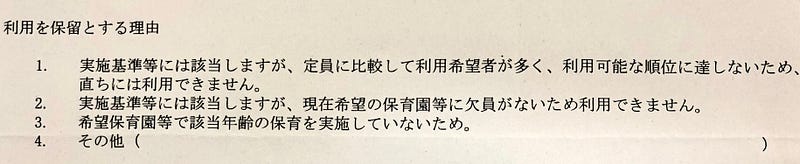
There was no daycare available in my neighborhood. However, I found a great English-based kindergarten with teachers from diverse backgrounds. I lost the battle and my job, but my daughter got the chance to become bilingual. Without this kindergarten, my motherhood could have been a burnt field.
Becoming a full-time working mother in Tokyo was way more challenging than I had expected, and not for reasons like balancing work and family, but simply because of the lack of daycare. Despite my capabilities and effort, I failed. It sucked.
And the daycare issue didn’t disappear when the Tokyo government terminated my career. It just caused another crisis because I needed to redesign my career path — even if the ward office employees were happy to check off a box to remove my daughter from the waiting list.
Meanwhile, the Government Discusses Dating Techniques
There are so many issues the Japanese government needs to solve; harsh working conditions for daycare teachers are a deeply rooted cause of the lack of childcare support. Many local governments find it more difficult to hire licensed teachers than to build facilities.
Childcare workers’ salaries have been catching up with other industries, but the average annual income of 374万円 ($28k) is still lower than the overall average of 445万円 ($33k).
Furthermore, many daycare and kindergarten teachers have to endure endless paperwork after returning home, such as writing newsletters and lesson plans and crafting artwork for seasonal events. This overtime work is, of course, unpaid.
Meanwhile, politicians are obsessed with strategies to coax young people into dating. The old men of the Japanese Cabinet Office have been busy analyzing what motivates people to date. One suggestion was teaching people techniques such as kabedon (壁ドン) — slamming your hand into the wall in front of someone.
This caused everyone’s jaw to drop because this macho move only works in comic books and anime. If a man did that in real life, I can’t imagine any woman who would want to date him!
The Real Problem
If politicians believe young people don’t get married because they have suddenly lost their interest in building relationships, that’s wrong.
The real reason is there are too few role models—particularly female mentors—around them who can enjoy both parenting and holding a professional career.
How can people in their 20's dream of a happily married life when their mentors are exhausted all day because they can’t get adequate childcare?
The Japanese government should stop being obsessed with changing citizens’ behavior. Societal structure is what changes people’s actions. One of the factors causing this aging society is the dysfunctional structure of this country.
The problem is not that young people are not dating. Of course, they might need more financial assistance to feel comfortable meeting people. But the underlying problem is that couples who want to raise children are facing a lack of childcare support.
There’s no point in teaching romantic techniques if people have to get divorced only to find daycare.
Why doesn’t the government invest in training childcare workers and improving teachers’ working conditions and income? Unifying the daycare booking system would also be helpful for both daycare employees and parents.
I wonder if someone in the Japanese cabinet understands the concept of a bottleneck. Tweaking the availability of daycare only makes the problem worse.
If you enjoyed this article, discover other works of the author at Japonica.
Follow Yuko for more stories about cross-cultural topics, travel, business, parenting, and equality. You can also subscribe from the referral link, which Medium uses a portion from followers for author support without any additional cost. Mediumの購読は、こちらのリンクからどうぞ。


