
This Is What Working in Hospitality Has Taught Me
Waitressing helped me to be a better person.
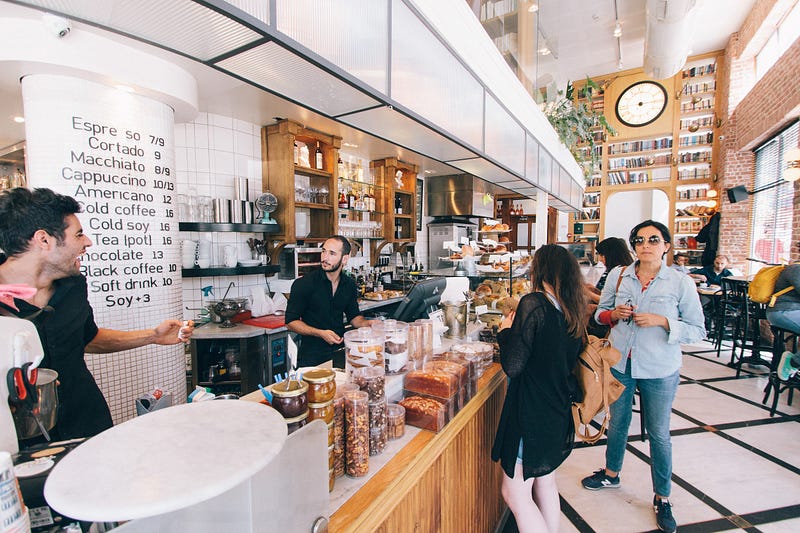
This weekend, I am indulging myself. I am away from home, in Warsaw, allowing myself all kinds of pleasures.
I went for a floating session to relax my body that has been very tense from staring at the computer screen recently. I saw a theatre play for the first time in two years. And, of course, I am eating out all the time. Having lunch or coffee in a nice place is my ultimate reward.
I love good hospitality. I am very perceptive to the quality of service I receive, beautiful coffee shop spaces and the way food and drink are presented. I developed this indulgence while I living in France. But it is not the fanciest food and places that I enjoy the most.
What I ultimately look for is the feeling of being welcome and treated as a person — rather than a customer. The greatest hospitality shows in the little hints of extra care, such as receiving a glass of water on a hot day, even though I haven’t asked for it.
This is when I am truly satisfied and this is when I tip. But even if the service or food is far from perfect, I hardly ever complain. This is because I know how it feels to be on the other side — and I can imagine all the things that can possibly go wrong, even with the best intentions.
I spend the summers of 2016, 2017 and 2018 working as a waitress, receptionist, housekeeper and barista in a guest lodge in the French Alps. Juggling all those roles — sometimes within a stretch of one hour! — during the high season meant I interacted with thousands of people in so many different ways. However, most customers clearly fell into one of the two main categories.
As much as I don’t like categorizing people in any way, that particular distinction was very apparent to me. There were clearly some clients to whom I was, first of all, human — and only then, a waitress. To others, I seemed to be a waitress existing to serve them — and only after I did (and did it well) had I the chance to be recognized as human.
The difference was profound and immediately felt as soon as someone approached me with a request. I could tell it by tiny cues — such as the way they thanked me for the coffee, or by how willing they were to wait for the bill during the rush hour, when I barely kept up with orders, dishes and payments.
What’s more, I could see myself mirroring their approach towards me. If they understood that I was a working human, I treated them as humans on holidays. But when someone approached me as a robot designed to serve them as the primary goal of my existence, I served them as people whose primary goal of existence was to make demands.
This was not even happening on a conscious level. Rather, it was a dynamic that emerged as something akin to a law of nature.
Dealing with clients and observing myself in those interactions made me take an important decision. I promised myself that I would do my best to never be the second type of customer — the one seeing a “serving machine” before human. Not only in a hospitality setting — but anywhere in my life, I want to recognize people I meet as humans in the first place.
Only after I make sure I see them, will I allow myself to assert how good of a job they are doing.
This kind of empathy — i.e. being able to put yourself in someone else’s shoes — is important not just for the sake of the other person you are dealing with. I firmly believe that it makes your own life more frictionless, too. That’s because most of your actions in this world are interdependent with those of others.
Let me illustrate this with a simple example.
The other day, I was walking up a narrow, one-way street in my neighbourhood. There was no sidewalk and the sides of the road were crowded by parked cars. I was, therefore, forced to walk on the road.
It was evening and there wasn’t too much traffic, so this wasn’t a problem. But at some point, a car came approaching me from the opposite direction. As the car was getting closer, I realized that there is more than enough space for us to pass uninterrupted, so I continued on the same route on the side of the road, without stopping.
Unconsciously, I expected the driver to slow down before passing me — but she didn’t. She stayed on her route as well and we both passed without the need for changing course or slowing down. At first, I thought that she acted a bit carelessly for not slowing down next to a pedestrian. But then I understood:
She knew how it felt to be a pedestrian in that situation — and she read my cue that we could pass safely.
In other words, she understood that because I was walking, I had a better judgment of whether there was enough space for us to pass. And because I didn’t stop or change my course, she got that there was more than enough space. She didn’t need to slow down, because she made sense of the situation just by looking at my behaviour.
This, however, was only possible because she once had been a pedestrian herself. That was what made it possible for her to make a judgment of the situation based on observing me.
This is the invaluable lesson that hospitality work has taught me: knowing how it feels to be on the other side. I know that I will never again look at people in customer service as if they were emotionless machines.
Maybe I am even positively biased towards them. When I see a waitress breaking a glass or struggling through the rush hour, I try to give her a hint of support. A smile. A tip. Telling her that I admire her sleight.
But this is not just about how I behave in a restaurant or another customer service setting. The lessons I learned in hospitality extend much further than that. Ultimately, they are about humbleness.
This humbleness helps me remember that on the other side of the interaction, there is a person with a different perspective than mine. I don’t know their story and I will never quite grasp how it feels to be in their shoes — I can only imagine that. That’s why making assertions about their way of conduct will pretty much always be, to some extent, misguided.
These days, whenever someone breaks the metaphorical glass in front of me, I try to think twice before I call them clumsy. Because it may be that they are just having a bad day. An argument with their best friend, perhaps — or a sick kid back at home. Or anything else, that I can’t even stretch my imagination far enough to grasp.
Whatever it is, I remind myself that they are simply doing their best with what they have at the moment. Just as I am. This is what makes us both equally human — and hence, more similar than different.