
CLIMATE FINANCE
This is What Happens When You Irrigate a Desert.
The Southwest water crisis was 85 years in the making.
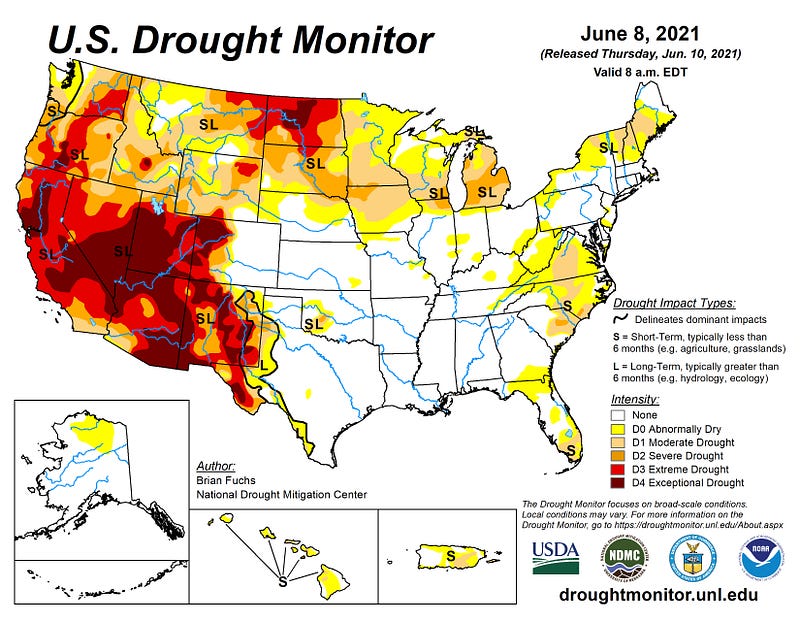
The past few days have seen alarm bells ring about the low level of Lake Mead, which is the largest reservoir in the United States and powers the turbines of the Hoover Dam.
The lake supplies drinking and irrigation water, along with providing electricity to a large portion of the American Southwest. All of these benefits are at risk of diminished capacity.
How bad is it?
It’s bad enough that states are already expecting the federal government to curtail water usage for 2022, and probably beyond.
From Gizmodo,
With that projected shortage in mind, officials are already planning to take the unprecedented step of declaring a Level 1 Shortage Condition for 2022 for Lake Mead in August — the month when operating conditions are typically set for the following year.
The declaration will mean that the surrounding states will be forced to resort to water-saving measures that Tom Buschatzke, Arizona’s Department of Water Resources Director, told CNN were likely to be “painful.”
You see, while the states and the people living in those states use the water and electricity, the federal government owns and operates the dam that supplies them. In the end, Uncle Sam calls the shots.
Let’s avoid that rabbit hole for another article and get right into the issue.
Water Cuts
The biggest impact to any water supply reductions will be to the area farmers, as they are the lowest priority. This kind of makes sense, as the government puts drinking water above industrial/agricultural water. But then again, if we can’t grow food, we can’t eat.
Talk about a catch-22. Anyways, here is what farmers are saying about the possible (probable) reductions.
Homeowners have higher priority and, at first, won’t feel the pain as badly as farmers.
Dan Thelander is a second-generation family farmer in Arizona’s Pinal County. The water to grow his corn and alfalfa fields comes from Lake Mead. “If we don’t have irrigation water, we can’t farm,” he said. “So, next year we are going to get about 25% less water, means we’re going to have to fallow or not plant 25% of our land.”
In 2023 Thelander and other farmers in this part of Arizona are expected to lose nearly all of their water from Lake Mead, so they are rushing to dig wells to pump groundwater to try to save their farms.
This poor bastard has been literally betting the farm on the stability of the water supply from Lake Mead. Now, all of a sudden, it’s gone in two years.
This is sad for him and so many other families, but the reality is that this is not a sudden occurrence.
The brief respite around 2019/2020 was misinterpreted by many to be a trend reversal, but it was not to be. The water levels at Lake Mead have been falling since flooding occurred in 1983, and you don’t reverse that trend in just a couple of years.
In response to the water cuts, Nevada has permanently instituted a policy that bans “non-functional turf” (i.e. grass). I use the term “bans” liberally, as there are some pretty big holes in the policy.
The bill doesn’t apply to some major usages of decorative grass. Specifically, it excludes single-family homes’ lawns, golf courses, and parks.
These seem like pretty glaring omissions, especially because as of 2017, golf alone accounted for roughly 7% of Las Vegas’ water use.
This is like firing a BB to stop a train.
Electricity Shortage
The other half of this story is that the Hoover Dam houses a massive hydroelectric power plant.
The blades are big, and a trickle of water doesn’t move them. They need power, and that comes from gravity.
However, if there isn’t enough water pushing down with enough force (head), then the generators won’t spin and electricity won’t flow.
Already, production is down 25%.
The prior lowest level for electricity production was 1,050 feet. Pretty scary considering the lake was at 1,070 feet as of this writing.
The dam installed more efficient blades that can handle levels down to 950 feet, but after that it’s lights out, literally and figuratively.
Back at Hoover Dam, facility manager Mark Cook has his own concerns. Lake Mead has dropped so much that it has cut the dam’s hydropower output by nearly 25%.
Cook wanted to show Tracy the brand-new turbine blades they just installed, designed to keep power flowing efficiently at rapidly-dropping lake levels. At some point, the dam could stop producing electricity altogether.
“Our previous number [for cutoff] was at elevation 1,050, and now we’ve lowered that number to 950,” Cook said. “So, we bought ourselves 100 feet.”
How long will it take to burn through that 100 feet?
The Takeaway
The big picture takeaway is this:
Don’t irrigate a desert.
The Hoover Dam has a memorial to the laborers who were killed onsite during construction. The quote used to commemorate them is, “They died so the desert could bloom.”
Big time idiocy for not realizing that nature changes.
Or hubris, for believing that humans could force the world to bend to our will without repercussion.
The personal takeaway is this:
Incorporate climate change into your life.
Most everyone has been focused on the cuts to water and electricity, but what if both of those just went away? What would happen then?
We might soon find out. Lake Mead has been refilling more slowly and with less water over the past several decades, and there is no reason to think the trend will shift in the coming ones.
Sure, there may be a bumper year of rain every now and then (weather), but the overall shift is towards less water (climate).
The crisis at Lake Mead and ensuing water and electricity shortages are just one of many instances that we have started to reach climate “tipping points” from where this is not return to our former climate.
It doesn’t matter if you think climate change is man made or not: it is here and its effect is real.
The planet doesn’t care what happens to it. It’s billions of years old and sees this as just another cycle to go through.
Humans, however, don’t have that kind of longevity.
It is imperative that you take climate change into consideration for your major life choices. Moving to the coast may sound fun now, but living there for decades may result in a flooded living room.
Most Recent Stories
- Parents: How to Add a COVID Career Gap on Your Resume.
- The K-Shaped Student Loan Story
- Breaking Down the Jobs Report — May 2021
- PSLF Will Only Get Better
- Is Your Tax Refund Late? Here’s Why.
Don’t miss my next article! Click here to get notified when I publish new material.
If you love the articles published in Money. Daily., then become a member of the Medium community and get full access to our full archives.
This article is for informational purposes only, it should not be considered Financial or Legal Advice. Not all information will be accurate. Consult a financial professional before making any major financial decisions.