
This Is What Happens When You Don’t Say No
Two boozy bookish men sail to Marseille
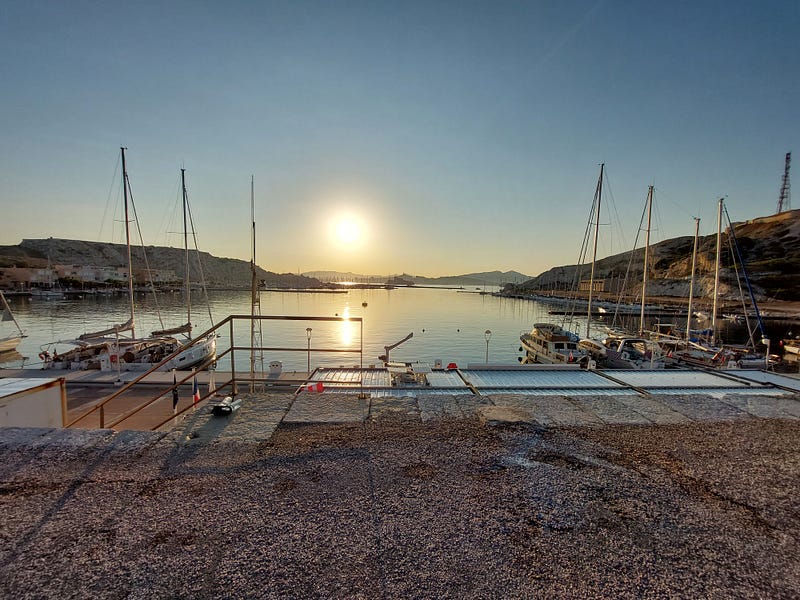
Morning came through the tiny windows of the boat’s cabin, pale and dripping. Ben was already up when I opened eyes that felt like they had been freshly sandpapered into sharp, hard points.
He said he had to get under my bed to connect the battery and start the engine. I made a crude remark about his mother’s virtue and stumbled to the bathroom.
The sea had spent its fury the night before. Now, our patch of the Mediterranean was a flat blue bowl, waveless and placid under a sky patched with thin and innocent clouds. We headed away from land under the power of the engine, hoping to turn back toward the shore and harness the wind that had changed direction in the night.
That’s what Ben did, anyway.
I sat on a hard bench in the stern and kept my eyes on the horizon, pouring one bottle of unrefrigerated water after another down a revolting throat.
And I was doing okay, too. I felt like some beached whale carcass washed up on a desert shore, but I was holding it together.
Until we run out of regular water, leaving us only with carbonated stuff.
A one-and-a-half liter bottle of San Pellegrino warmed by the sun is not something I’d recommend even to the well. To those of us suffering from an acute bout of drinker’s remorse, it’s poison.
Ben had given up on the sail and had just turned the engine back on when the copious water I had drunk arced gracefully from my donkey-kicking stomach, over the side of the boat to rejoin the sea again.
“Want some rum?” he grinned. Wordlessly, I slumped drooling against the side of the boat, staring listlessly out over the violated sea.
Marseille
We’re not meant to travel the way we do.
Planes and cars and even trains are newcomers, and they distort the way we experience time and space. I’ve been to Marseille before, and it’s easy to forget that not so long ago, someone from my town would never make a journey like that in their lives.
Boats belonged to an older, colder world, where time moves differently. The steady motion of the waves, the hot sun, the unblinking blue ferocity of the sky, all lull you into a mindset that is somewhere close to timeless.
The hours just pass. It’s hard to say how.
For most of the day, the coastline was barely visible, just a thin pale band away on the horizon to our left. But by the time we approached Marseille, the vomiting and some foul-tasting but mercifully uncarbonated water from Prems’ water tank had done their job. I was feeling, if not well, at least like I might pull through.
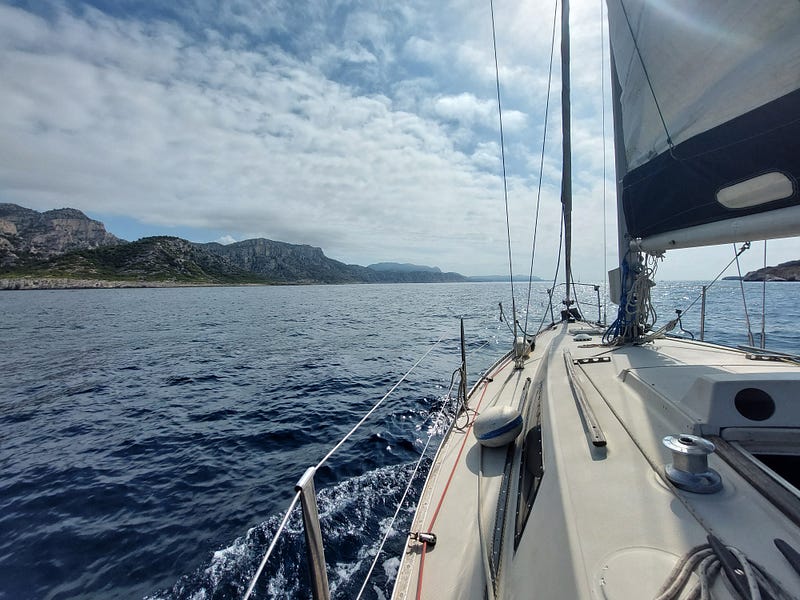
Ahead of us, the sunbleached and wind-scoured mountains of Provence slowly grew larger. Soon, the sprawling city of Marseille, the second biggest in France, appeared.
Let’s be honest: Marseille is a bit of a shithole. Yes, it’s surrounded by incredible scenery. Yes, it’s one of the most ancient cities in Europe, founded by those Phoenician traders who no doubt struggled with their sails the way we did the previous day, but without Cuban rum to help them.
But modern Marseille is the big, busy, rancid port the rest of France likes to pretend doesn’t exist.
We had no intention of going into the city itself. Instead, our target was Les Îles, the Frioul Archipelago that lies a few kilometers out to sea. The wakes of racing ferries to North Africa made Prems plunge and leap as we chugged toward the island. By now, the sun was mercifully failing, the heat dying down as evening approached.
You don’t park a boat the way you park your car. Even your worst parallel parking nightmare is nothing compared to showing up in a port you don’t know after a long day of sailing and having to figure out where you’re supposed to go and how you’re supposed to get there.
Finally, we found our spot. Ben backed the boat toward the harbor wall while I crouched on the bow. A buoy floated in the turquoise water, and I grabbed the steel ring on top as we passed, quickly threading a rope through it to keep us in position. It took a few passes to get the boat straightened up, close enough to the harbor that we could step off but far enough away not to crash into it. As usual, I was little help, pulling on the rope that kept us tethered to the buoy only to find it was too short.
But we got there eventually.
Port Frioul
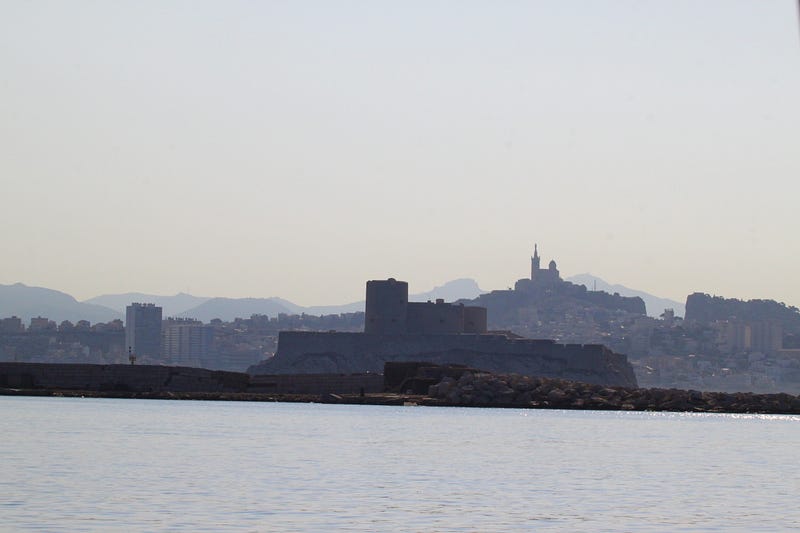
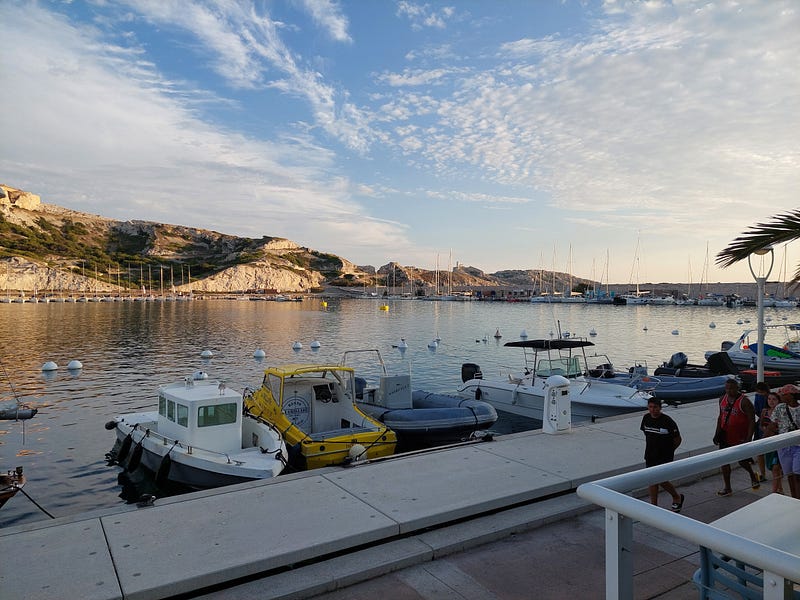
Port Frioul is an absolute beauty. The rocky islands are full of natural coves and harbors, two of them joined together by a narrow causeway that protects the harbor on all sides. From where the boat sat, we could look out across the city and see the forbidding Château d’If, the 16th-century island castle that was a setting in the Alexander Dumas novel The Count of Monte Cristo.
And behind that, on the highest hill in the city, the bullet-scarred church of Notre Dame de la Garde, where generations of Marseille fishermen have left tiny trinkets and tokens in the hope of a safe return from these same waters.
Comfort is always relative. We live in luxury former kings of France could not have imagined, but we only ever look up, not down. After two days at sea, just the idea of a real flush toilet, instead of a marine head that requires several strong pumps every time you use it to dispose of the evidence of your bestial nature, sounded like the most outrageous extravagance.
To say nothing of a communal shower.
But first, dinner.
Shaggy and stinking, we wandered through the sunset along the handful of restaurants that line the harbor. Ben was already chafing at the €23 nightly fee imposed by the port, so I volunteered to pay for dinner. Given how little I had brought to the sailing experience at that point, it seemed like the least I could do.
We found the cheapest restaurant Port Frioul had to offer. It was a pizza place with a blackboard out front offering a couple of pasta dishes and salads. A trumpeting giant standing by the front door pointed us toward a free table with a characteristic Gallic shrug. Ben ordered for us both. His French is better than mine will ever be.
A tall laconic waiter, his features a replica of the giant’s with twenty years of bright sun removed, came by to take our order. Next, a waitress brought us spaghetti and clams, along with a crisp cold beer that I drank solely and generously to keep Ben company, along with a jug of red wine cheaper than water.
She was singing as she brought the food and still singing as she walked away again, chirping like a bird while we offered our thanks. I faced the harbor, looking out over the mountainous island, watching the lights come on in distant Marseille. Ben watched the kitchen behind me.
“This is hilarious,” he said, his eyes flickering as he tracked the movements of the staff. “They’re clearly a family. Probably inherited this place. They’re just going at each other in the kitchen.”
I risked a glance over my shoulder. He was right.
A woman close in age to the giant who greeted us was standing in the kitchen, brandishing a bass and barking orders in rapid-fire French. One of her sons was wheeling out a cheap gas grill to barbecue fish right on the restaurant patio. Daughters carried trays of endangered glasses at shoulder height, and cousins sneaked sly cigarettes right by the open doorway.
It was a scene of total chaos, a whirling mess of instructions and orders and recriminations mixed in with sudden embraces, tearful apologies, and snatches of songs that they would all join in on for a bar or two before stopping to argue about the lyrics.
They were still singing and arguing when we left.
Back on the boat, Ben reached for the rum. This time, I let him keep himself company.
After Marseille, everything becomes magnificent
Ben was looking a little ragged when I got up the next day. I, on the other hand, seemed to have finally found my sea legs. As we sailed away from the gorgeous harbor, I ran back and forth along the deck, snapping photos of the city we were leaving and the mountainous region we were heading into.
Just outside Marseille, Calanques National Park is one of the most beautiful in France. A labyrinth of white cliffs and bathtub-clear water, the place receives more than three million visitors every year.
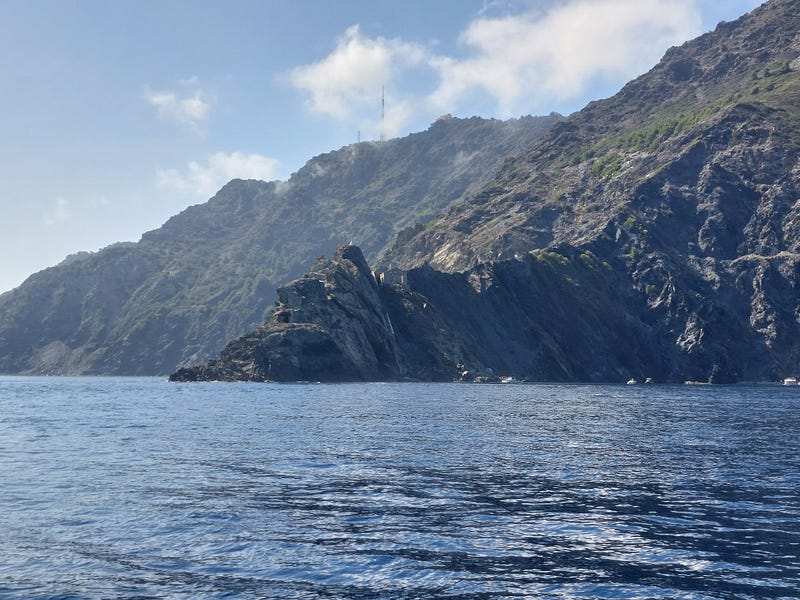
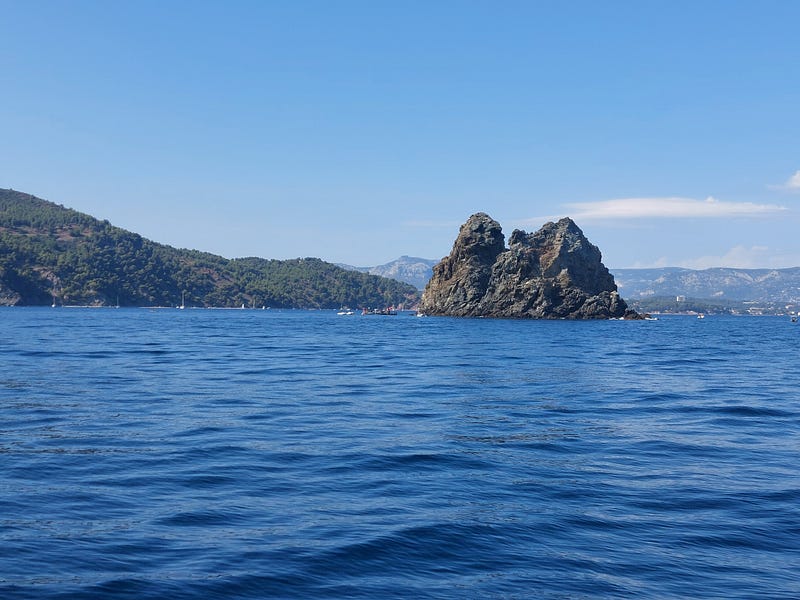
Craggy cliffs, jagged islands, and crumbling sea stacks rose up from the water, and Prems chugged slowly through it all while Ben sweated out last night’s overindulgence. He stood on the deck, re-coiling a rope that I had wound up wrong somehow, looking out to a fogbank on the far horizon.
“I should be reciting Auden while I do this.”
But the really reckless were fetched
By an older colder voice, the oceanic whisper:
“I am the solitude that asks and promises nothing;
That is how I shall set you free.”
“Try it, you lousy bastard, and I’ll beat you about the head and neck with a sea bass.”
This is what saying yes gets you
A seat on a cheap bus home next to a hungover Chekhov fan. His short stories lay half-hidden under a scattering of greasy tools in Prems’ cabin, an unfired pistol hanging on the wall.
With the boat docked in some other, cheaper harbor, we spent five hours getting home by road which felt longer than the three days it took us to make the same journey by boat.
Ahead of us, my house waited, hidden just over that mouthwatering horizon. My work waited too, the thousands of words I write to keep uncarbonated water cold in the fridge and the toilet flushing my problems far away.
I’d do it again in a heartbeat.


