
This is what a good Data Resume should have!
What does a Data recruiter look for in your resume — Advices, tips and hacks

Our world is swamped with data.
The opportunity to leverage insights from data has never been greater. But we don’t have enough skilled employees to help us make sense of it all. So, if you want to be a data person, working with data in the next 5–10 years, then this is your time. Go win all those jobs!
And while you look around for that crazy paying job with exciting challenges each day, this little guide on what to put to your resume might become a little handy.
Writing a resume for an internship or job application is rarely fun. Cringing through a job application deadline when you finally start to put things together, you realize it more over the place then on a single page. The majority of the onus lies to get all the right things on your one-page resume. When a resume is often the first layer of the application process in the job, getting past this gatekeeper and reach the recruiter or hiring manager is burdensome but important.
When I went to Grace Hopper Celebration this year, two months back, I met about 100+ recruiters discussing my resume and how good or okay I was standing at that point, how could I get better on my profile. In all that crazy frenzy, I was fortunate to have a long insightful discussion with a lady at Disney Animation who suggested some edits and tweaks on my resume and it actually helped me better convey my endeavors! (Thanks to the lady whose name I don’t remember now 😅)
When a recruiter SCANS your resume, the first impression that your resume should reflect exactly the amount of work you’ve done to that date.
Your work speaks a volume for yourself, no need to mention but it does. Recently, I had an interview where the interviewer directed the entire interview on all my past endeavors in all-depth. No coding questions, no pseudo codes to write, pure resume discussion!
Therefore,
60+ applications, 24 responses, 7 interviews and 2 offers later…
This is what a good Data Resume should have!
1. Choose a subtle template
We’ve all been told that looks don’t matter as much as substance, but in the case of your resume, this just isn’t true. The ideal resume design is clean, and uncluttered, with effective and strategic use of white space. Remember that your resume is your marketing tool. It’s the first impression a potential employer has of you.
Sometimes, I see some resumes and as a reader, there is too much information to grasp that sometimes you tend to get lost in the sea of erudition and deviate from what is important.
- You should consider using a few more bullet points to increase the impact on the employer.
- If employers see too many long sections of text, they might find it difficult to zero in on the most crucial information.
- The size and type of bullets should also be taken into account.
- Cut loose on career objectives. Objective statements are considered outdated. Include a one-line career summary instead, if need be. I personally do not have a career summary either.
- Aim for a more classic, subdued style of the resume when applying to the “big” firms!
To succeed in unique resume design, create your resume and support it with creative resume templates from free sites such as Novoresume, Zety, Creddle, Canva, VisualCV, CVMKR, SlashCV, or even a Google Doc resume template.
2. Skills
Data is a field spread across multiple disciplines, say healthcare, finance, food and beverages, clothing, technology, movies, e-commerce, songs, and even Netflix! People working with data need a tint of every skill of the fields they work in.
Perhaps the most prominent skill for a data expert is to be able to analyze information.
An average day of a data person, she might be developing an algorithm or training a model, analyze data to learn about scientific processes, visualize market trends, and handle risk management statistics. They have to be able to comprehend patterns and trends and have an idea of what all those patterns mean. All of this takes strong statistical, analytical, mathematical, programming, reporting skills, and more.
- Big Data, Critical Thinking, Data Analysis, Data Manipulation, Data Wrangling, Data Mining, Data Modelling, Data Visualization, Data Research, Risk Modeling, Machine Learning, and Testing Hypotheses can be some of the good technological skills to have.
- Adaptability, Decision Making, Creativity, Logical Thinking, Problem Solving, Working independently as well as in teams, Communication (Written and Verbal), Leadership, Reporting, Presentation, Training, Supervision can be good soft skills to have.
- Linear Algebra, Multivariable Calculus, Statistics are good mathematical must-knows for a Data Scientist.
On Your Resume
Your resume should atleast have the range of skills listed below, not limited to or necessarily this.
Languages: C, C++, C#, HTML, Java, JavaScript, Python, R, PHP, SAS
Databases: SQL Server, MySQL, NoSQL, Oracle DB2, PostgreSQL, MongoDB, CouchDB, Hadoop
Visualization Tools: Tableau, PowerBI, MS Excel, MATLAB, Octave
Version control: GitHub/GitLab
Devops: AWS/Floydhub/Digital Ocean/Flask
3. Projects
When I talk to the recruiters about what they ideally expect on a good candidate's resume project section, the common answer to that would be :
I want to hear about a project they’ve worked on recently. I ask them about how the project started, how they determined it was worth their time and effort, their process, and their results. I also ask them about what they learned from the project. Why did they choose that particular project?
The recruiters gain a lot of from answers to this question: if they can tell a narrative, how the problem related to the bigger picture, and how they tackled the hard work of doing something.
Put the projects that on your resume that are MOST relevant to the position you are applying. For instance, I am a FinTech enthusiast and have worked on about three projects surrounding finance terms. Now, when I interview for a financial firm, I make sure one of those three visualization projects gets placed on my resume.
Next, if I apply for a healthcare firm, I would put a visualization project that talks about results on policy claims or life expectancy ratios and such.
4. Professional Experience
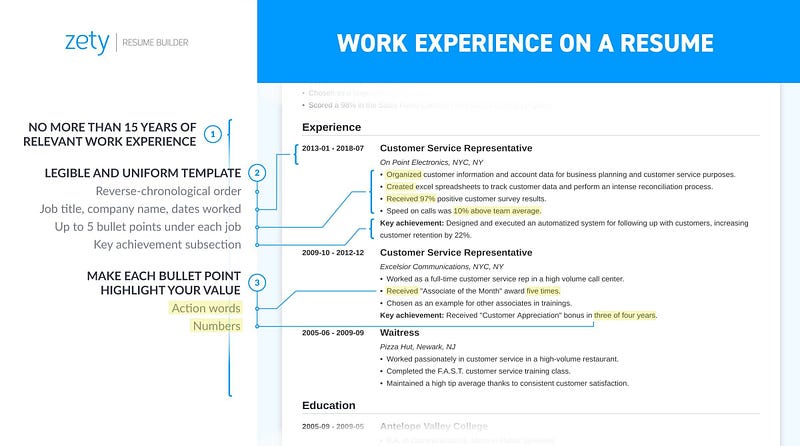
How much work experience to put on a resume?
- Senior-level candidates = List up to 15 years of relevant work experience
- Junior- to mid-level candidates = Include detailed job descriptions of relevant positions in your field and a brief mention of other positions: internships, temporary gigs, freelancing
- Entry-level candidate = List and describe all paid work you’ve ever done, including internships, part-time or temporary work, freelancing, independent projects
- Candidates with no professional work experience (students)= Include all paid and unpaid work experience: roles in student organizations, practicums, unpaid internships, volunteer experience
Some good tips to care about
- Avoid putting irrelevant experience on your resume
- Include more keywords and skills to help categorize you as a stronger candidate
- Do not overuse monotonous words that add little value to your resume. Try to use synonyms if need be
- Use more of strong action verbs with compelling language to outline exemplary achievements
- Put your work experience section in the right spot
- Use not more than 5 bullet points for each job description
- Come out as an achiever, not a doer
- List job descriptions on your resume in reverse-chronological order; start with your current or most recent job, follow it with the previous one, then the one before it, and so on.
- Use active language: Slashed payroll/benefits administration costs 30% by negotiating pricing and fees while ensuring the continuation and enhancements of services instead of just being passive about work you’ve done: Negotiated contracts with vendors
5. Certifications
When you’re looking for something extra to spice up your resume, licenses and certifications are a thing. Do list all relevant coursework that is applicable for the job description. Certifications are often believed to be a test standard for your current skills.
Do not confuse certification with an online course though. An online course is synonymous to a college class that might not necessarily indicate that you are good at a particular skill. Certification can be a Google Cloud Developer, Google Data Engineer, IBM Data Science Professional and such.
Almost every profession has certifications you can get. Whether you work for Starbucks or Microsoft or Target, resume certifications stays a long way with you to prove that you’ve got the skills and knowledge.
If you haven’t already, MOOCs can be a good consideration. Coursera, Udemy, Udacity, DataCamp, LinkedIn Learning have a lot of courses and certifications to look up to. For Data people, Data Camp and Coursera have some really cool things to offer!
How to List Certifications on a Resume?
- Name of Certification
- Name of Certifying Agency or Body
- Dates of Obtainment
- Location (If Applicable)
NOTE: If your certification has an expiration date, you’ll need to add that as well. Don’t list certifications on a resume that have expired.
6. Awards / Recognition
This is a non-compulsory section but can do wonders for people who have things to fill in here.
When a recruiter sees my resume, I make sure the person reads through my awards and recognition. When you have achieved an exemplary feat in your professional career, be sure to list that down. However, make that a heading only if it cannot be mentioned as part of your education or employment history.
I would not encourage adding First Prize Winner in a hackathon. That’s completely not necessary. List only the achievements in a separate section if they’re notable enough and IMPRESSIVE. Your entire resume should be about your achievements, not only one of its sections. Always try to include achievements together with your work history, education, or even hobbies. But if need be to add an awards section, be very specific when listing your achievements.
With these six bullet points that I have learned over time from the recruiters, my resume definitely has improved its appearance, its performance and my confidence when I give my resume out. Strangely, your resume will be a huge validation when you get an interview call from THAT resume you’ve worked on with sheer dedication.
Thank you for reading! If you’ve enjoyed this article, hit the clap button and let me know if you plan to rework on your resume. Or if you are a recruiter, what do you think of it!
Know your author
Rashi is a graduate student and a Data Analyst, User Experience Analyst and Consultant, a Tech Speaker, and a Blogger! She aspires to form an organization connecting the Women in Business with an ocean of resources to be fearless and passionate about the work and the world. Feel free to drop her a message here!


